A backend framework comparison usually starts with the feature list. We start with the support window instead, because a system lives for ten years and the demo lasts ten minutes. The framework you pick this week decides how many upgrade projects you fund before 2036.
TL;DR
- ASP.NET Core (.NET 10 LTS) and Django 5.2 LTS give three years of free support — about three planned upgrades per decade.
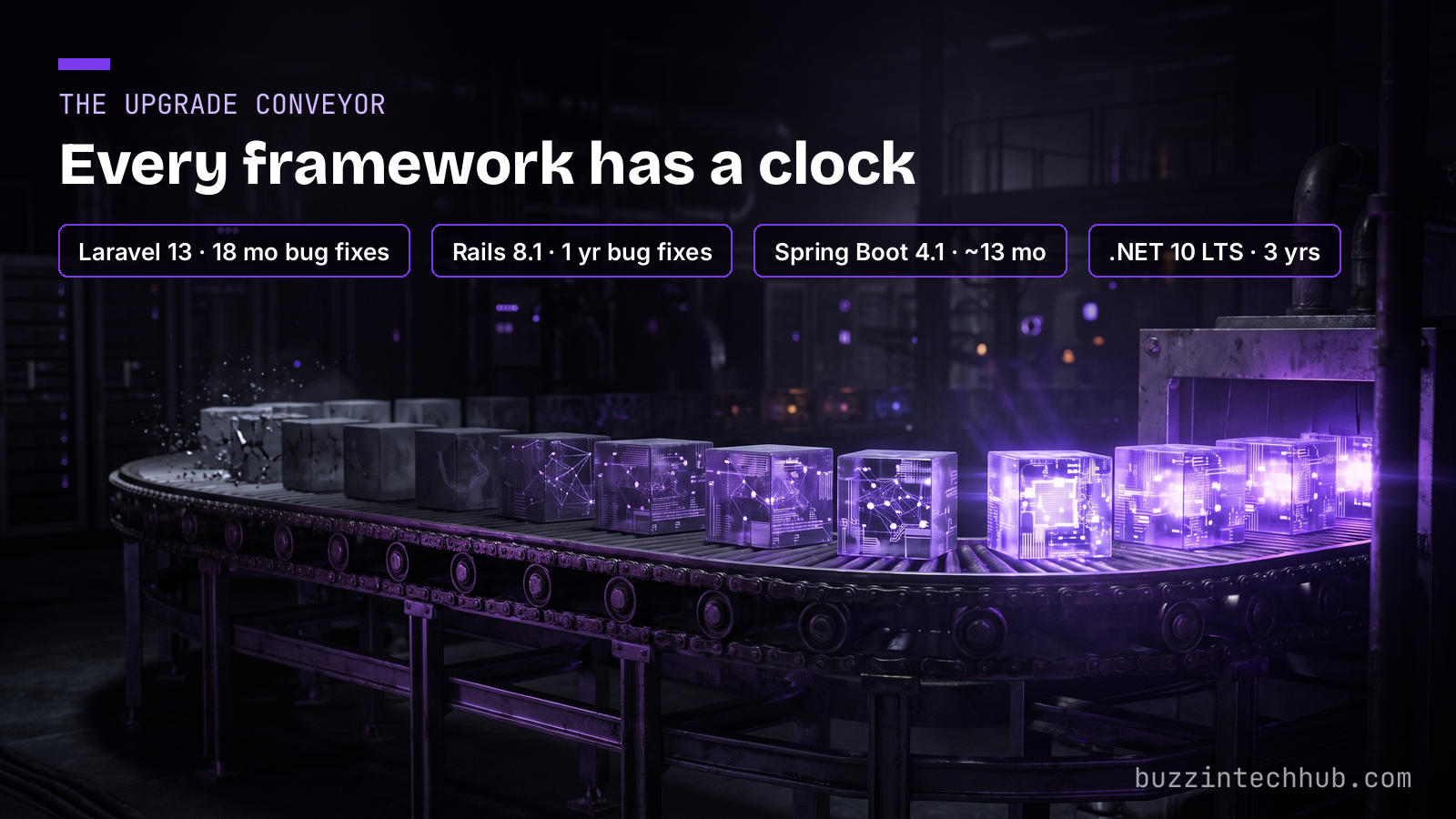
- Laravel, Rails, and Spring Boot minor lines give a year of bug fixes or eighteen months per major — closer to ten upgrades per decade.
- FastAPI and NestJS publish no support calendar of their own; their windows come from Python and Node.js.
- This week made the case: Node 24 moved to maintenance and PHP 8.6 reached RC4.
The feature list expires; the support window does not
Most stack decisions get made on the wrong evidence: benchmarks, star counts, and syntax debates, then a maintenance contract nobody read. The framework is the easy part of the first month; the support policy is the hard part of the next ten years.
Every framework ships with a clock. Some run three years, some run one, and some do not exist. That clock decides how often you stop shipping features and start migrating frameworks: about three planned upgrades per decade against about ten. Price each one in audit, staging, and lost feature time, and the support window becomes the biggest line item in the stack decision.
This is the conversation our custom web development team runs before any build: Discovery and Architecture, with the support window on the first page of the brief.
The seven support windows, side by side
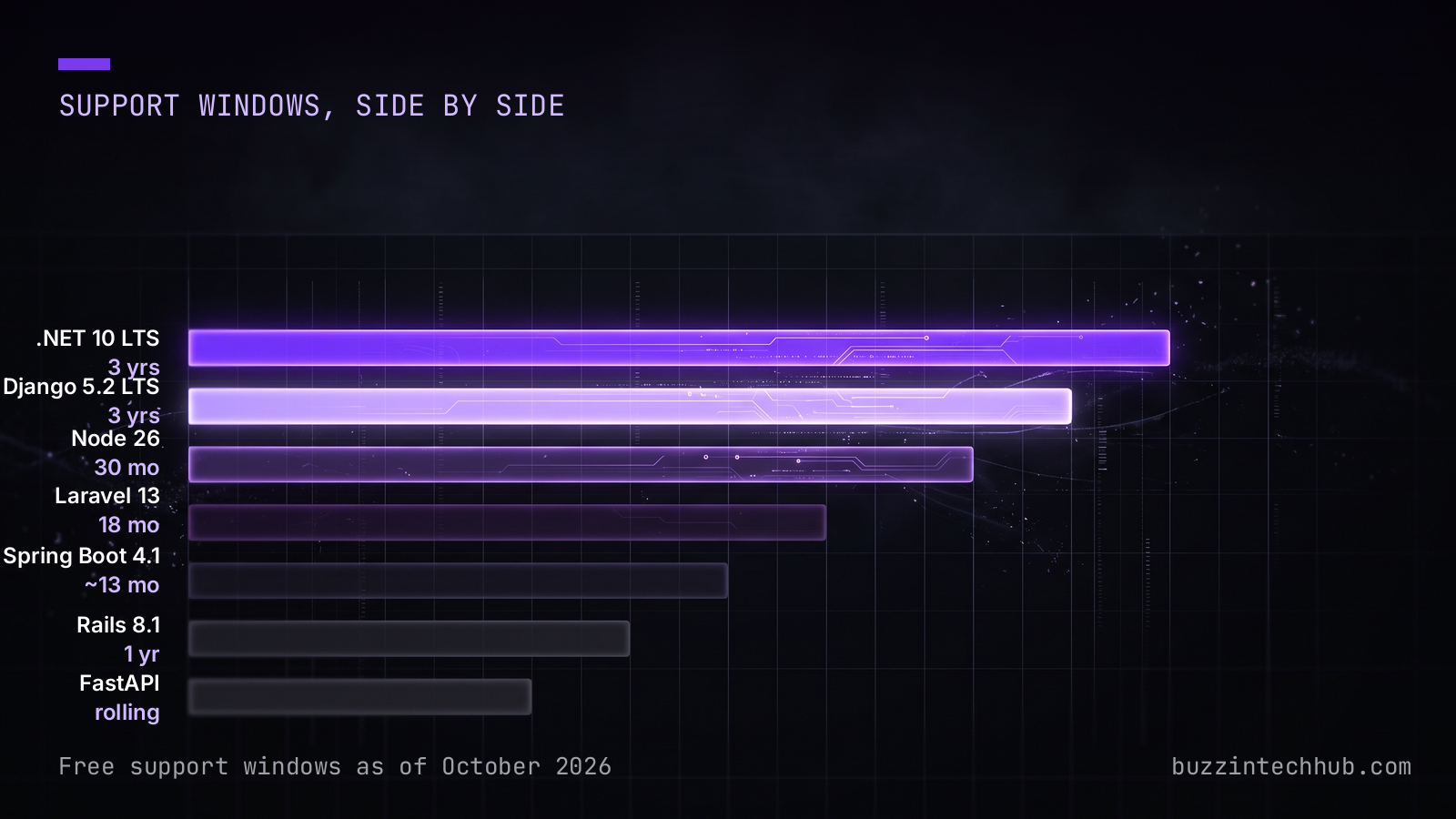
Here are the seven frameworks teams ask us about most, as of October 2026. Every date comes from the project's own published policy.
| Framework | Current line | Free support window | Support ends |
|---|---|---|---|
| ASP.NET Core (.NET 10 LTS) | .NET 10, released Nov 11, 2025 | 3 years | Nov 14, 2028 |
| Django 5.2 LTS | Released Apr 2, 2025 | 3 years | Apr 30, 2028 |
| Spring Boot 4.1 | Released Jun 10, 2026 | About 1 year per minor | ~Jul 2027 |
| NestJS | Tracks Node.js LTS | Rides the Node line | Node 26: Apr 30, 2029 |
| Laravel 13 | Released Mar 17, 2026 | 18 months bug fixes, 2 years security | Mar 17, 2028 |
| Ruby on Rails 8.1 | Released Oct 2025 | 1 year bug fixes, 2 years security | Security: Oct 10, 2027 |
| FastAPI | Rolling releases | No formal policy | No published end date |
ASP.NET Core is the longest free window in the mainstream set. Microsoft's official .NET support policy gives LTS releases three years of free patches and STS releases two, and the policy explicitly covers ASP.NET Core alongside the runtime. .NET 10 is an LTS line, so a system started today is covered to November 2028, with the next LTS overlapping from 2027.
Django 5.2 LTS matches that three-year promise, running to April 2028. What comes next is kind: Django's steering council has accepted an annual release cycle, and Django 6.2 LTS arrives in April 2027 with support to April 2030. A project started on 5.2 today gets a full year of overlap with its successor.
Spring Boot is the shortest free window among the enterprise frameworks. Spring's support policy gives each minor a minimum of 13 months of free fixes; only the last minor of a major version gets the extra five years, as a paid Tanzu extension. Spring Boot 4.1, released June 10, 2026, is covered to roughly July 2027. The choice is a yearly minor upgrade or a subscription — the mistake is assuming the free window is longer.
NestJS has no support calendar of its own. It rides Node.js — the docs recommend the latest active LTS — so Node's calendar is your calendar. Node 24 moved to maintenance on October 20, 2026; Node 26 becomes the Active LTS on October 28, supported to April 30, 2029.
Laravel has no LTS policy. Every major gets 18 months of bug fixes and two years of security fixes: Laravel 13, released March 17, 2026, is covered for bugs to Q3 2027 and security to March 2028. The current moment is instructive — 12 lost bug fixes on August 13 and is security-only to February 2027, and 11 has had no security patches since March 12, 2026. The honest budget line is one major upgrade per year.
Rails is the other short window: one year of bug fixes and two years of security fixes per minor series, per the official maintenance policy. Rails 8.1's bug-fix window closed on October 10, 2026 — twelve days ago — with security to October 2027, and 7.0 and 7.1 went end of life in October 2025. Rails upgrades tend to be small, which softens the blow, but the calendar still fires every year.
FastAPI publishes no support calendar: no LTS branches, no guaranteed backport window. The framework is still pre-1.0 and ships rolling releases, so an old minor means relying on your own pins rather than promised fixes. With FastAPI, the upgrade schedule is yours to write.
The ten-year upgrade math
Project the table over a ten-year system life — a realistic horizon for a business platform.
A three-year LTS — .NET 10 or Django 5.2 — means about three planned upgrades per decade. Each is a real project, but there are only three, and each comes with years of warning.
A one-year bug-fix window — Rails minors, Spring Boot minors — means about ten upgrade cycles per decade. Each is smaller than an LTS migration, but skipping one is not free: the gap between where you are and where the patches are only widens.
Laravel's eighteen-month majors land at six or seven per decade, though most teams move when the new major lands rather than stretching the security tail. Node, and therefore NestJS, gives you about four LTS lines per decade at thirty months each. FastAPI gives you no calendar at all: either a steady rolling upgrade habit, or an unplanned migration when a dependency forces your hand.
None of this argues against short windows — frequent small upgrades can be cheaper than rare big ones. The point is that the number belongs in the budget before the framework is in the repo.
This week proved the point
The calendar above is not abstract. This single week moved half of it.
Node.js turned over on October 20: Node 24 "Krypton" moved from Active LTS to Maintenance — critical and security fixes only, to April 30, 2028. On October 28, Node 26 becomes the Active LTS, supported to April 30, 2029. Node 26 is also the last release under the old even/odd model; Node's official announcement confirms that from Node 27, one major lands each April and every release goes LTS. Any Node shop that has not planned the 24-to-26 move is now planning it.
PHP had its own busy week. PHP 8.6.0 RC4 landed, the last candidate before general availability on November 19 — we covered the full checklist in our PHP 8.6 release and upgrade guide. The date that matters more for Laravel shops is December 31, 2026, when PHP 8.2 loses security support. A Laravel 12 app on PHP 8.2 now faces two migrations at once: the framework and the runtime.
.NET has a deadline three weeks out. Both .NET 8 and .NET 9 reach end of support on November 10, 2026. .NET 10 becomes the only supported line, and systems still on 8 or 9 are not choosing when to upgrade; the calendar chose for them.
Rails 8.1 left bug-fix support on October 10. Spring Boot 4.0's free patches end around December 2026, which makes 4.1 — not 4.0 — the migration target. Django's next LTS is already dated: 6.2 in April 2027.
Six frameworks, six deadlines, one week. The feature lists did not change at all.
What a support window costs in real money
Each upgrade on the calendar is a small project with a real price, and the shape is the same every time: audit what you run, branch the code, sweep the deprecations, run the suite, stage it against production-like traffic, keep a rollback plan. A clean minor upgrade is a week or two of senior time; a major one is a month or more, depending on how far behind you fell.
The paid extensions change the math but do not erase it. Spring's five-year extension is a subscription that buys time, not freedom — the migration still waits at the end. The question is whether the subscription costs less than the upgrade labor it defers. For a large fleet with compliance needs, it often does; for a single product with a small team, the upgrade is usually cheaper.
The expensive outcome is the unplanned migration: the framework that goes end of life while the team is busy, the security release that forces a major jump, the dependency that drops your version. Every framework on this list has produced that story. The support window keeps the migration on the calendar instead of in the incident channel.
The decision order that actually holds up
So how should a CTO order the decision? We use four factors, in this order, with the support window as the tiebreaker rather than the starting point.
First, hire-ability: the framework your market can staff is the framework you can maintain. A brilliant stack nobody local writes is a single point of failure with a job title.
Second, team skill: the best framework is the one your team already knows well enough to operate under pressure. A migration is the worst time to also learn a language.
Third, hosting. The runtime has to run well where you deploy: container images, cold starts, managed platforms, machine cost. A framework that fights your infrastructure taxes every deploy.
Fourth, maintenance budget — this is where the support window enters. Take the ten-year upgrade count from the table, price each cycle, add the paid-extension option where it exists, then compare the totals across your finalists.
When two frameworks survive all four — and they usually do — the support window breaks the tie. The longer free window wins for systems you intend to run for a decade with a small team; the shorter window wins when you have the team to ride it and you want the faster feature cadence. There is no universally right answer — only the one that matches your staffing and your budget, written down before the build starts.
That is what Discovery and Architecture is for. Every project we take on starts there: the client's problem, the constraints, the team that will own the system, and the maintenance calendar for the next ten years. Only then do we reach for a framework. Our project portfolio shows the platforms this process has produced — the runtime is the part you never notice, which is exactly the point.
Picking a stack this quarter?
We run every build through Discovery and Architecture before a line of code is written, and the support window is part of the brief. Tell us where the system needs to be in ten years, and we will help you pick the stack that gets there cheapest.
See how we approach stack decisions
Frequently asked questions
Which backend framework has the longest free support window right now? ASP.NET Core on .NET 10 LTS and Django 5.2 LTS both carry three years of free support — .NET 10 runs to November 14, 2028 and Django 5.2 to April 30, 2028. Node 26 gives a comparable line for NestJS apps, with Active LTS from October 28, 2026 to April 30, 2029. Spring's five-year extension stretches furthest, but it is a paid subscription, not a free window.
My app runs Laravel 12. Am I safe? For now, with a deadline. Laravel 12 lost bug fixes on August 13, 2026 and gets security patches only until February 24, 2027. You are covered against disclosed vulnerabilities, but no new fixes land for ordinary bugs. Plan the move to Laravel 13 — bug fixes to Q3 2027, security to March 17, 2028 — in the next two quarters, and do not start new work on 12.
When does Node 24 stop receiving patches? Node 24 "Krypton" moved from Active LTS to Maintenance on October 20, 2026. It still gets critical and security fixes until April 30, 2028. The practical move is Node 26, which becomes the Active LTS on October 28, 2026 and is supported to April 30, 2029. NestJS apps ride the same lines, since NestJS follows Node's LTS calendar.
Should I wait for Django 6.2 LTS instead of starting on 5.2? No. Django 5.2 LTS is supported to April 30, 2028, and 6.2 LTS lands in April 2027 with support to April 2030. Starting on 5.2 today gives you a full year of overlap to move when 6.2 is mature. Waiting costs you a year of shipping for a release that is still on the roadmap.
Does Spring Boot have an LTS version? Not in the free sense. Spring's policy gives each minor about a year of free fixes — Spring Boot 4.1 runs to roughly July 2027. The five-year extension applies to the last minor of a major version and comes with a Tanzu subscription. In the Java world, the real choice is between a disciplined yearly minor upgrade and paying for the extension.
FastAPI has no support calendar. Is that a problem? It is a planning problem, not a quality problem. FastAPI ships rolling releases with no LTS branches and no guaranteed backport window, so an old minor carries no promised security fixes. The fix is process: pin versions, read the release notes, and budget a steady rolling upgrade cadence instead of the big migrations other frameworks force on you.
How do we price maintenance into a build decision? Count the upgrades per decade — about three on a three-year LTS, closer to ten on a one-year bug-fix window — and cost each one as a small project: audit, branch, deprecation sweep, staging, rollback plan. Add the paid-extension option where it exists. We run this math in Discovery and Architecture, the first phase of every build, before any code is written.