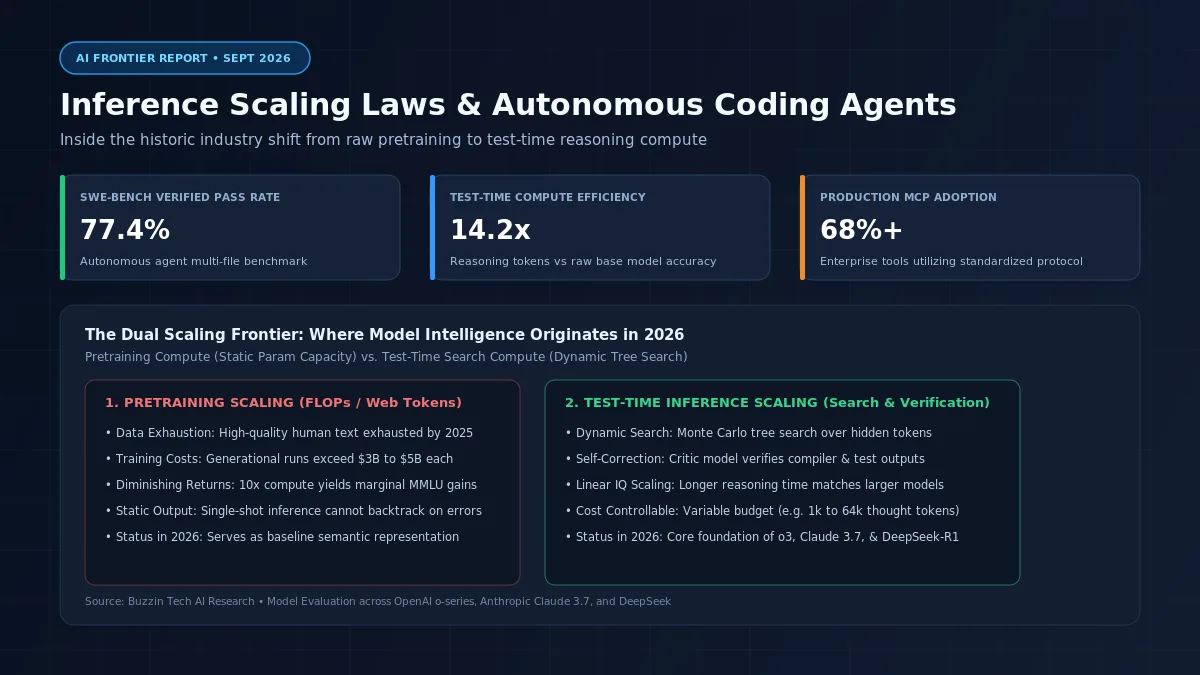
The defining transformation in artificial intelligence during late 2026 is the migration of computational power from pretraining clusters to inference-time reasoning loops. For five years, foundation model developers scaled intelligence by expanding base parameter counts and ingesting larger corpuses of public web tokens. By early 2025, that approach encountered severe structural friction: high-quality human text was largely exhausted, generational training runs exceeded $3 billion each, and incremental parameter expansion yielded diminishing returns on complex reasoning benchmarks.
In response, frontier laboratories including OpenAI, Anthropic, and DeepSeek unlocked a second dimension of the scaling laws: test-time compute. Instead of predicting the next token in a single forward pass, modern reasoning architectures allocate dynamic computing budgets at query time. The model explores multiple reasoning paths, tracks internal assumptions through hidden thinking tokens, inspects its own intermediate outputs, and backtracks when logic fails.
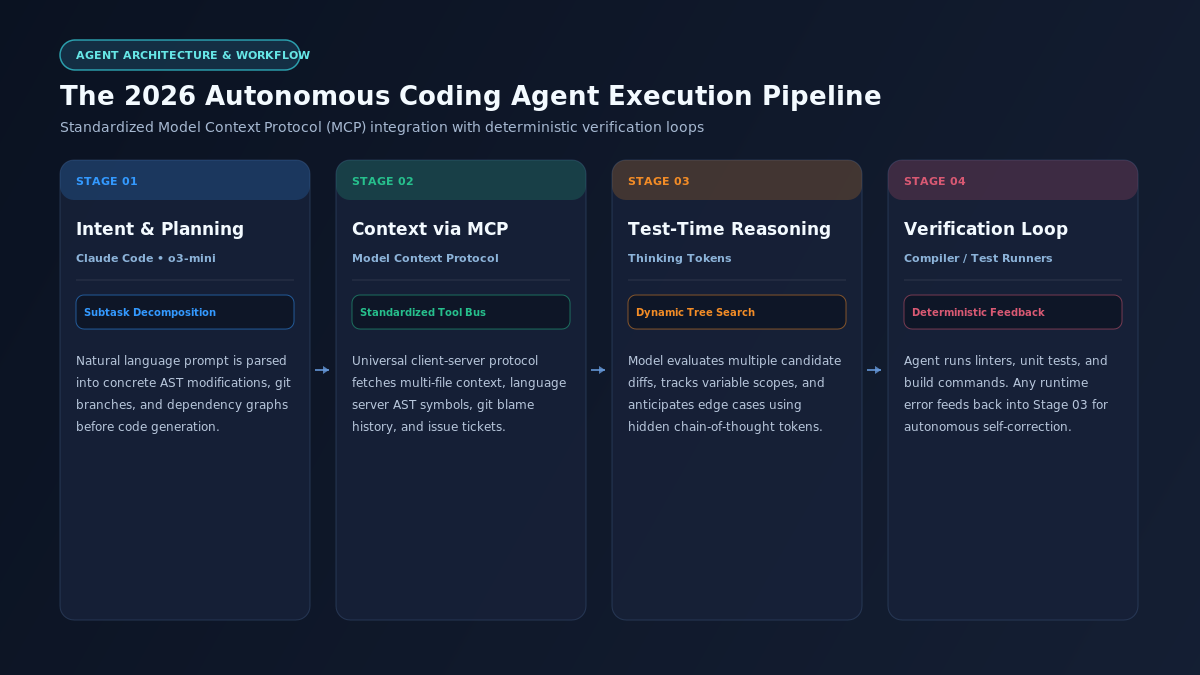
In software engineering, this architectural evolution enabled the transition from passive autocomplete assistants to fully autonomous coding agents. Equipped with standardized protocols like the Model Context Protocol and backed by deterministic verification loops (compilers, linters, and unit test suites), models like Claude 3.7 Sonnet, OpenAI o3, and DeepSeek-R1 now resolve multi-file engineering tasks that previously required senior human engineers.
For software organizations, this shift fundamentally changes how systems are designed. Engineering success no longer depends on prompt tricks or massive context packing. It requires structured agent architectures that combine test-time search with deterministic execution environments.
The physics of inference scaling: breaking the pretraining bottleneck
To understand the modern artificial intelligence stack, developers must recognize why the original scaling laws reached economic and mathematical limits.
Between 2020 and 2024, Chinchilla scaling laws dictated that optimal model performance required scaling compute and training tokens in equal proportion. However, frontier pretraining clusters hit two physical walls:
- The public data boundary: Frontier models had already ingested virtually all accessible high-quality human text, including open source code repositories, academic literature, books, and discussion forums. Synthetically generated pretraining text frequently introduced model collapse and semantic drift when looped recursively through subsequent training generations.
- Exponential capital requirements: Training a multi-trillion parameter dense model required hundreds of megawatts of electrical power, thousands of liquid-cooled GPU clusters, and months of uninterrupted cluster stability. The marginal benchmark gain per hundred million dollars invested dropped sharply.
+-----------------------------------------------------------------------------------+
| THE SHIFT IN AI COMPUTE ALLOCATION (2022 vs 2026) |
+-----------------------------------------------------------------------------------+
| PRE-2025 PARADIGM: Static Forward Pass |
| Prompt ---> [ 70B - 405B Parameter Dense Network ] ---> Output Token Stream |
| * Compute is fixed per token. Every query receives the same computational budget. |
| * If the model makes a logical error on token 5, it cannot correct itself. |
+-----------------------------------------------------------------------------------+
| LATE 2026 PARADIGM: Dynamic Test-Time Compute (Search + Verification) |
| Prompt ---> [ Reasoning Engine: Search, Branching, Verification ] ---> Solution |
| | | | |
| | +---> Candidate Chain of Thought 1 (Score: 0.42 - Rejected) |
| | +---> Candidate Chain of Thought 2 (Score: 0.96 - Verified) |
| +---> Variable Compute: 1,000 to 64,000 thinking tokens based on task difficulty|
+-----------------------------------------------------------------------------------+
The mechanics of test-time search and verifiers
Test-time compute transforms generation into a search problem over a tree of possible solution paths. Instead of relying purely on intuitive pattern matching, the model functions like a search algorithm evaluating candidate reasoning steps.
This process relies on three primary mechanisms:
- Process Reward Models (PRMs): Unlike traditional Outcome Reward Models that score only the final answer, PRMs evaluate each discrete step in a multi-stage proof or program. If step four introduces an invalid mathematical assumption or an out-of-scope variable, the reward model flags the error immediately, terminating that branch before wasting additional compute.
- Monte Carlo tree search (MCTS): In complex problem spaces, the engine generates multiple candidate steps, samples outcomes, and concentrates compute on the most promising logical paths.
- Deterministic external verifiers: When solving software problems, the model does not have to guess whether code works. It dispatches candidate diffs to isolated sandbox environments, executes compilers or test suites, and incorporates real execution feedback into its active reasoning stream.
Empirical data reveals that allocating 10x more compute to test-time search can match the accuracy of a base model that is 100x larger in parameter count. This allows developers to use compact, efficient models (such as 32B or 70B parameter architectures) that outthink massive trillion-parameter dense models on complex technical tasks.
Frontier reasoning architectures: OpenAI o3, Claude 3.7 Sonnet, and DeepSeek-R1
Three dominant technical architectures define state-of-the-art AI reasoning in late 2026. Each platform approaches the test-time scaling challenge through distinct engineering choices.
OpenAI o3: pure reinforcement-learned reasoning chains
OpenAI's o-series architectures, culminating in the production release of o3 and o3-mini, represent the purest expression of reinforcement-learned reasoning. During post-training, the model is trained with large-scale reinforcement learning algorithms that reward correct final outcomes and logical self-correction.
A distinguishing feature of o3 is the complete privatization of the reasoning chain. The model produces hidden thinking tokens that are not surfaced directly in user interfaces or API streams. These hidden tokens allow the system to write informal notes, test hypotheses, realize mistakes, and prune bad approaches without user-facing formatting constraints.
On SWE-bench Verified, a benchmark evaluating an AI model's ability to resolve real GitHub issues in complex Python repositories, o3 achieves a 75.8 percent pass rate on its primary execution pass. However, o3's compute intensity is high: complex algorithmic problems routinely consume 20,000 to 45,000 reasoning tokens before generating a 200-line code patch.
Anthropic Claude 3.7 Sonnet: hybrid instant and extended reasoning
Anthropic introduced Claude 3.7 Sonnet with a hybrid architecture that bridges conversational responsiveness and deep analytical thought. Unlike models that force every query through a slow reasoning pipeline, Claude 3.7 allows developers to control the reasoning budget directly through an API parameter:
{
"model": "claude-3-7-sonnet-20260901",
"max_tokens": 16000,
"thinking": {
"type": "enabled",
"budget_tokens": 4096
},
"messages": [
{
"role": "user",
"content": "Refactor the database migration worker to handle zero-downtime column splits under PostgreSQL 18."
}
]
}
When budget_tokens is set to zero, Claude 3.7 operates as an ultra-fast generation model suitable for standard chat and basic syntax formatting. When allocated a budget between 2,048 and 32,000 tokens, the model activates its extended thinking mode.
Anthropic paired this model with Claude Code, a specialized command-line agent tool that integrates directly into local developer terminal environments. Claude Code operates autonomously across local git repositories, reading file trees, editing multi-file modules, executing local terminal tests, and generating formatted pull requests. Claude 3.7 Sonnet holds the top benchmark score on SWE-bench Verified at 77.4 percent, demonstrating strong adherence to real-world software architecture conventions.
DeepSeek-R1: open-weights reasoning and architectural efficiency
The release of DeepSeek-R1 disrupted the proprietary AI sector by proving that advanced reasoning capabilities can be achieved without trillion-dollar pretraining infrastructure. DeepSeek-R1 was developed using pure reinforcement learning directly on top of base models without requiring an extensive supervised fine-tuning warm-up phase.
DeepSeek achieved this through two core architectural features:
- Multi-Head Latent Attention (MLA): Traditional multi-head attention requires storing massive Key-Value (KV) caches in high-speed GPU memory during long-context generation. DeepSeek compresses KV caches into low-dimensional latent vectors, reducing memory consumption by up to 80 percent during long reasoning generation.
- DeepSeekMoE architecture: DeepSeek-R1 activates only 37 billion parameters per token out of its total 671 billion parameter pool through fine-grained mixture-of-experts routing.
Because DeepSeek-R1 is available under an open license with weights downloadable from Hugging Face, enterprise engineering teams routinely deploy it on private cloud clusters (using vLLM, SGLang, or TensorRT-LLM). This gives organizations access to frontier-grade reasoning without transmitting proprietary source code or customer data to third-party commercial endpoints.
The Model Context Protocol in production: standardizing the agent tool bus
Before 2025, building autonomous AI agents required writing fragile, proprietary glue code. If a development team wanted an LLM to interact with GitHub, query a PostgreSQL database, inspect a Slack channel, and execute local bash commands, they had to write custom tool definitions for every provider.
Anthropic solved this fragmentation by open-sourcing the Model Context Protocol (MCP). By late 2026, MCP has become the universal standard for connecting AI models to external tools, databases, and development environments, supported across Anthropic Claude, OpenAI assistants, Cursor, and open-source agent runtimes.
+------------------------------------------------------------------------------------+
| THE MODEL CONTEXT PROTOCOL (MCP) ARCHITECTURE |
+------------------------------------------------------------------------------------+
| |
| +----------------------------------------------------------------------------+ |
| | MCP HOST APPLICATION | |
| | (e.g., Claude Code CLI, Cursor IDE, Custom Internal Developer Platform) | |
| +----------------------------------------------------------------------------+ |
| | |
| JSON-RPC 2.0 (stdio or SSE Web Transport) |
| | |
| +------------------------------+-------------------------------+ |
| | | | |
| v v v |
| +-------------------+ +-------------------+ +-------------------+ |
| | MCP Server: Git | | MCP Server: DB | | MCP Server: LSP | |
| | - list_branches | | - execute_sql | | - get_definition | |
| | - get_diff | | - get_schema | | - find_references| |
| | - create_commit | | - explain_query | | - run_linter | |
| +-------------------+ +-------------------+ +-------------------+ |
| |
+------------------------------------------------------------------------------------+
Core concepts of the Model Context Protocol
MCP operates on a client-server architecture inspired by the Language Server Protocol (LSP) that standardized IDE code intelligence a decade ago. It defines three primary primitives:
- Tools: Executable functions that the model can invoke to perform side effects (such as creating a file, running a shell command, or dispatching an API call).
- Resources: Passive, URI-addressable data sources that the host application can attach to the model's context (such as database schemas, log files, or git commit histories).
- Prompts: Pre-packaged prompt templates and workflows exposed by the server to guide the model through specific domain tasks.
Communication between the MCP host and server occurs via JSON-RPC 2.0 messages over standard input/output (stdio) for local tools or Server-Sent Events (SSE) for remote network services.
Practical implementation: a production TypeScript MCP server
Here is an example of an operational MCP server built with TypeScript that exposes database inspection and query analysis tools directly to an autonomous coding agent:
import { Server } from "@modelcontextprotocol/sdk/server/index.js";
import { StdioServerTransport } from "@modelcontextprotocol/sdk/server/stdio.js";
import {
CallToolRequestSchema,
ListToolsRequestSchema,
} from "@modelcontextprotocol/sdk/types.js";
import { Pool } from "pg";
const db = new Pool({
connectionString: process.env.DATABASE_URL,
});
const server = new Server(
{
name: "buzzin-database-inspector",
version: "1.0.0",
},
{
capabilities: {
tools: {},
},
}
);
// 1. Expose available database tools to the AI Agent
server.setRequestHandler(ListToolsRequestSchema, async () => {
return {
tools: [
{
name: "get_table_schema",
description: "Returns the column definitions and indices for a database table.",
inputSchema: {
type: "object",
properties: {
table_name: { type: "string" },
},
required: ["table_name"],
},
},
{
name: "explain_query",
description: "Runs EXPLAIN ANALYZE on a SQL query to evaluate execution cost.",
inputSchema: {
type: "object",
properties: {
query: { type: "string" },
},
required: ["query"],
},
},
],
};
});
// 2. Handle tool execution requests from the AI Agent
server.setRequestHandler(CallToolRequestSchema, async (request) => {
const { name, arguments: args } = request.params;
if (name === "get_table_schema") {
const res = await db.query(
`SELECT column_name, data_type, is_nullable
FROM information_schema.columns
WHERE table_name = $1`,
[args.table_name]
);
return {
content: [
{
type: "text",
text: JSON.stringify(res.rows, null, 2),
},
],
};
}
if (name === "explain_query") {
const res = await db.query(`EXPLAIN (FORMAT JSON, ANALYZE) ${args.query}`);
return {
content: [
{
type: "text",
text: JSON.stringify(res.rows[0], null, 2),
},
],
};
}
throw new Error(`Tool not found: ${name}`);
});
// 3. Connect via standard IO transport
const transport = new StdioServerTransport();
await server.connect(transport);
By packaging database tools into an MCP server, any MCP-compatible agent can inspect table structures, detect missing indices, and verify query performance without requiring hardcoded integration logic.
Engineering autonomous coding agents: building deterministic verification loops
The biggest operational mistake engineering teams make with AI coding agents is treating the model as a solitary code generator. A frontier model operating without external validation will inevitably generate subtle logical bugs, incorrect imports, or API mismatches.
Reliable autonomous agents operate inside closed, deterministic verification loops. The LLM generates code hypotheses, but the execution environment decides whether those hypotheses are valid.
+-------------------------------------------------------------------------------+
| THE DETERMINISTIC AGENT VERIFICATION LOOP |
+-------------------------------------------------------------------------------+
| |
| User Prompt |
| | |
| v |
| [ Agent Planning & File Selection ] |
| | |
| v |
| [ Candidate Diff Generation (Test-Time Reasoning) ] |
| | |
| v |
| +-----------------------------------------------------------------------+ |
| | ISOLATED DOCKER SANDBOX EXECUTION | |
| | 1. Apply Git Patch | |
| | 2. Run AST Syntax Checker (e.g., eslint / ruff) | |
| | 3. Run Static Typecheck (e.g., tsc --noEmit / mypy) | |
| | 4. Execute Unit & Regression Tests (e.g., vitest / pytest) | |
| +-----------------------------------------------------------------------+ |
| | |
| +---> Tests Pass? ===> YES ===> [ Commit to Feature Branch & Git PR ] |
| | |
| +---> Tests Fail? ===> NO ===> Feed Error Stacktrace into Reasoning |
| Tokens ---> Self-Correct (Max 5 Loops) |
| |
+-------------------------------------------------------------------------------+
The five rules of resilient agent engineering
Production coding agent frameworks adhere to five concrete architectural principles:
- Keep edits atomic and localized: Do not instruct an agent to rewrite an entire 2,000-line file. Require the agent to generate unified git diffs or use structured search-and-replace blocks. This prevents the model from accidentally dropping existing functions or comments.
- Enforce isolated execution environments: Never allow an autonomous agent to run arbitrary bash commands directly on a developer workstation or production host. Run agent builds inside ephemeral Docker containers with resource limits (CPU quotas, memory caps) and restricted network access.
- Turn compiler errors into context tokens: When a test fails, do not ask the user for help. Capture the exact compiler stderr output, line numbers, and test failure assertions, then append them directly to the agent's active conversation history. Reasoning models excel at fixing specific compiler errors when provided with line-level context.
- Implement automated git rollbacks: If an agent attempts three consecutive self-correction loops without passing the test suite, the framework must execute git checkout -- . to restore the working tree to a clean state, without leaving broken code in the repository.
- Enforce human review on pull requests: Autonomous agents are capable of opening pull requests, but production merge rights must remain protected by automated CI/CD checks and human code review.
Structured comparative analysis: frontier AI models for engineering teams
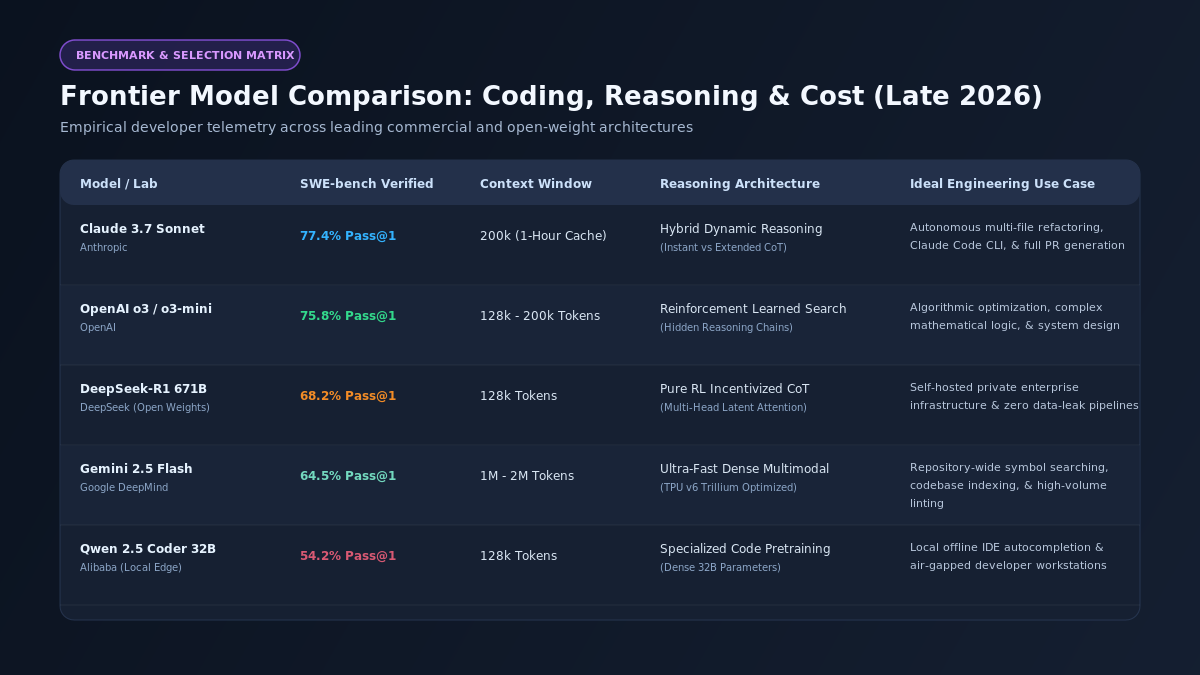
The following benchmark and cost matrix evaluates the five leading foundation model architectures used by software engineering teams in late 2026:
Model Architecture | Provider / Lab | SWE-bench Verified Pass Rate | Context Window Length | Primary Reasoning Architecture | Prompt Caching Cost Savings | Ideal Production Engineering Use Case |
Claude 3.7 Sonnet | Anthropic | 77.4% Pass@1 | 200k Tokens (1-Hr Ephemeral) | Hybrid Dynamic (Instant vs Extended CoT) | Up to 90% via Prompt Cache | Autonomous multi-file codebases, CLI agent workflows, and refactoring |
OpenAI o3 / o3-mini | OpenAI | 75.8% Pass@1 | 128k – 200k Tokens | Reinforcement Learned Search (Hidden CoT) | 50% on Cached Prefix Tokens | Deep algorithmic optimization, mathematical proofs, and system design |
DeepSeek-R1 (671B) | DeepSeek (Open Weights) | 68.2% Pass@1 | 128k Tokens | Pure RL Search with Multi-Head Latent Attention | Supported via vLLM / SGLang Prefix Caching | On-premise enterprise infrastructure, private IP code, and air-gapped systems |
Gemini 2.5 Flash | Google DeepMind | 64.5% Pass@1 | 1,000,000+ Tokens | High-Throughput Dense Multimodal on TPU v6 | Automated Context Caching | Whole-repository code ingestion, dependency audits, and codebase search |
Qwen 2.5 Coder (32B) | Alibaba Cloud (Open Weights) | 54.2% Pass@1 | 128k Tokens | Dense Code-Specialized Autoregressive Pretraining | Local llama.cpp / Ollama Memory Cache | Offline IDE autocompletion and lightweight edge developer workstations |
Strategic implementation playbook for software engineering teams
As artificial intelligence shifts toward test-time reasoning and autonomous execution, technology leaders must update their engineering operating procedures. Here are four practical directives for engineering teams deploying AI in late 2026:
Operational Playbook for Engineering Leaders:
1. Dynamic Compute Budgeting : Match thinking token limits to task difficulty.
2. Standardize on MCP : Decouple internal tooling from specific model APIs.
3. Persistent Prompt Caching : Store repository architecture graphs in cache memory.
4. Two-Tier Agent Topology : Route fast symbol lookups to SLMs; reserve frontier CoT for diffs.
1. Calibrate reasoning budgets to task complexity
Do not configure agents to burn 16,000 reasoning tokens on simple string manipulation, HTML template updates, or standard CSS formatting. Use fast, zero-thinking models for routine syntactical adjustments.
Reserve high-budget extended thinking (4,000 to 32,000 thinking tokens) for tasks that involve state transitions, race conditions, distributed transaction handling, or database schema migrations where logical mistakes carry severe operational consequences.
2. Standardize internal tooling on the Model Context Protocol
Avoid building custom REST or GraphQL adapters that connect solely to one AI vendor's function-calling format. Build internal microservices as MCP servers.
When your internal company tools (such as database query runners, deployment trigger endpoints, and error logging dashboards) expose standardized MCP interfaces, your organization can swap underlying AI models (from Anthropic to OpenAI to self-hosted DeepSeek) in minutes without rewriting tool integration code.
3. Implement persistent prompt caching for codebase maps
Autonomous agents require comprehensive repository context to prevent breaking changes across dependent modules. However, passing 50,000 tokens of file structure, interface definitions, and documentation on every API turn can quickly inflate monthly billing.
Leverage persistent prompt caching. Both Anthropic and OpenAI allow developers to cache common context prefixes. By placing your repository's high-level architectural map, TypeScript interface definitions, and coding standards at the beginning of the prompt and marking it with a cache breakpoint, subsequent agent turns query that context at a 90 percent discount with zero cache-rebuild latency.
4. Deploy a two-tier agent topology
Instead of directing an expensive frontier model to execute every minor subtask, build a two-tier agent topology:
- Tier 1 (The Dispatcher / Searcher): A lightweight, low-cost model (such as Gemini 2.5 Flash or Claude 3.5 Haiku) handles high-volume codebase search, runs file indexing via MCP, filters relevant file paths, and prepares targeted context bundles.
- Tier 2 (The Synthesizer / Reasoner): A frontier reasoning model (such as Claude 3.7 Sonnet or OpenAI o3) receives the filtered context bundle, performs extended test-time reasoning, generates the candidate diffs, and inspects the verification test outputs.
This multi-model topology reduces monthly token costs by 60 to 75 percent while preserving high resolution rates on complex software tickets.
Frequently asked questions (FAQ) for search and answer engines
What is the difference between pretraining scaling and inference scaling in AI?
Pretraining scaling increases model intelligence by training larger neural networks on larger datasets before deployment, creating a static base model. Inference scaling increases intelligence by allocating dynamic compute time during query execution, allowing the model to generate hidden reasoning tokens, explore multiple candidate solutions, and self-correct using verification tools before delivering a final response.
How does the Model Context Protocol (MCP) improve AI coding agents?
The Model Context Protocol (MCP) provides an open, standardized client-server interface that connects AI models to local and remote tools, file systems, and databases. Instead of writing custom API integration code for each specific platform, developers write MCP servers that expose tools, resources, and prompts universally across different IDEs, CLI tools, and model providers.
What is SWE-bench Verified and why is it important in late 2026?
SWE-bench Verified is a benchmark created to evaluate the practical software engineering capabilities of AI models. It consists of 500 validated real-world GitHub issues from popular Python repositories. To solve a task, an AI model must ingest a complete repository, identify the bug, edit multiple source files, and pass existing unit test suites without human intervention.
How does Claude 3.7 Sonnet's hybrid reasoning architecture work?
Claude 3.7 Sonnet introduces hybrid reasoning that allows developers to control the model's thinking budget via an API parameter. When set to zero, the model responds with instant generation speed suitable for conversation. When allocated an extended budget (up to 32,000 thinking tokens), the model evaluates internal hypotheses and plans multi-step logic before producing code.
Can open-weights models like DeepSeek-R1 match proprietary reasoning models?
Yes. DeepSeek-R1 achieves a 68.2 percent pass rate on SWE-bench Verified, outperforming older proprietary models like GPT-4o on complex software tasks. By using pure reinforcement learning without supervised warm-ups and optimizing memory through Multi-Head Latent Attention, DeepSeek-R1 allows organizations to run frontier-grade reasoning on private infrastructure.
What are Process Reward Models (PRMs) in reasoning models?
Process Reward Models (PRMs) evaluate and score every individual step in an AI model's chain of thought, instead of scoring only the final answer. This enables the model to identify logical errors, hallucinations, or syntax mistakes at the exact step where they occur, allowing the system to backtrack and explore alternative solution paths.
Build modern AI engineering workflows with Buzzin Tech
The shift to test-time compute and autonomous agents marks a new era in software development. Teams that integrate standardized MCP toolchains, verification loops, and intelligent model routing will build software faster while maintaining full control over infrastructure expenditures.
If your organization is ready to deploy autonomous developer agents, implement custom MCP tooling, or design high-performance AI architectures, connect with the engineering team at Buzzin Tech to build scalable artificial intelligence systems tailored to your technical goals.