
Insurance broker website design: the Ecovers rebuild
By Mustehsan Sheikh
Most insurance broker website design starts with a redesign brief and ends with the same site in a new suit. The Ecovers project asked a different question: what happens to every quote request after the visitor clicks submit? The answer was a fast site wired into full GoHighLevel automation, and in the CEO's words, a lead generation engine.
TL;DR
Ecovers, an independent UK insurance broker, sold insurance online in minutes; the old site was slow and did not convert.
We designed the new site in Figma and built it from scratch: fast, mobile-responsive, and structured around quote requests.
Every request flows into GoHighLevel, gets an instant first response, and runs a follow-up sequence until the team picks it up.
A blog admin panel, clean Google tags, and SEO/GEO/AEO from day one keep it measurable.
The problem: a broker whose website could not sell insurance
eCOVERS is an independent insurance broker in the UK. The pitch is simple: insurance in minutes, bought online. The old website could not deliver it. It was slow, it did not convert, and quote requests had no reliable path to a salesperson.
For a broker, that is not a cosmetic problem. The quote request is the whole business. A visitor who fills in a form and hears nothing back is a customer who buys from someone else. The brief named the fix directly: a fast, mobile-responsive site designed to capture quote requests, with instant follow-up on every request.
This is the kind of rebuild our web development team takes on when the existing site is the bottleneck: the front door and the plumbing behind it, rebuilt together.
Discovery: mapping the quote's path before touching a pixel
Our method starts with discovery and architecture, and here it meant one thing: tracing what happened to a quote request from click to close. The old flow had the usual leaks. Requests sat in an inbox. Replies depended on who checked it first. Nobody could say how many requests arrived on a given day, let alone how fast each one got an answer.
So the new build was specified around a single rule: no quote request waits in an inbox. Everything else, the design, the speed budget, the automation, served that rule.
Design: a Figma build around the quote form
The new site was designed in Figma first, not in code. That sounds obvious; it is not how most agency sites get built. Starting in Figma meant the quote flow was laid out as a user flow before a line of markup existed: what the visitor sees, what they tap, what happens next.
The design decisions were plain ones. The quote request sits one tap from every page. The form asks only what the broker needs to respond. The site is mobile-responsive because most of the traffic arrives on a phone. Nothing decorative survived that did not serve the form.
Engineering: fast, mobile-responsive, and built from scratch
The build is a custom website, written from scratch rather than assembled from a theme. Themes carry weight the site does not need, and speed was a stated requirement, not a hope.
Core Web Vitals were the benchmark, and the public standard is documented on web.dev, the bar every fast site is now measured against. The Ecovers pages were built to load fast on mid-range phones on ordinary connections, because that is where the customers are.
SEO, GEO, and AEO were built in from day one rather than bolted on later: clean markup, structured content, and pages written so both search engines and AI answers can read them. The full published account is in the live Ecovers case study.
The automation: every request answered instantly
The website is half the build. Behind it sits the complete GoHighLevel system, and this is where the project stops being a redesign and becomes a different way of running the business.
Every quote request flows straight into the CRM. The moment it lands, the system sends an automatic first response. No waiting for office hours, no dependence on someone checking email. Then the request moves through a follow-up sequence: timed messages that keep the conversation warm until someone on the Ecovers team picks it up.
The connections are done properly, not with duct tape. GHL webhooks carry the data between the site and the CRM, so nothing is retyped and nothing is lost. Google tags and the leads connection feed clean data back, so the broker can see where requests come from and which pages earn them.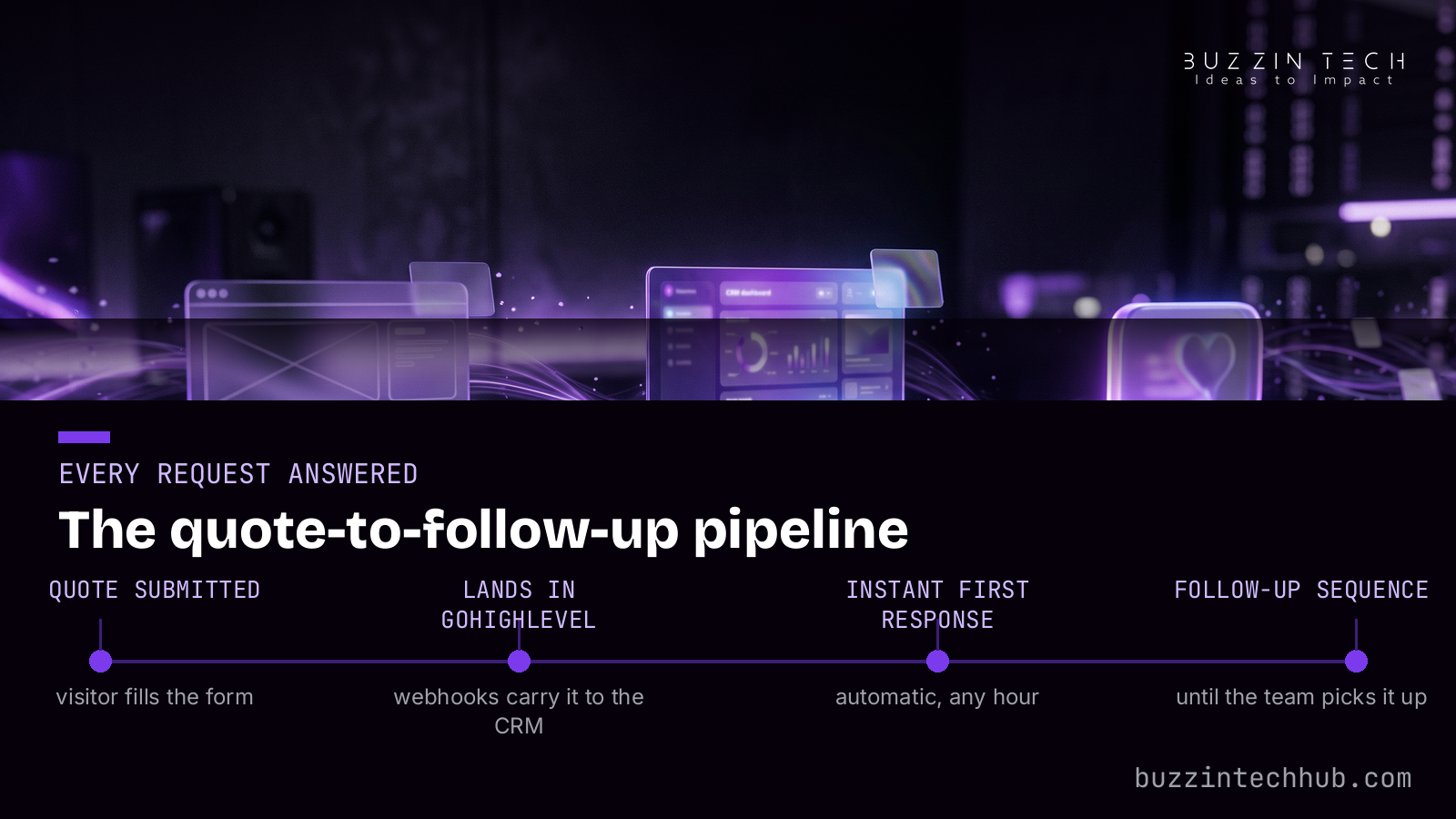
This is the same automation discipline we apply across our automation work: the system handles the first response and the follow-up; humans handle the conversation that closes the deal. For the official product behind the pipeline, see GoHighLevel.
The backend: a blog admin panel and clean measurement
Two quieter pieces of the build matter as much as the visible ones.
First, a backend admin panel for blog posting. The broker can publish articles without touching code or calling a developer. Content becomes a habit instead of a project. That matters for organic growth: fresh, useful pages are what search and AI answers feed on.
Second, clean tracking. Google tags were set up so every quote request is attributed to its source. A site that cannot tell you which page produced the quote is a site you cannot improve. This one can.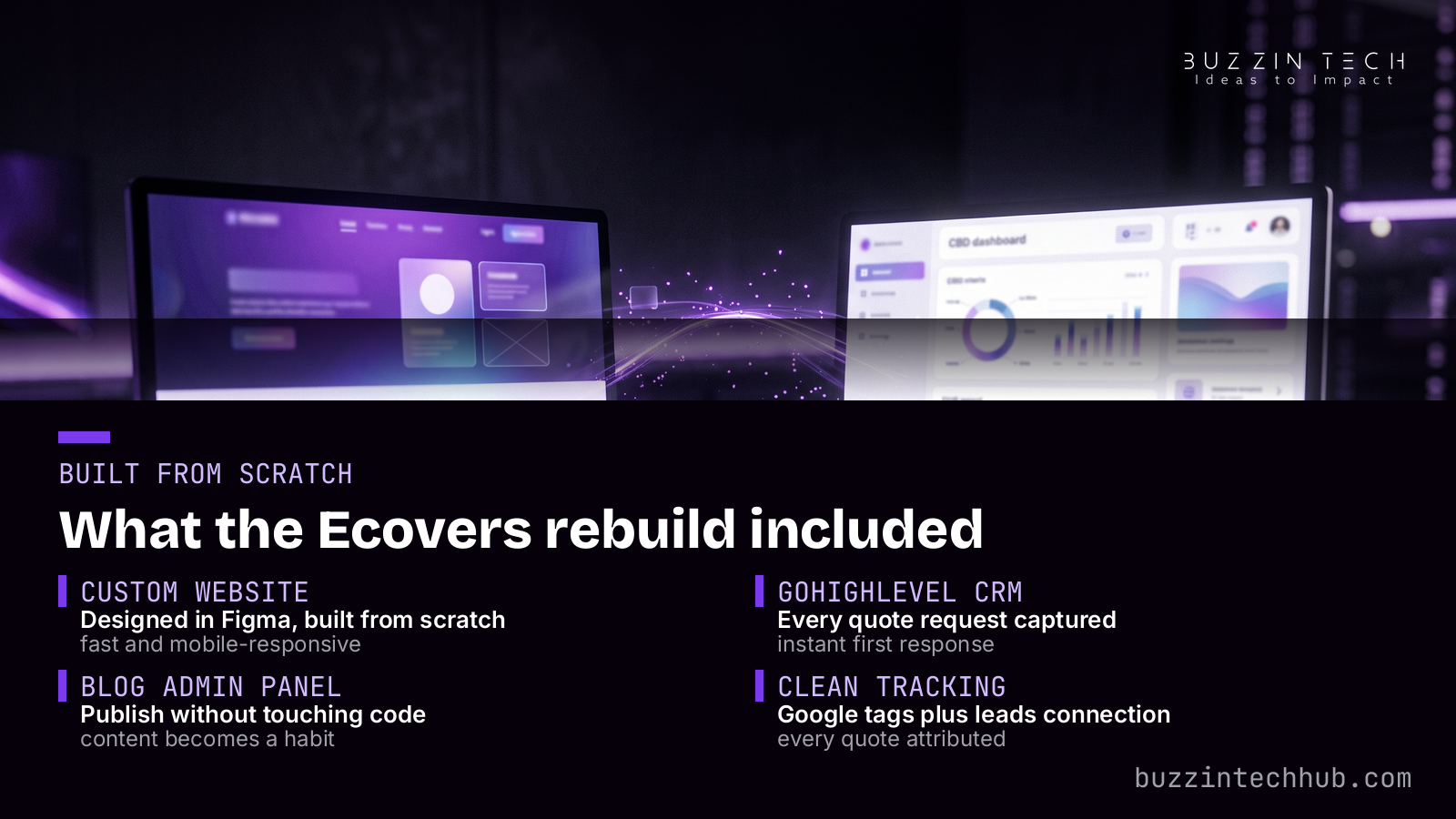
The outcome: a lead generation engine
The published result is a complete online front door that loads fast and turns visitors into quote requests. Every request is captured and followed up automatically. Nothing waits in an inbox.
Nicolae Caminschi, the CEO of Ecovers, put it this way: the new site became "a fast, high-performing lead generation engine," built through web design and SEO. The results, he said, were phenomenal, and he recommends the team to any business looking to scale.
We never claim numbers we did not publish. What is on the record is the change itself: a broker that used to lose quote requests to a slow site and an inbox now answers every one instantly and follows up until a human takes over. That is the difference between a website and a front door.
More of this kind of work is on our projects page.
Still answering quote requests from an inbox?
If every enquiry lands in email and gets a reply when someone gets to it, you are losing the ones who asked a competitor too. We build sites where the first response is automatic and the follow-up never stops.
See how we build websites that capture every enquiry
Frequently asked questions
What did BuzzinTech build for Ecovers?
A custom website designed in Figma and built from scratch, fast, mobile-responsive, and structured around quote requests, plus a complete GoHighLevel automation system. Every request flows into the CRM, receives an automatic first response, and runs through a follow-up sequence until the team picks it up. The build also includes a blog admin panel, GHL webhook connections, and clean Google tags with a leads connection.
Why was the old Ecovers website not working?
It was slow and it did not convert. For an insurance broker selling online, the quote request is the product page: if visitors will not wait for it to load or cannot find the form, the business loses the sale at the first step. The rebuild treated speed and the quote flow as the requirements everything else served.
How does the GoHighLevel automation work?
When a visitor submits a quote request, webhooks carry it straight into the GoHighLevel CRM. The system sends an instant first response, then moves the request through a follow-up sequence of timed messages. Nothing waits in an inbox, and nothing depends on someone checking email first. A person on the team takes over when the conversation is warm.
What is SEO/GEO/AEO in a website build?
SEO makes the site readable to search engines; GEO and AEO make it readable to the AI answers and generative engines that now sit on top of search. For Ecovers this meant clean markup, structured content, and pages written to be quoted by assistants as well as ranked by Google, built in from day one rather than added later.
How long does a build like this take?
Timelines depend on scope, and we do not publish per-project durations. What we do publish is the method: discovery and architecture, design and prototyping, engineering and build, then deployment and scaling, with senior engineers and marketers on the project and a direct line to the people doing the work, no account managers in between.
More from Buzzin Tech Hub
Monday brings the Engineering pillar: a technical deep-dive for builders. Browse the full archive at https://buzzintechhub.com/blog.php.