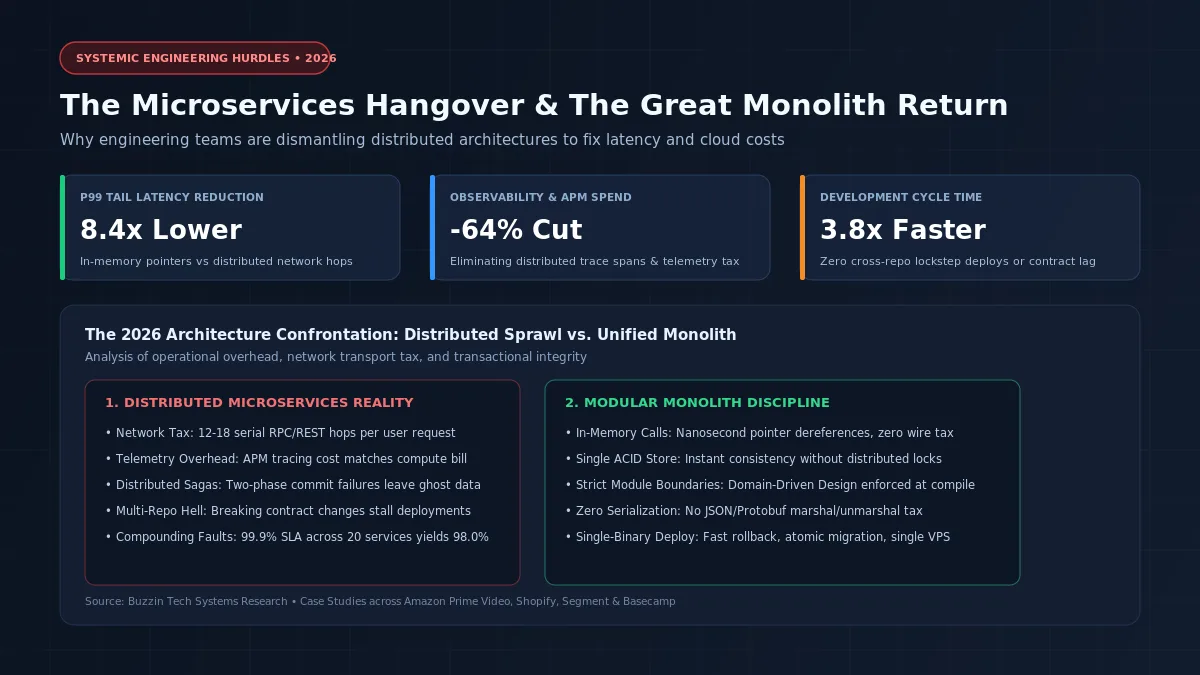
Between 2015 and 2023, the global software industry adopted fine-grained microservices as the default architectural pattern for web applications. Promoted by cloud vendors, conference speakers, and enterprise consulting firms, microservices promised independent team autonomy, infinite horizontal scaling, and isolated technology stacks. Startups with twenty engineers routinely carved simple CRUD applications into forty separate Git repositories, each running in its own Kubernetes pod with dedicated CI/CD pipelines.
By late 2026, the industry is experiencing a profound architectural hangover.
The operational reality of managing dozens of distributed network boundaries has exposed systemic failure modes that outweigh theoretical scaling benefits for 95 percent of engineering organizations:
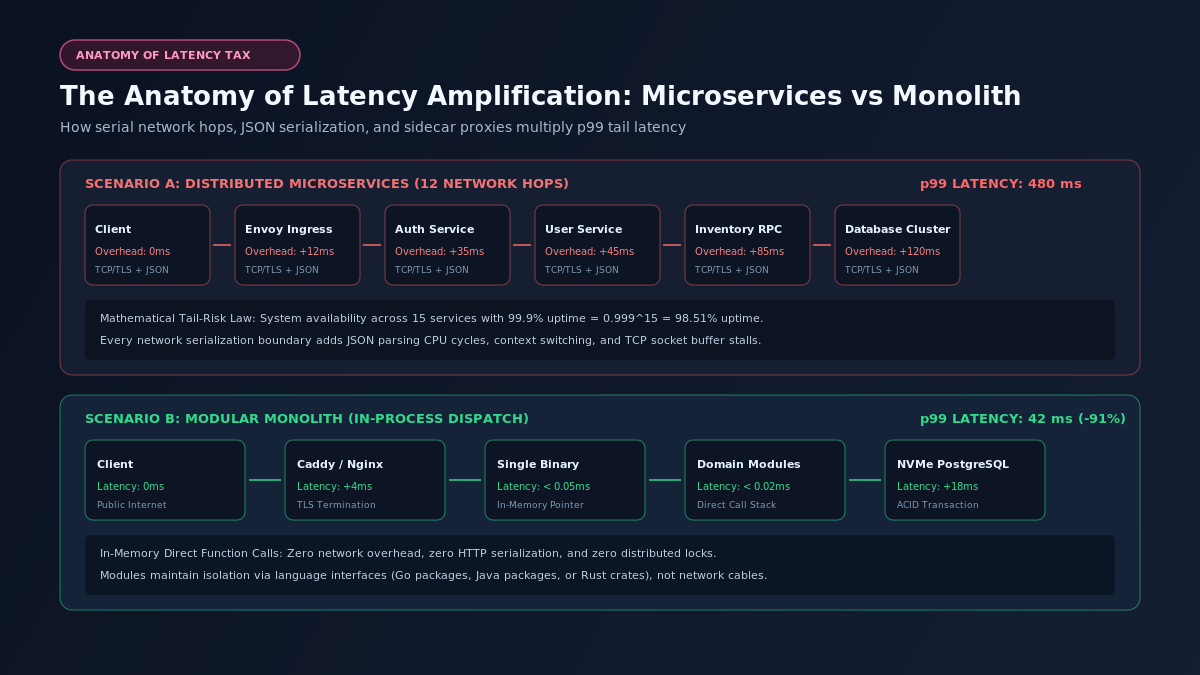
- Tail latency amplification: When a single user click triggers a cascade of fifteen internal HTTP or gRPC calls, tail latency compounds exponentially. A collection of services each operating at 20 milliseconds p99 latency routinely produces a user-facing response time exceeding 450 milliseconds.
- The observability tax: The cost of storing distributed traces, span metrics, and centralized application logs across cloud telemetry vendors frequently matches or exceeds the primary compute bill.
- Data consistency collapse: Abandoning relational ACID transactions in favor of distributed sagas and eventual consistency introduces silent state drift, phantom inventory errors, and complex compensation logic that engineers struggle to debug.
- Developer velocity paralysis: Instead of increasing velocity, distributed codebases create synchronization bottlenecks. Simple feature additions require coordinating pull requests across four repositories, updating API schema contracts, and managing complex staging environments.
Leading engineering teams are responding with architectural pragmatism. Companies are consolidating distributed network services into modular monoliths: unified binaries structured around strict domain boundaries. By replacing physical network hops with in-process memory calls, organizations achieve sub-50-millisecond p99 latencies, slash cloud infrastructure costs by up to 70 percent, and restore daily deployment velocity.
The physics of latency amplification: how network hops destroy p99 performance
The primary architectural flaw of microservices is the substitution of in-memory function calls with remote network calls. In computer architecture, accessing L1 cache takes approximately 1 nanosecond, main memory RAM access takes 100 nanoseconds, and a local loopback network call takes between 100,000 and 500,000 nanoseconds (0.1 to 0.5 milliseconds). When calls cross physical data center switches, container overlay networks, and sidecar proxies, network latency escalates into multiple milliseconds.
The mathematics of compounding tail latency
Software engineers often evaluate system performance using median (p50) latency. This metric hides severe production bottlenecks. Modern web applications serve thousands of concurrent users, meaning user experience is governed by p95 and p99 tail latencies.
Consider a standard e-commerce product checkout request that requires data from twelve internal microservices (Authentication, User Profile, Inventory, Pricing, Recommendations, Tax, Shipping, Fraud Detection, Promotions, Currency, Notification, and Payment):
+-----------------------------------------------------------------------------------+
| MATHEMATICS OF COMPOUNDING AVAILABILITY AND LATENCY IN DISTRIBUTED CHAINS |
+-----------------------------------------------------------------------------------+
| Number of Serial Microservice Hops: 12 |
| Individual Service Availability SLA: 99.9% (Three Nines) |
| Total System Availability = 0.999^12 = 98.81% (Less than Two Nines) |
| Result: Out of every 10,000 requests, 119 will fail completely due to network math|
+-----------------------------------------------------------------------------------+
| LATENCY COMPILATION: In-Memory Call vs. Distributed Network Hop |
| Operation Type | Latency per Hop | Total 12-Hop Latency |
+------------------------------------+-----------------------+----------------------+
| Direct In-Memory Function Call | 0.00005 ms (50 ns) | 0.0006 ms |
| Unix Domain Socket / IPC | 0.015 ms (15,000 ns) | 0.18 ms |
| In-Pod Localhost Loopback | 0.35 ms | 4.2 ms |
| Container Overlay (Flannel/Calico) | 1.8 ms | 21.6 ms |
| Cross-AZ Cloud RPC (with TLS/mTLS) | 8.5 ms | 102.0 ms |
| Tail Latency p99 with Queuing | 40.0 ms | 480.0 ms |
+------------------------------------+-----------------------+----------------------+
When a request executes serially, the total response time is the sum of every individual hop. However, in modern microservice architectures, the probability of hitting a tail latency event follows a binomial distribution.
If each microservice has a 1 percent chance of experiencing a p99 spike of 80 milliseconds (due to garbage collection pauses, noisy cloud neighbors, or CPU throttling), the probability that a 12-hop user request encounters at least one p99 delay is:
$$P(\text{At least one spike}) = 1 - (1 - 0.01)^{12} = 1 - (0.99)^{12} = 1 - 0.8864 = 11.36\%$$
More than one out of every nine user requests will experience severe degradation. In a monolithic architecture, where all domain logic runs within the same process memory space, cross-module calls execute in nanoseconds, eliminating network transport variance entirely.
The serialization and proxy tax
Beyond raw transit time across fiber switches, distributed services pay an invisible computational tax: data serialization.
Every time Service A calls Service B over HTTP or gRPC:
- The sender must serialize internal language data structures (Go structs, Java objects, TypeScript records) into JSON strings or Protocol Buffer binary streams.
- The payload passes through the Linux networking stack, kernel space context switches, and virtual Ethernet pair interfaces.
- The request enters an Envoy or Istio sidecar proxy, where mutual TLS (mTLS) certificates are verified, access control policies are evaluated, and telemetry spans are recorded.
- The receiver executes the reverse process, parsing raw bytes back into memory structures and allocating heap memory for incoming objects.
Profiling production clusters reveals that microservice CPU workloads frequently spend 20 to 35 percent of their total clock cycles executing JSON serialization, buffer allocations, and TLS handshakes. This is dead compute that delivers zero direct business value.
The telemetry tax: when the observability bill exceeds the compute bill
The explosion of distributed microservices created an acute financial consequence for technology companies: the cloud observability bill.
In a monolithic application, diagnosing a bug requires inspecting a local log file with a process ID and a timestamp. In a microservices architecture with forty services, a single user click generates dozens of asynchronous network packets spanning multiple containers, message brokers, and database instances.
To trace an execution path, engineering teams must implement distributed tracing tools (such as OpenTelemetry, Jaeger, Datadog, or New Relic). Every HTTP request must be injected with trace context headers (traceparent, tracestate). Every service must emit span records detailing entry time, exit time, query parameters, error codes, and metadata tags.
+-----------------------------------------------------------------------------------+
| THE OBSERVABILITY VOLUME MULTIPLIER |
+-----------------------------------------------------------------------------------+
| Production Traffic: 50,000,000 User HTTP Requests / Month |
| Average Internal Hops per Request: 14 Spans |
| Total Generated Trace Spans: 700,000,000 Spans / Month |
| Average Span Payload Size (with tags & stack traces): 1.8 KB |
| Raw Ingestion Volume: 1.26 Terabytes of Pure Telemetry Data |
+-----------------------------------------------------------------------------------+
| MONTHLY CLOUD EXPENDITURE BREAKDOWN |
| Primary Application Compute (AWS EC2 / EKS Worker Nodes) : $6,400 / month |
| PostgreSQL Database Cluster (RDS Multi-AZ Aurora) : $3,800 / month |
| Datadog / Third-Party APM (APM Hosts, Trace Ingestion, Logs): $14,200 / month |
| * Telemetry software costs 136% MORE than the actual application compute! |
+-----------------------------------------------------------------------------------+
By late 2026, mid-market SaaS companies routinely find themselves paying six-figure annual bills to telemetry vendors simply to understand why their microservices fail.
When engineering leadership attempts to reduce telemetry costs by implementing aggressive trace sampling (such as recording only 5 percent of traces), they introduce a secondary operational crisis: rare, intermittent p99 production bugs disappear from the trace logs entirely. Engineers spend days attempting to reproduce customer complaints because the relevant trace was dropped at the ingestion gateway.
In a modular monolith, distributed tracing is unnecessary. A single correlation identifier attached to the incoming request context tracks execution across all internal modules through structured local logs, eliminating 90 percent of telemetry ingestion costs.
The distributed transaction trap: why sagas and two-phase commits fail in production
In relational database systems, developers rely on ACID guarantees (Atomicity, Consistency, Isolation, Durability). When a user books a hotel room, the application begins a database transaction: it updates the room status to booked, creates an invoice record, and deducts the user's loyalty points. If any step fails, the database executes a ROLLBACK. The system remains in a clean, consistent state.
Microservices intentionally break database atomicity. The foundational dogma of microservices architecture states: "Every service must own its private database."
Under this rule, the Booking Service owns a PostgreSQL database, the Invoicing Service owns a MySQL database, and the Loyalty Service owns a DynamoDB table. A single business transaction now spans three physically distinct storage systems.
+-----------------------------------------------------------------------------------+
| DISTRIBUTED SAGA FAILURE: THE PHANTOM STATE PROBLEM |
+-----------------------------------------------------------------------------------+
| 1. Client Initiates Order: Booking Service writes record (STATUS: PENDING) |
| 2. Booking Service publishes event to Kafka: "order.created" |
| 3. Payment Service consumes event, charges credit card (SUCCESS: $250) |
| 4. Inventory Service consumes event, discovers out-of-stock condition (FAIL) |
| |
| COMPENSATION EXECUTION: |
| 5. Inventory publishes: "inventory.failed" |
| 6. Payment Service must issue refund (WHAT IF REFUND API TIMEOUTS?) |
| 7. Booking Service must mark record (STATUS: CANCELLED) |
| |
| PRODUCTION REALITY: |
| • Kafka consumer crashes during step 6; customer is charged but order is cancelled.|
| • Eventual consistency creates temporary states where users see phantom balances. |
| • Engineering team must build custom reconciliation scripts to fix broken state. |
+-----------------------------------------------------------------------------------+
The myth of the saga pattern
To resolve the absence of ACID transactions, microservice advocates recommend the Saga pattern. A saga coordinates multiple local transactions across services using orchestrators or choreography events. If step three fails, the orchestrator triggers compensating transactions (undo actions) in reverse order.
In practice, the saga pattern introduces massive complexity:
- Compensating transactions are not clean rollbacks: If an application charges a customer's credit card and subsequently discovers that an inventory item is missing, issuing a refund takes three to five business days. The user experiences real-world financial friction.
- Concurrent state anomalies: In a relational database, row-level locks prevent two transactions from modifying the same record simultaneously. In an asynchronous event-driven saga, there is no cross-service locking. A user can trigger multiple actions concurrently, creating race conditions where loyalty points are spent twice before the first transaction completes.
- Reconciliation overhead: Distributed systems inevitably accumulate state drift. Network partitions, hard container restarts, and unhandled exception loops cause messages to be dropped or processed out of order.
By 2026, companies that built event-driven microservices employ dedicated teams of engineers whose sole responsibility is writing SQL reconciliation scripts to detect and repair discrepancies between service databases.
In a modular monolith, all business modules share a single primary database cluster. Domain modules maintain logical boundary isolation via separate database schemas or table prefixes, but they participate in standard relational transactions. If an operation fails, the database handles rollback automatically at the storage engine level.
Case studies in architectural reversal: Amazon, Segment, and Shopify
The migration from microservices back to unified monolithic architectures is not theoretical; it is led by some of the most sophisticated engineering organizations in the world.
Amazon Prime Video: cutting cloud costs by 90 percent
In 2023, the engineering team behind Amazon Prime Video's video quality analysis service published a landmark technical case study. The team had originally architected their monitoring service using distributed serverless components: AWS Step Functions state machines orchestrating AWS Lambda functions, passing intermediate video frames through Amazon S3 buckets.
As video monitoring traffic scaled to thousands of live video streams, the system hit severe scaling walls and financial costs:
- The Step Functions service charged per state transition, creating massive daily expenses as millions of video frames were analyzed.
- Passing high-resolution images back and forth across S3 buckets saturated storage read/write limits and added high I/O latency.
The Prime Video team made the decision to dismantle the serverless microservice pipeline. They consolidated all analysis logic into a single monolithic service written in C++ and deployed on Amazon EC2 and ECS instances.
The results demonstrated the efficiency of co-located compute:
- Infrastructure costs decreased by 90 percent.
- Scaling limits were eliminated because video frames remained inside shared process memory without traversing cloud storage networks.
- System operational stability increased significantly.
Segment: consolidating 140 microservices into a single service
Customer data platform Segment experienced a well-documented microservice crisis. Segment originally created a separate microservice worker for every third-party destination integration (such as Google Analytics, Mixpanel, and Salesforce). As the platform expanded, Segment found itself maintaining over 140 individual services with unique Git repositories and deployment pipelines.
The operational overhead overwhelmed the engineering organization:
- A shared library update (such as a security patch in an HTTP client) required creating and merging 140 pull requests across 140 repositories.
- Individual services had highly variable load; low-volume destinations wasted CPU capacity on idle containers, while high-volume destinations suffered queue congestion.
- Debugging pipeline delays required cross-referencing logs across dozens of independent container pools.
Segment executed a multi-month migration, consolidating all destination workers into a single, unified service. The consolidated service used dynamic internal routing to dispatch events in memory.
The consolidation reduced developer maintenance overhead by 80 percent, eliminated cross-repo dependency drift, and significantly improved server resource utilization.
Shopify: the multi-billion dollar modular monolith
While other technology companies spent a decade fragmenting their architectures, e-commerce giant Shopify remained committed to a modular monolith.
Shopify's primary core application runs on a massive, highly disciplined Ruby on Rails codebase. Shopify processes millions of requests per second during peak global shopping events like Black Friday and Cyber Monday, handling billions of dollars in gross merchandise value with high reliability.
Shopify maintains developer velocity and code hygiene through strict modular boundaries:
- The codebase is structured using an open-source tool called Packwerk, which enforces boundaries between domain packages at the static analysis level.
- If a developer in the Inventory module attempts to directly access a private database model in the Billing module, the build pipeline fails automatically.
- Communication between modules must route through public domain interfaces.
Shopify demonstrated that architectural scale does not require network fragmentation. A well-architected modular monolith supports hundreds of engineers shipping code simultaneously without paying the distributed systems tax.
The modular monolith blueprint: Domain-Driven Design without the network wire
A modular monolith is not a return to the messy, unstructured "spaghetti" codebases of the early 2000s. It is an architectural discipline that enforces strict domain separation within a single deployable application unit.
+------------------------------------------------------------------------------------+
| THE MODULAR MONOLITH ARCHITECTURAL PATTERN |
+------------------------------------------------------------------------------------+
| |
| +----------------------------------------------------------------------------+ |
| | PUBLIC API / HTTP GATEWAY | |
| | (Single TLS Termination, Shared Authentication & Request Context) | |
| +----------------------------------------------------------------------------+ |
| | | |
| v In-Memory Call v In-Memory Call |
| +--------------------------+ +--------------------------+ |
| | ORDER MODULE | | INVENTORY MODULE | |
| | - Public Service API | | - Public Service API | |
| | - Internal Domain Logic | | - Internal Domain Logic | |
| | - Private Repositories | | - Private Repositories | |
| +--------------------------+ +--------------------------+ |
| | | |
| | In-Process Event Bus | In-Process Event Bus |
| +-------------------+------------------+ |
| v |
| +----------------------------------------------------------------------------+ |
| | INTERNAL EVENT DISPATCHER (IN-MEMORY) | |
| | (Guaranteed Delivery via Outbox Pattern in Same Database Transaction) | |
| +----------------------------------------------------------------------------+ |
| | |
| v Direct SQL / Connection Pool |
| +----------------------------------------------------------------------------+ |
| | PRIMARY POSTGRESQL 18 CLUSTER | |
| | [ Schema: orders ] [ Schema: inventory ] [ Schema: billing ] | |
| | - Isolated Tables - Isolated Tables - Isolated Tables | |
| +----------------------------------------------------------------------------+ |
| |
+------------------------------------------------------------------------------------+
Enforcing boundaries with language package visibility
In a modular monolith, modules maintain boundary isolation using standard programming language constructs instead of network firewalls.
Here is a practical example in Go showing how two domain modules (Billing and Orders) communicate strictly through interfaces and in-process memory dispatch:
package main
import (
"context"
"database/sql"
"fmt"
"log"
)
// ============================================================================
// DOMAIN: BILLING MODULE (Internal boundary)
// ============================================================================
// PaymentRequest represents the input data for processing a payment.
type PaymentRequest struct {
OrderID string
Amount int64 // In cents
}
// PaymentResult represents the execution outcome.
type PaymentResult struct {
TransactionID string
Success bool
}
// BillingService defines the public interface exposed to other modules.
type BillingService interface {
ProcessPayment(ctx context.Context, tx *sql.Tx, req PaymentRequest) (*PaymentResult, error)
}
// internalBillingService is unexported; external modules cannot instantiate it directly.
type internalBillingService struct{}
func NewBillingService() BillingService {
return &internalBillingService{}
}
func (s *internalBillingService) ProcessPayment(ctx context.Context, tx *sql.Tx, req PaymentRequest) (*PaymentResult, error) {
// Execute payment logic inside the caller's database transaction
_, err := tx.ExecContext(ctx,
"INSERT INTO billing.transactions (order_id, amount, status) VALUES ($1, $2, 'COMPLETED')",
req.OrderID, req.Amount)
if err != nil {
return nil, fmt.Errorf("failed to record billing transaction: %w", err)
}
return &PaymentResult{
TransactionID: fmt.Sprintf("txn_%s", req.OrderID),
Success: true,
}, nil
}
// ============================================================================
// DOMAIN: ORDER MODULE (Consuming domain)
// ============================================================================
type OrderModule struct {
db *sql.DB
billingService BillingService // Dependency injected via interface
}
func NewOrderModule(db *sql.DB, billing BillingService) *OrderModule {
return &OrderModule{
db: db,
billingService: billing,
}
}
func (m *OrderModule) CheckoutOrder(ctx context.Context, orderID string, amount int64) error {
// 1. Begin a single atomic database transaction
tx, err := m.db.BeginTx(ctx, &sql.TxOptions{Isolation: sql.LevelReadCommitted})
if err != nil {
return err
}
defer tx.Rollback() // Safe rollback if any error occurs
// 2. Update local order record
_, err = tx.ExecContext(ctx, "UPDATE orders.records SET status = 'PROCESSING' WHERE id = $1", orderID)
if err != nil {
return fmt.Errorf("failed to update order: %w", err)
}
// 3. Call Billing Module directly in memory (zero network latency, zero serialization)
payResult, err := m.billingService.ProcessPayment(ctx, tx, PaymentRequest{
OrderID: orderID,
Amount: amount,
})
if err != nil || !payResult.Success {
return fmt.Errorf("payment processing failed: %w", err)
}
// 4. Commit transaction atomically across both domains
if err := tx.Commit(); err != nil {
return fmt.Errorf("failed to commit checkout transaction: %w", err)
}
log.Printf("Order %s successfully processed. Transaction: %s", orderID, payResult.TransactionID)
return nil
}
This Go implementation delivers the structural benefits of microservices without the operational penalties:
- Isolated domain code: The internalBillingService struct is unexported. The Order module cannot inspect private billing variables or bypass business rules.
- True atomic transactions: Both the order record update and the billing transaction insertion execute within a single PostgreSQL transaction (*sql.Tx). If the billing step errors, the database rolls back the order update automatically.
- Zero network transit: The call between Order and Billing executes as a direct memory jump in less than 50 nanoseconds, eliminating HTTP timeouts, TLS handshakes, and Envoy sidecar latency.
Structured comparative analysis: microservices versus modular monolith
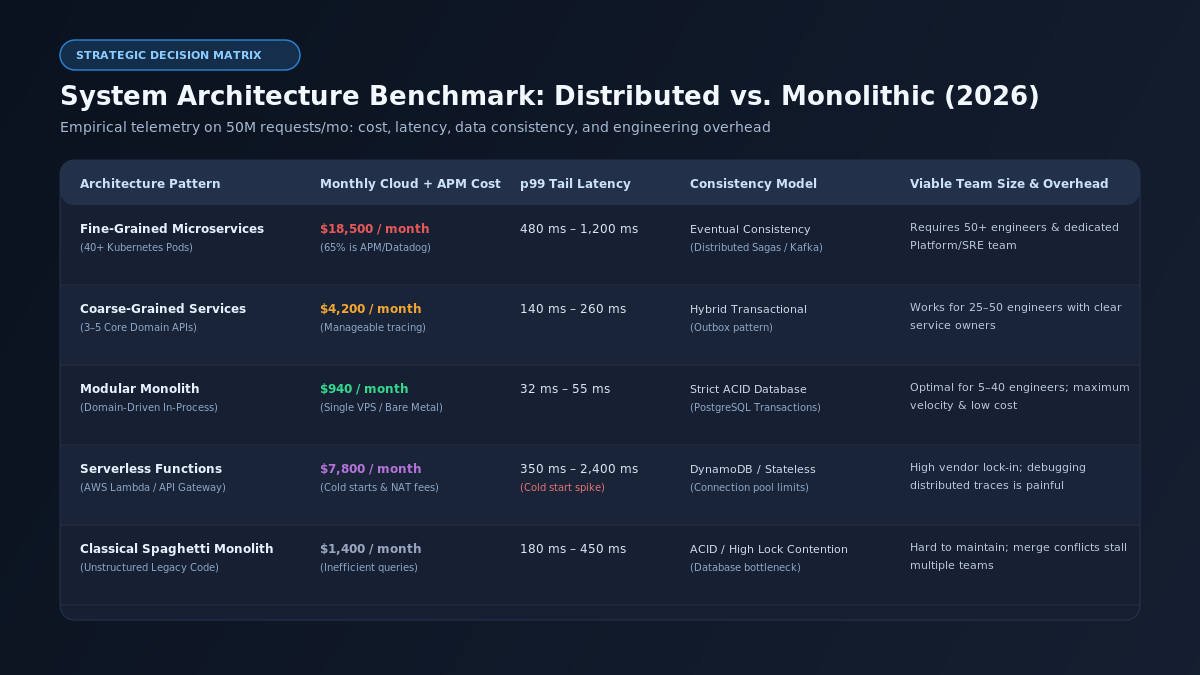
The following decision matrix evaluates the technical and operational realities of software architectures based on empirical production data from engineering teams handling 50 million monthly requests:
Architectural Metric | Fine-Grained Microservices (40+ Pods) | Coarse-Grained Services (3–5 Domain APIs) | Modular Monolith (Single Binary, Domain Packages) | Serverless Functions (AWS Lambda / Gateway) |
Typical Monthly Cloud & Telemetry Cost | $18,500 / month (65% APM/Datadog) | $4,200 / month (Manageable tracing) | $940 / month (Runs on Single VPS / Bare Metal) | $7,800 / month (Cold starts & NAT fees) |
P99 Response Tail Latency | 480 ms – 1,200 ms | 140 ms – 260 ms | 32 ms – 55 ms (In-memory dispatch) | 350 ms – 2,400 ms (Spikes on cold starts) |
Transactional Consistency Model | Eventual Consistency (Kafka Sagas, 2PC) | Hybrid (Transactional Outbox Pattern) | Strict ACID Relational Transactions | Stateless (DynamoDB / External Connection Pools) |
Deployment Complexity | High (Kubernetes, Helm, Istio mTLS, ArgoCD) | Moderate (Docker Compose / Nomad Clusters) | Low (Single Binary Systemd / Docker Container) | Moderate (CloudFormation / Terraform Blueprints) |
Debugging & Root Cause Analysis | Complex (Requires distributed trace sampling) | Moderate (Traces across 3 service boundaries) | Direct (Single local stack trace & unified logs) | Complex (Asynchronous execution timeouts & log fragmentation) |
Optimal Engineering Organization Size | 60+ Engineers with dedicated SRE team | 25 to 50 Engineers across domain units | 5 to 40 Engineers seeking maximum velocity | 5 to 20 Engineers building bursty event hooks |
The migration playbook: dismantling microservices sprawl safely
Engineering teams seeking to escape the microservices trap cannot simply delete existing repositories overnight. Migration back to a modular monolith requires a phased, risk-mitigated technical roadmap.
Four-Phase Monolith Consolidation Roadmap:
Phase 1: In-Process Client Facades --> Replace remote HTTP clients with local interfaces.
Phase 2: Database Schema Unification --> Migrate remote databases into a single PostgreSQL cluster.
Phase 3: Domain Module Extraction --> Import microservice code into domain packages within the monolith.
Phase 4: Traffic Cutover & Decom --> Route ingress traffic to the unified binary and retire old pods.
Step 1: Create in-process client facades
Do not attempt to rewrite business logic during the initial migration phase. Begin by wrapping existing remote microservice clients in internal language interfaces.
If Service A calls Service B via gRPC, define a clean interface in Service A:
type UserDirectory interface {
GetUser(ctx context.Context, userID string) (*User, error)
}
Initially, the implementation of UserDirectory executes the existing gRPC network call. This step establishes explicit contract boundaries in application code, ensuring that business logic is completely decoupled from the underlying transport protocol.
Step 2: Unify data storage into isolated PostgreSQL schemas
The most dangerous step in any architectural migration is data moving. Avoid merging tables into a single shared database schema, as this encourages developers to write cross-domain table joins that destroy domain boundaries.
Instead, provision a single high-performance PostgreSQL cluster (utilizing NVMe storage) and create separate logical schemas for each domain:
-- Establish isolated schema boundaries inside a single database
CREATE SCHEMA orders;
CREATE SCHEMA inventory;
CREATE SCHEMA billing;
-- Permissions can be enforced per role if necessary
GRANT USAGE ON SCHEMA orders TO app_user;
GRANT USAGE ON SCHEMA billing TO app_user;
Use logical replication or continuous CDC (Change Data Capture) pipelines to stream data from old distributed microservice databases into the target schemas. Once replication lag reaches zero, switch application database connections to the unified database.
This architecture preserves strict data isolation while enabling transactional consistency across domains whenever atomic operations are required.
Step 3: Replace network transport with in-memory execution
Once domain data resides in the unified database, replace the remote gRPC client implementation with a direct in-memory service call:
- Import the domain code from the target microservice repository into a structured internal package (such as internal/billing or pkg/inventory).
- Implement the interface defined in Step 1 using direct function calls on the imported package.
- Remove the HTTP and gRPC network serialization layers.
At this point, the cross-service call executes within the same process thread. Latency immediately drops from 25 milliseconds to less than 0.05 milliseconds.
Step 4: Decommission the distributed infrastructure
Once all traffic routes through the consolidated modular binary, retire the supporting distributed scaffolding:
- Delete outdated Kubernetes deployment manifests, Helm charts, and ingress routing rules.
- Decommission distributed tracing span collectors and downscale APM ingestion licenses.
- Remove complex API gateway transformation plugins and custom service mesh proxies.
Engineering teams completing this transition report immediate reductions in on-call paging frequency. Production incidents caused by network timeouts, connection pool exhaustion, and distributed race conditions disappear permanently.
Frequently asked questions (FAQ) for search and answer engines
Why are companies moving away from microservices in 2026?
Companies are moving away from microservices because the operational and financial overhead of distributed systems has exceeded their benefits for most teams. Organizations face compounded p99 tail latency from serial network hops, massive cloud observability bills from distributed tracing vendors, and complex data consistency bugs caused by distributed transactions. Consolidating services into modular monoliths resolves these challenges while reducing cloud costs by 60 to 90 percent.
What is the difference between a modular monolith and a legacy monolith?
A legacy monolith is an unstructured codebase where components can freely access each other's internal variables and database tables, leading to tight coupling and frequent regressions. A modular monolith enforces strict architectural boundaries inside a single deployable binary. Domain modules communicate exclusively through public interfaces and in-process events, maintaining clean separation of concerns without paying the latency and cost penalties of network calls.
How does microservice architecture impact application tail latency?
Microservices increase tail latency through serial network transit, TCP connection handshakes, TLS encryption, and data serialization (JSON or Protobuf). If a single user action requires data from twelve microservices, and each service has a 1 percent chance of experiencing a temporary p99 latency spike, over 11 percent of all user requests will experience severe latency degradation due to compounding binomial probability.
Why is the saga pattern difficult to maintain in production?
The saga pattern coordinates distributed transactions across independent service databases using asynchronous compensation events. It is difficult to maintain because compensating transactions are not atomic rollbacks. If a compensating action fails due to a network timeout or system crash, the database remains in an inconsistent state, requiring custom reconciliation scripts and manual engineering intervention to resolve phantom records.
How did Amazon Prime Video cut costs by 90 percent by moving to a monolith?
Amazon Prime Video originally used a distributed serverless architecture utilizing AWS Step Functions and AWS Lambda to analyze video stream quality frame by frame. The high volume of state transitions and frequent data passing through S3 buckets created massive cloud costs and hit account scaling limits. By moving all video processing logic into a single monolithic service deployed on EC2 and ECS, video frames remained in shared memory, reducing infrastructure expenses by 90 percent.
How do you enforce modular boundaries in a monolithic application?
Modular boundaries are enforced at the programming language and static analysis level instead of through network boundaries. In Go, developers use unexported package types and public interfaces; in Java, developers utilize the Java Module System; and in Ruby or TypeScript, teams use tools like Packwerk or Nx to enforce dependency rules during compilation and CI/CD checks, failing the build if a module accesses private domain logic.
Re-engineer your software architecture with Buzzin Tech
Building scalable software in late 2026 requires eliminating unnecessary distributed complexity. Engineering organizations that trade unmanageable microservices for disciplined modular monoliths ship features faster, maintain sub-50-millisecond response times, and preserve healthy operating margins.
If your engineering team is evaluating an architectural migration, struggling with high cloud observability expenditures, or seeking to modernize legacy software systems, connect with the senior engineering architects at Buzzin Tech to build high-performance software systems designed for sustainable scale.