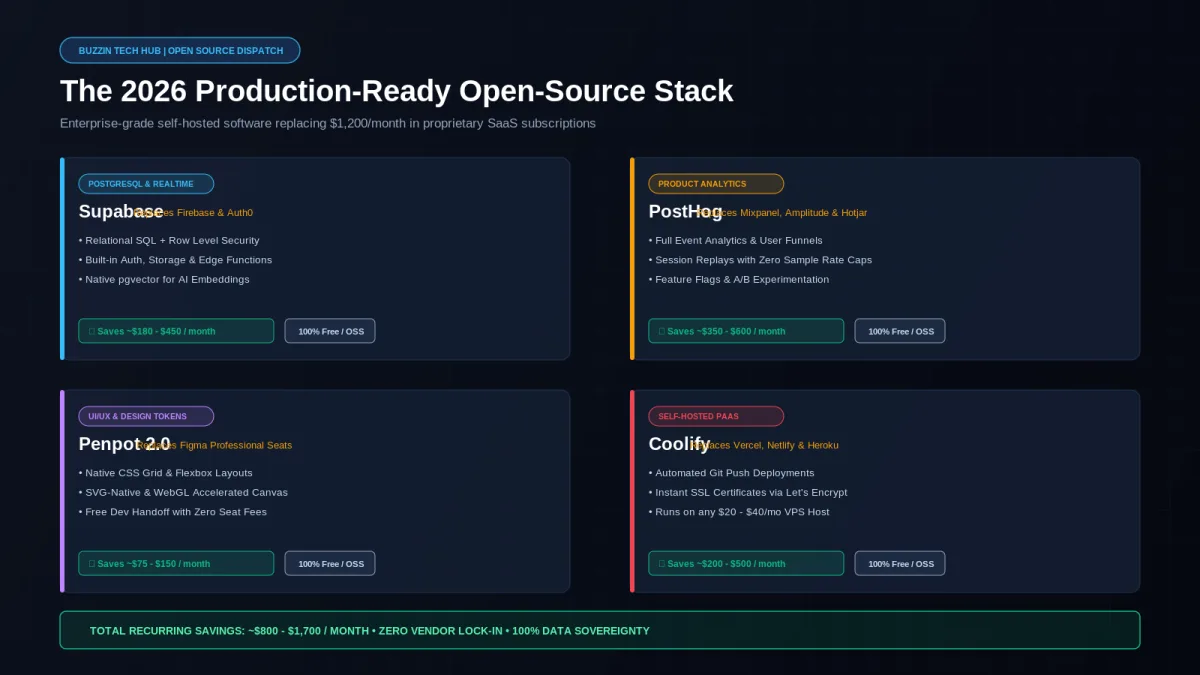
The 2026 self-hosted SaaS stack: five open-source alternatives that replace $1,200/month in proprietary software
Between 2022 and 2025, commercial software-as-a-service (SaaS) platforms adopted usage-based pricing models that penalized business growth. A startup with 50,000 monthly active users frequently found itself paying separate monthly bills for database read operations, event analytics quotas, developer design seats, and continuous deployment bandwidth. These individual subscription line items routinely totaled between $1,200 and $3,500 every month.
By late 2026, the open-source software ecosystem crossed a decisive maturity threshold. Modern open-source projects now ship complete production packaging: containerized Docker Compose configurations, automated database migrations, built-in role-based access control, and active enterprise backing. By self-hosting these five platforms on a single $24-to-$48/month virtual private server (VPS) with 4 vCPUs and 16 GB of RAM, engineering teams gain three primary operational advantages:
- Direct cost containment: Predictable hardware costs replace unpredictable utility bills. You pay for server compute rather than arbitrary event counts or per-seat licensing.
- Full data sovereignty: All user records, telemetry events, and design files remain stored within your own private database network, simplifying compliance with GDPR, HIPAA, and SOC2 regulations.
- Zero vendor lock-in: If your company outgrows a specific hosting provider, you can export your entire infrastructure using standard PostgreSQL dumps and Docker volumes in minutes.
1. Supabase: replacing Firebase, DynamoDB, and Auth0
Google Firebase was long considered the default rapid prototyping platform for web and mobile applications. However, Firebase's NoSQL document structure (Cloud Firestore) introduces two severe long-term engineering hurdles: complex relational data modeling and unpredictable pricing spikes caused by chatty client-side document read operations.
Supabase provides an open-source backend engine built entirely on PostgreSQL. Unlike Firebase's proprietary closed API, Supabase gives developers direct access to a standard relational database paired with auto-generated REST and GraphQL APIs, real-time WebSocket subscriptions, storage buckets, and authentication.
Key technical capabilities in production
- PostgreSQL 18 engine: Takes full advantage of native asynchronous I/O and time-ordered UUIDv7 primary keys, eliminating index bloat on high-volume tables.
- Built-in Row Level Security (RLS): Authorization logic executes directly at the SQL engine level. You define access policies in SQL, preventing unauthorized data access even if application code contains bugs.
- Native pgvector for AI workloads: Stores and queries high-dimensional vector embeddings within the same database as your operational user records, removing the need for a separate vector database like Pinecone.
- Self-hosting cost comparison: Firebase Blaze plans routinely reach $250 to $500 per month for applications serving 50,000 daily users. A self-hosted Supabase instance handles the same workload on a $24/month VPS, saving roughly $2,700 to $5,700 annually.
# Minimal Supabase Self-Hosted docker-compose.yml snippet
services:
studio:
image: supabase/studio:2026.08
restart: unless-stopped
ports:
- "3000:3000"
environment:
STUDIO_PG_META_URL: http://meta:8080
POSTGRES_PASSWORD: ${POSTGRES_PASSWORD}
db:
image: supabase/postgres:18.1
restart: unless-stopped
ports:
- "5432:5432"
volumes:
- db_data:/var/lib/postgresql/data
environment:
POSTGRES_PASSWORD: ${POSTGRES_PASSWORD}
2. PostHog: replacing Mixpanel, Amplitude, and Hotjar
Product analytics platforms like Mixpanel and Amplitude charge aggressively as event volumes climb. Furthermore, connecting separate tools for user funnels, heatmaps, session recordings, and feature flags fragments user context and requires multiple client-side tracking scripts that slow down web performance.
PostHog is an open-source product analytics platform that consolidates user funnels, full session replays, feature flags, A/B testing experiments, and user surveys into a unified application running on ClickHouse and PostgreSQL.
Operational advantages of self-hosting PostHog
- Uncapped session recording: Commercial session recording tools (such as Hotjar or FullStory) force teams to sample only 5 percent or 10 percent of user sessions due to cost. Self-hosted PostHog records 100 percent of user traffic without additional fees.
- Zero ad-blocker interception: When PostHog runs under your own domain (e.g., analytics.buzzintechhub.com), browser ad blockers do not block tracking scripts, recovering roughly 25 to 30 percent of previously lost analytics data.
- Local data residency: Sensitive user interactions and form data remain on your infrastructure, preventing private customer data from reaching external third-party tracking servers.
- Monthly savings: Commercial analytics tiers for 100,000 monthly active users typically cost $350 to $700 per month. Running PostHog on dedicated storage costs only the base disk space.
3. Penpot 2.0: replacing Figma professional seats
Figma's licensing structure has placed severe financial friction on software development agencies and product teams. Figma charges between $15 and $75 per editor seat each month, and recent policy changes restricted developer mode and code inspection behind paid seat tiers. For an agency with ten designers and developers, design tooling alone can cost over $5,000 annually.
Penpot is an open-source design and prototyping platform built from the ground up on open web standards: SVG, native CSS Grid, and Flexbox. Following its major 2.0 line updates, Penpot transitioned its rendering core to WebGL and WebAssembly (WASM), delivering responsive 60 FPS performance on complex UI artboards.
Why Penpot matters for product teams in 2026
- Designs that match actual web code: Traditional design tools use arbitrary coordinate math that developers must translate into HTML and CSS. Penpot uses native CSS Grid and Flexbox rules directly inside the canvas. When a designer aligns elements, the generated layout translates directly to production CSS without interpretation errors.
- Free developer inspection: Developers can log in, inspect typography, copy CSS styles, and export assets with zero paid seat requirements.
- Native design tokens: Penpot manages design tokens (colors, typography scales, spacing variables) natively, allowing teams to sync design tokens directly to Git repositories via automated webhooks.
- Format longevity: All files are stored as standard SVG vectors. If Penpot were ever abandoned, your design assets remain readable by any standard vector editor on earth.
4. Coolify: replacing Vercel, Netlify, and Heroku
Cloud deployment platforms like Vercel and Netlify gained popularity through frictionless git-push deployments. However, their pricing models include heavy markups on serverless execution timeouts, edge bandwidth, and team member seats. Teams scaling Next.js, Remix, or SvelteKit applications frequently see their monthly hosting bills jump from $20 to $600 with little warning.
Coolify is an open-source, self-hosted platform-as-a-service (PaaS) that transforms any plain Linux server into an automated cloud platform. It acts as an open-source alternative to Vercel, Heroku, and Netlify.
Core capabilities of Coolify
- Push-to-deploy workflow: Connects directly to GitHub, GitLab, or self-hosted Gitea. Every time you push to your main branch, Coolify pulls the code, builds the Docker container, and deploys it with zero downtime.
- Automated SSL and domains: Coolify configures Traefik or Caddy automatically, requesting and renewing Let's Encrypt SSL certificates for your custom domains with zero manual configuration.
- One-click database provisioning: Deploy PostgreSQL, MySQL, Redis, ClickHouse, or MongoDB clusters with isolated internal container networks and automated daily volume backups.
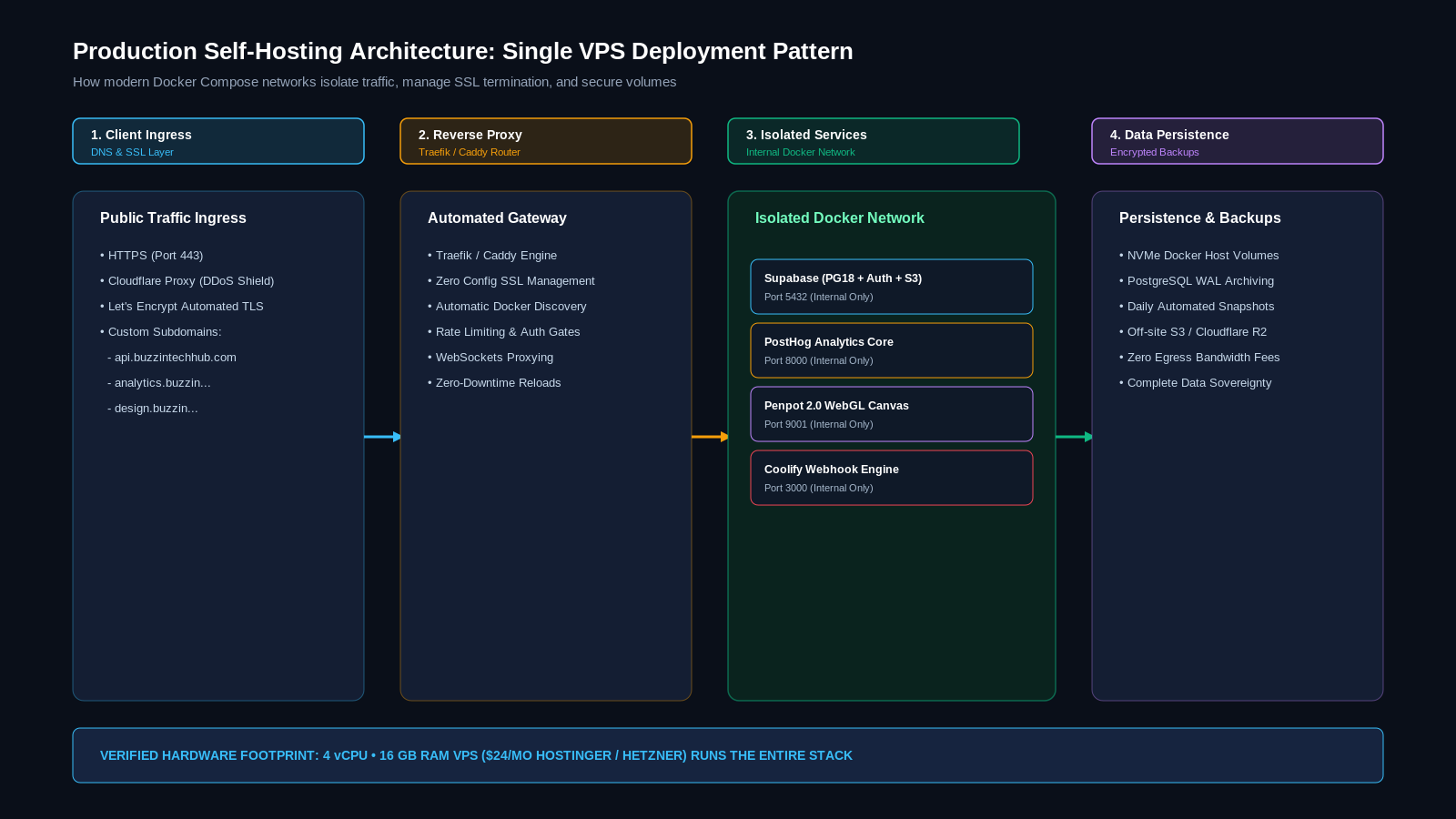
- Hardware cost reality: A $24/month VPS on Hostinger or Hetzner provides 4 vCPU cores, 16 GB of RAM, and 20 TB of free bandwidth. Running five production applications on that server eliminates hundreds of dollars in managed cloud fees.
5. Documenso: replacing DocuSign and Adobe Acrobat Sign
Electronic signatures are a mandatory requirement for agencies, software consultancies, and modern businesses. Commercial platforms like DocuSign and Adobe Sign charge steep per-envelope fees, with standard business plans costing $40 per user per month while imposing annual document limits.
Documenso provides an open-source, legally binding document signing platform. Built with TypeScript and Next.js, it provides public signing links, field assignment (signatures, initials, dates, custom text inputs), audit trails, and cryptographic verification.
Why self-hosting signatures makes business sense
- Unlimited documents: Send thousands of client contracts, non-disclosure agreements, and proposals with zero per-envelope surcharges.
- Complete document privacy: Proprietary contracts and financial terms remain inside your own encrypted storage rather than sitting on a third-party vendor's document cloud.
- REST API integration: Automate document generation and signing requests directly from your internal CRM or admin dashboard without paying thousands of dollars for commercial enterprise API tiers.
Comparative cost and operational analysis
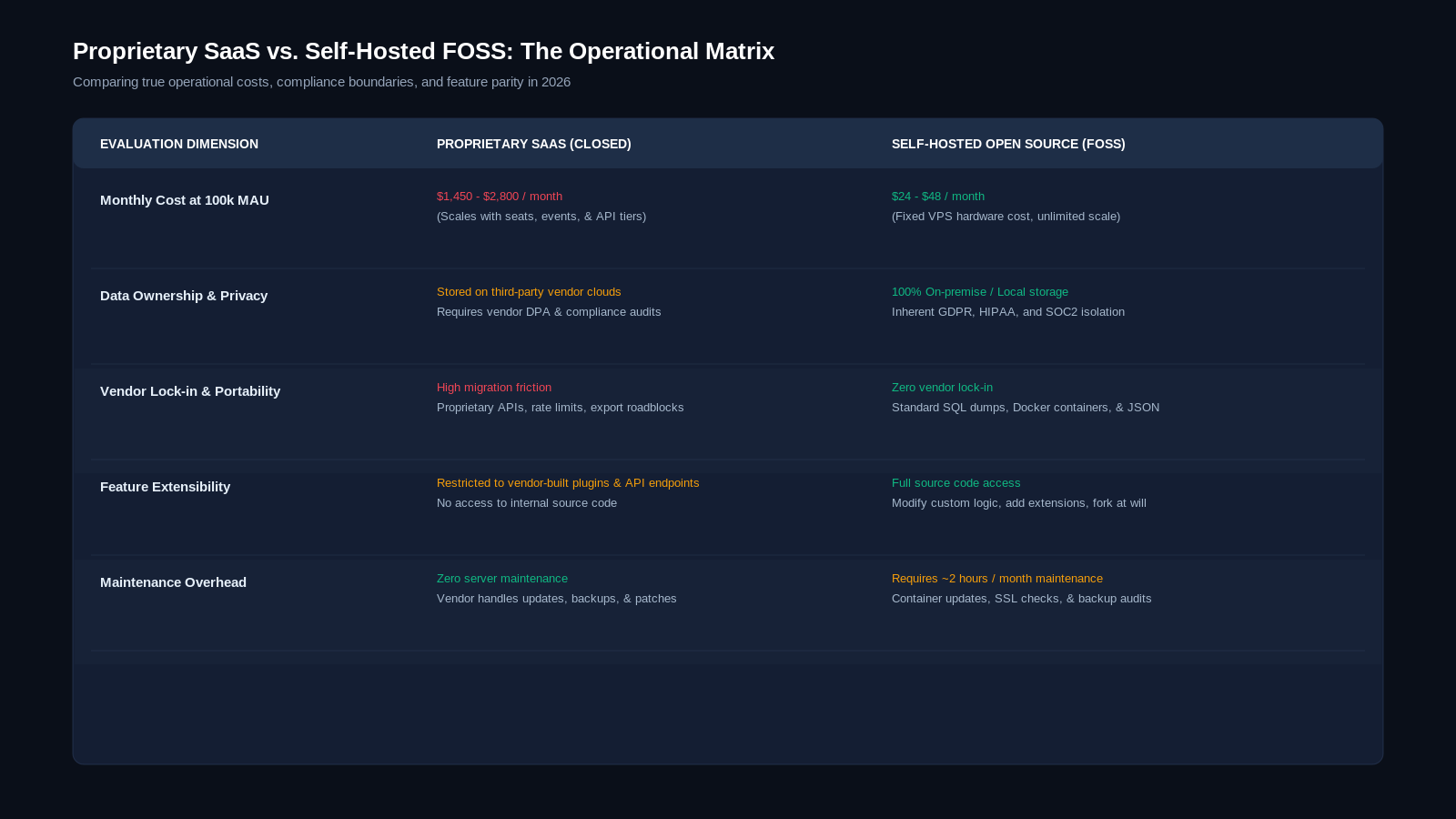
The following table compares the operational realities of running a typical 10-person software product team on closed commercial SaaS tools versus the self-hosted open-source stack:
Function | Commercial SaaS Pick | Open-Source Replacement | Commercial Cost | Self-Hosted Cost |
Database & Auth | Firebase Blaze + Auth0 | Supabase (Postgres 18) | $280 / month | $0 (Runs on VPS) |
Product Analytics | Mixpanel + Hotjar | PostHog (ClickHouse) | $420 / month | $0 (Runs on VPS) |
UI/UX Design | Figma (10 Editor Seats) | Penpot 2.0 (MPL-2.0) | $150 / month | $0 (Runs on VPS) |
App Hosting & CI | Vercel Pro (5 Team Seats) | Coolify (Apache-2.0) | $200 / month | $0 (Runs on VPS) |
E-Signatures | DocuSign Business Pro | Documenso (AGPL) | $160 / month | $0 (Runs on VPS) |
Underlying Infrastructure | Multi-cloud markups | Hostinger / Hetzner VPS | Included above | $32 / month (Total) |
TOTAL MONTHLY SPEND | Net Annual Savings: $14,136 / year | $1,210 / month | $32 / month | |
Practical deployment: the single-server blueprint
Running five self-hosted services does not require a complex Kubernetes cluster. For 90 percent of early-stage software companies and digital agencies, a single dedicated virtual server running Ubuntu 26.04 or Debian 13 handles the entire workload safely.
Recommended hardware sizing
- Compute: 4 vCPU cores (AMD EPYC or Intel Xeon).
- Memory: 16 GB ECC RAM.
- Storage: 200 GB NVMe SSD storage with automated daily snapshots.
- Bandwidth: Unmetered or 10 TB+ monthly allocation.
- Typical cost: $24 to $40 per month across providers like Hostinger, Hetzner, or Contabo.
Three essential security rules for self-hosting
- Keep internal databases off public ports: Never expose database ports (such as PostgreSQL 5432 or ClickHouse 9000) to the public internet. Ensure all database containers communicate strictly through internal Docker bridge networks. Only your web proxy (ports 80 and 443) should touch the public interface.
- Automate off-site volume backups: An on-server backup is not a backup. Configure daily encrypted snapshots using tools like Restic or Borg to push database dumps to independent object storage (such as Cloudflare R2 or Backblaze B2). Cloudflare R2 offers 10 GB of free storage with zero egress fees.
- Use automatic security updates: Enable unattended-upgrades on your host Linux operating system to ensure Linux kernel and OpenSSH security patches install automatically without manual intervention.
Frequently asked questions (FAQ) for search and answer engines
Is self-hosting open-source software legal for commercial businesses?
Yes. Tools licensed under MIT, Apache 2.0, MPL-2.0, and standard AGPL allow commercial organizations to use, host, and run the software for internal and client-facing commercial applications. Only selling the software itself as a closed competing managed cloud service violates certain modern source-available licenses.
How much maintenance time does a self-hosted software stack require?
In practice, a stable Docker Compose stack managed through Coolify requires roughly two hours of maintenance per month. Routine tasks include running docker compose pull to update images, reviewing automated snapshot logs, and applying host operating system updates.
What happens if our self-hosted server experiences hardware failure?
Because modern self-hosted stacks use Docker Compose definitions and automated volume backups, disaster recovery is straightforward. If a server fails, you can spin up a fresh VPS, restore your daily volume snapshot from Cloudflare R2 or S3, and bring the entire stack back online in under thirty minutes.
Can self-hosted open-source software comply with GDPR and HIPAA?
Yes. Self-hosting often makes compliance significantly easier. Because customer records, session recordings, and database tables never leave your private server, you eliminate third-party data processing agreements (DPAs) and international cross-border data transfer concerns entirely.
Does Penpot import existing Figma files smoothly?
Yes. Penpot includes a native Figma importer that translates Figma components, vector shapes, layers, and color styles into open SVG assets. While complex proprietary Figma plugins do not transfer, visual layouts and vector design systems import cleanly.
Can small teams scale PostHog on a single server without performance lag?
Yes. On a server with 16 GB of RAM, a self-hosted PostHog instance utilizing ClickHouse easily ingests and queries up to 5 million events per month without noticeable query latency. Only enterprise organizations processing tens of millions of monthly events need distributed multi-node clusters.
Take control of your technology infrastructure
Software development in 2026 does not require surrendering your company's margins or data sovereignty to proprietary SaaS vendors. The modern open-source stack provides the performance, stability, and polish required to run high-growth applications on your own terms.
If your team wants to design a resilient self-hosted software infrastructure, reduce recurring cloud spend, or build custom web applications on open-source foundations, connect with the technical engineering team at Buzzin Tech to build scalable software that you truly own.