AEO vs SEO is the budget question of 2026: rankings alone no longer measure visibility when nearly half of searches end in an AI answer. This comparison breaks down what each discipline optimizes, where they overlap, and how to split your spend so your brand gets cited and ranked alike.
TL;DR
SEO competes for ranked positions in a list of links. AEO competes for citations inside AI-generated answers. Both matter in 2026.
The fundamentals overlap 80 to 90 percent, so rankings still feed citations.
Clicks keep dropping on queries with AI Overviews, so rank tracking alone now misses half the board.
Spend on the shared foundation first, then add answer-shaped content and off-site presence, and measure citations alongside rankings.
What each one actually optimizes
SEO optimizes whole pages to rank in a list of links that a person clicks. AEO optimizes passages, entities, and answers so AI engines like ChatGPT, Perplexity, Gemini, and Google's AI Overviews can extract them and cite them inside a synthesized answer. The two share fundamentals like crawlability, structured data, and genuinely useful content. They differ in the unit of success: a position versus a citation.
That difference shapes everything downstream. SEO chases keywords and topics; AEO chases natural-language questions and prompts. SEO measures rankings, click-through, and organic sessions. AEO measures citation frequency, brand mentions, and referral traffic from AI platforms. In our search engine optimization work, the shift is visible in the reporting: clients now ask where they appear in AI answers, not just where they rank.
Competition works differently too. In classic SEO the landscape is a gradient: positions one through ten all earn some traffic. In AEO the result is binary: your brand is cited or it is not. That binary outcome is why teams that treat AEO as a line item inside SEO keep misjudging the scoreboard.
The click data that forced the question
The budget question only exists because behavior changed. Pew Research found people clicked a result 8 percent of the time when an AI summary appeared, against 15 percent without one. Ahrefs measured a 58 percent lower click-through rate for top-ranking pages when an AI Overview appeared above them. One analysis put the share of US Google searches ending without a click at 58.5 percent in 2024, and AI Overviews now appear on roughly 43 percent of US Google searches.
There are two sides to the data. Seer Interactive tracked organic click-through on AI-Overview queries falling from 1.76 percent to 0.61 percent, then recovering to 2.4 percent by February 2026. Seer also found that brands cited inside AI Overviews earned 35 percent more organic clicks than uncited brands. In other words, the answer does not destroy the channel. It redistributes the clicks toward the brands it cites.
That redistribution is the whole argument for AEO. Google says AI Overviews now have over 2.5 billion monthly active users, and its guidance for site owners is that clicks from AI experiences run higher quality, with visitors more likely to spend time on the site. Fewer clicks, better clicks, and a strong advantage to cited brands: that is the 2026 scoreboard.
Where the two overlap (and why the foundation still matters)
Here is the part that keeps SEO from becoming obsolete. An industry breakdown of Google's AI Optimization Guide confirms the core point: Google's own guidance is that its AI features run on core Search ranking systems, and practitioners put the overlap between the two disciplines at 80 to 90 percent of the same tactics. Answer engines still depend on search indexes to discover candidate pages, so a site Google cannot crawl or rank rarely shows up in AI answers either.
Google has said plainly that there are no extra requirements to appear in AI Overviews: a page has to be indexed and eligible for a snippet under the standard rules. Its May 2026 AI Optimization Guide told publishers they do not need llms.txt files, chunked content formats, or over-indexed structured data. The advice was the familiar set: unique, non-commodity content, a reachable page, structured data that matches what is visible, clear headings and paragraphs, and strong images and video.
Think of SEO as the entry ticket and AEO as the difference between being retrieved and being quoted. A playbook we wrote for small brands on generative engine optimization covers the same ground: the brands that win citations are usually the ones that already rank. One field study put 92 percent of AI Overview citations on pages already in the organic top ten. The ranking is the raw material; AEO is the shaping.
Where they split: the work that belongs to each side
The split starts at the content level. SEO favors long-form topic clusters built around keywords. AEO favors short, direct answer blocks placed high on the page: one passage that states the answer in 40 to 60 words, then expands. Headings work better as questions than as service names, because conversational headings match how people search and how AI systems scan for sections.
Schema priorities shift too. SEO leans on titles and meta descriptions. AEO leans on FAQPage, HowTo, Article with dateModified, and Organization markup, kept in sync with what the page actually shows. Recency matters more: AI systems prefer recently refreshed content, so flagship pages need quarterly updates, not annual ones.
Then there is the off-site half of AEO, which classic SEO teams usually ignore. AI engines cite heavily from third-party sources. Field research attributes ChatGPT's citations largely to Wikipedia, and Perplexity's to Reddit. A brand with strong entity signals gets cited more often even when the specific page has fewer backlinks. That means the work moves beyond your own site: consistent terminology everywhere you are mentioned, expert bylines on publications AI engines already trust, and real participation in the communities your buyers read.
Measurement is the final split. Rank tracking cannot see AI answers. AEO needs repeated prompt sampling across engines, tracking citation rate, brand mention rate, and AI referral traffic as separate metrics. Google now ships a Generative AI performance report in Search Console showing generative-AI impressions by page, country, device, and date, which gives teams their first official lens into the answer layer.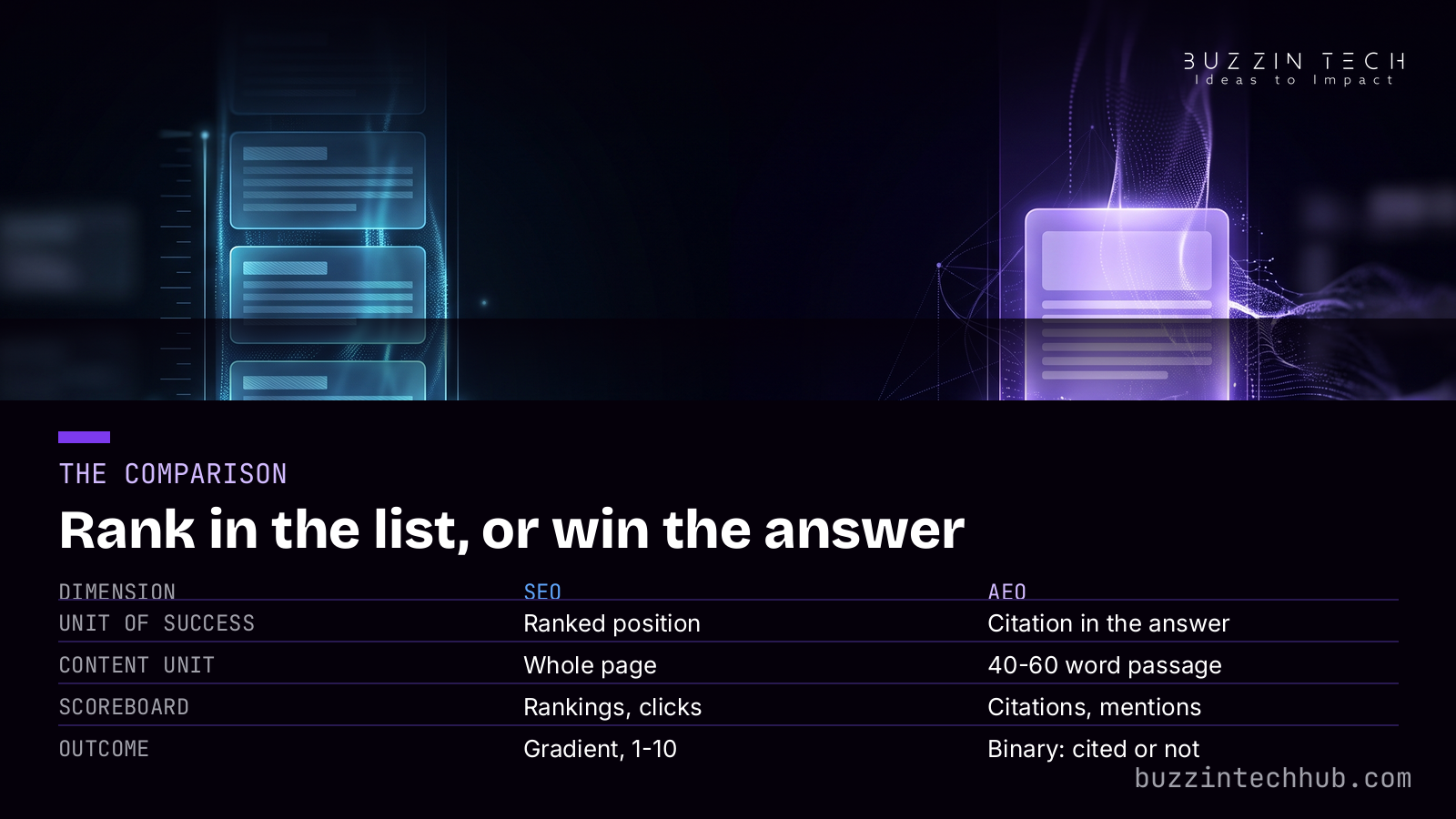
How to split your search budget this quarter
The honest answer: most of your budget stays where it was. Start with the shared foundation and fund it fully, because nothing else works without it. Technical health, crawlability, page experience, and a real content operation remain the highest-return spend. If that foundation is weak, every dollar aimed at AI visibility is a tax on a broken base.
Spend the next slice on answer-shaped content. Take the pages that already rank for question-style queries and rewrite their openings: state the answer in the first paragraph, put the key facts in extractable blocks, add FAQ sections with direct 40-to-80-word answers, and refresh the dateModified data. This is repackaging, not a rebuild, and it is the cheapest AEO win available.
Spend the final slice on off-site presence. Pick the engines your buyers actually use and work one platform per quarter: Wikipedia and industry press for ChatGPT, Reddit and community depth for Perplexity, Bing index health for Copilot, and top-ten rankings plus schema for AI Overviews. Trying to win all four at once produces generic content that wins nowhere.
The ratio moves with your situation. A local service business with zero AI-answer exposure can run 80/15/5: foundation, answer shaping, off-site. A B2B SaaS company whose buyers research in ChatGPT and Perplexity should tilt harder, maybe 60/25/15, because Perplexity referral traffic has been measured converting at roughly 11 times the rate of traditional organic search. The traffic is smaller and the intent is sharper.
One caution before you spend anything: do not buy the hacks. There is no shortcut markup, no secret file, and no chunking ritual that replaces the foundation. When a vendor sells you AI visibility as a separate black box, ask them what happens to your citations if your rankings drop. If they cannot answer, keep your money.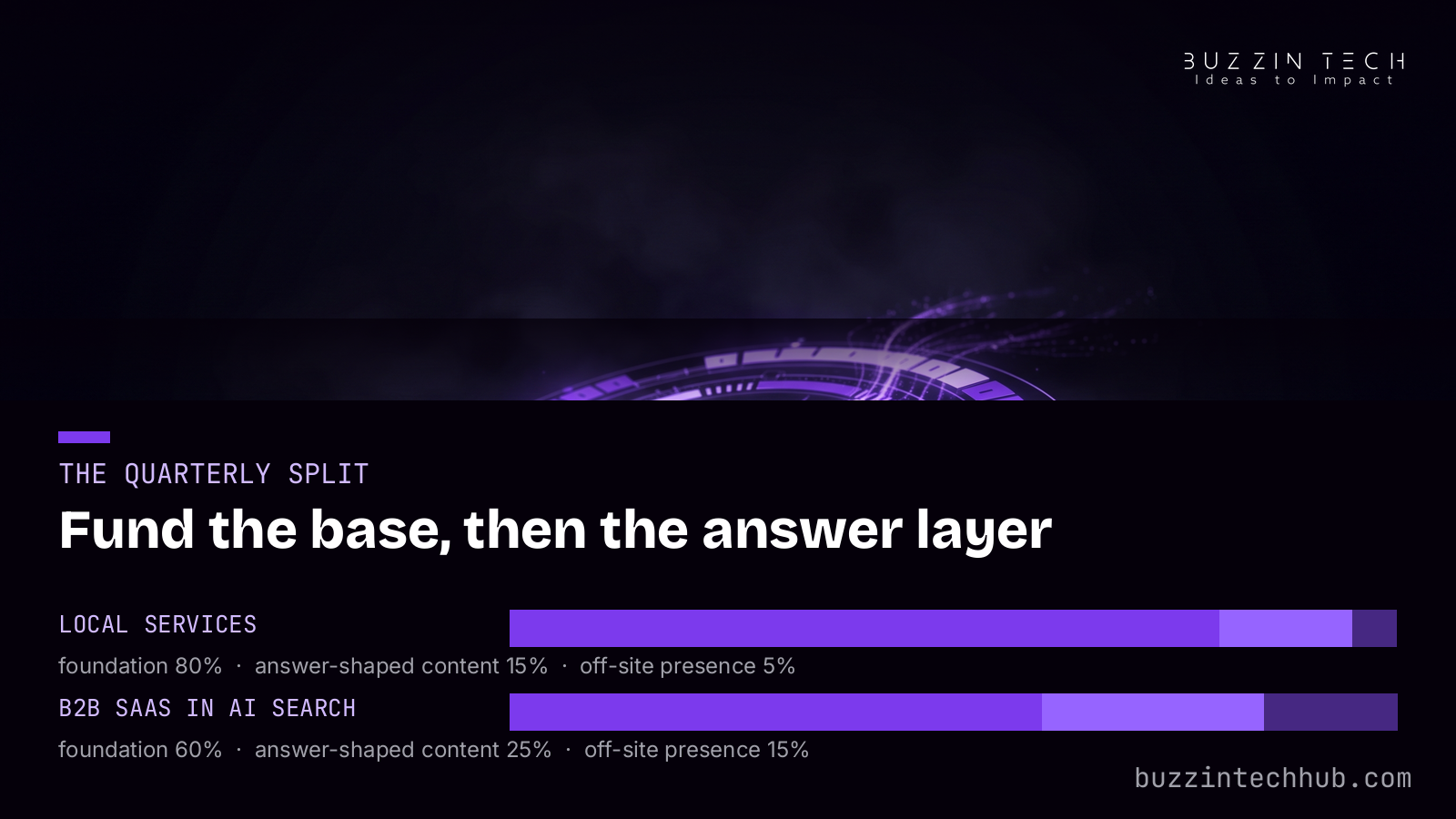
What good looks like when both fire together
The end state is simple: your page ranks in the top ten and your passages get cited in the answer above it. That is the compound position. The ranking drives the clicks that still convert; the citation puts your brand in front of everyone who never scrolls. Seer's finding is the proof: cited brands earned 35 percent more organic clicks than uncited ones on the same queries.
Getting there is a process, not a project. We run it the way we run everything: discovery and architecture first, so the content model supports extraction; design and prototyping so answer blocks read well for humans too; engineering and build for the schema, performance, and indexation layer; then deployment and scaling with quarterly refreshes and prompt-level measurement. It is the same four-step methodology behind how we rebuilt Ecovers' site into a fast, lead-generating engine with its SEO, automation, and blog admin panel.
AEO does not replace SEO in 2026. It extends it onto a second scoreboard. The brands that treat the two as one system, funded from one budget, keep the rankings they earned and collect the citations their competitors leave on the table.
Not sure how your brand shows up in AI answers right now?
We audit your current rankings, your AI-answer presence, and the off-site signals engines cite, then hand you a quarter-by-quarter plan that fits one budget.
See how we run search and AI visibility
Frequently asked questions
Is AEO replacing SEO in 2026?
No. AEO extends SEO onto a new surface rather than replacing it. Google's guidance is that its AI features run on core Search ranking systems, and practitioners put the tactical overlap at 80 to 90 percent. What changes is the scoreboard: a growing share of searches now ends in an AI answer instead of a click, so rankings alone no longer measure your visibility. Most brands need both.
What does AEO work cost compared to SEO?
It is usually an increment on an SEO budget, not a second one. The shared foundation (technical health, content, authority) is the same spend. The AEO increment goes to answer-shaped rewrites, schema and refresh cycles, off-site presence on cited sources, and prompt-level measurement. Teams with a solid SEO base often run the AEO layer at 15 to 25 percent of the total search budget.
Can a small site win AI citations without big domain authority?
Sometimes, on narrow questions. AI engines cite passages that answer precisely, so a small brand can win specific prompts with direct, well-structured answers and strong topical focus. But citation overlap with the organic top ten is high for Google's AI Overviews, so authority still helps. Small brands should pick a tight set of questions and own them completely rather than chasing everything.
Which schema matters most for AI answers?
FAQPage and HowTo carry the most weight for extractable answers, with Article (including dateModified) and Organization close behind for trust and attribution. The rule Google enforces is that markup must match what the page visibly shows. Schema that describes hidden or mismatched content is a liability, not an asset.
How do you measure AEO results?
Track citations and brand mentions through repeated prompt sampling across the engines your buyers use, plus AI referral traffic in analytics. Google's Generative AI performance report in Search Console now shows generative-AI impressions by page, country, device, and date. Keep rank tracking running alongside it: the two scoreboards together tell you whether you are winning positions, citations, or both.
Should we block AI crawlers to protect our content?
For most businesses, no. Blocking removes you from the answer layer entirely, and the data shows cited brands earn more organic clicks, not fewer. Reserve crawler blocks for genuinely sensitive or paywalled content. If the concern is AI training rather than search answers, handle it with the specific training crawlers, not the search ones that feed visibility.
More from Buzzin Tech Hub
Read our Tuesday Growth piece: Generative Engine Optimization: A Small-Brand Playbook
Browse the archive: Buzzin Tech Hub blog