Generative engine optimization is the discipline of getting your brand cited inside AI answers — Google's AI Overviews, AI Mode, ChatGPT, Perplexity. The clicks those answers keep are not coming back. But the citation slots are open to anyone, and small brands can win them with sharper passages, not bigger budgets.
TL;DR
- Seer measured a 61% organic CTR drop on AI Overview queries; Ahrefs found the top result loses 58% of clicks when an AI Overview appears.
- Google says normal SEO fundamentals still matter for AI Overviews and AI Mode. GEO extends SEO; it does not replace it.
- A KDD 2024 study found quotations lift AI visibility 41% and statistics 36%. Passages win over domain size.
- The playbook: map buyer prompts, write answer-first blocks, publish checkable facts, earn mentions, measure citations.
The clicks AI answers keep are not coming back
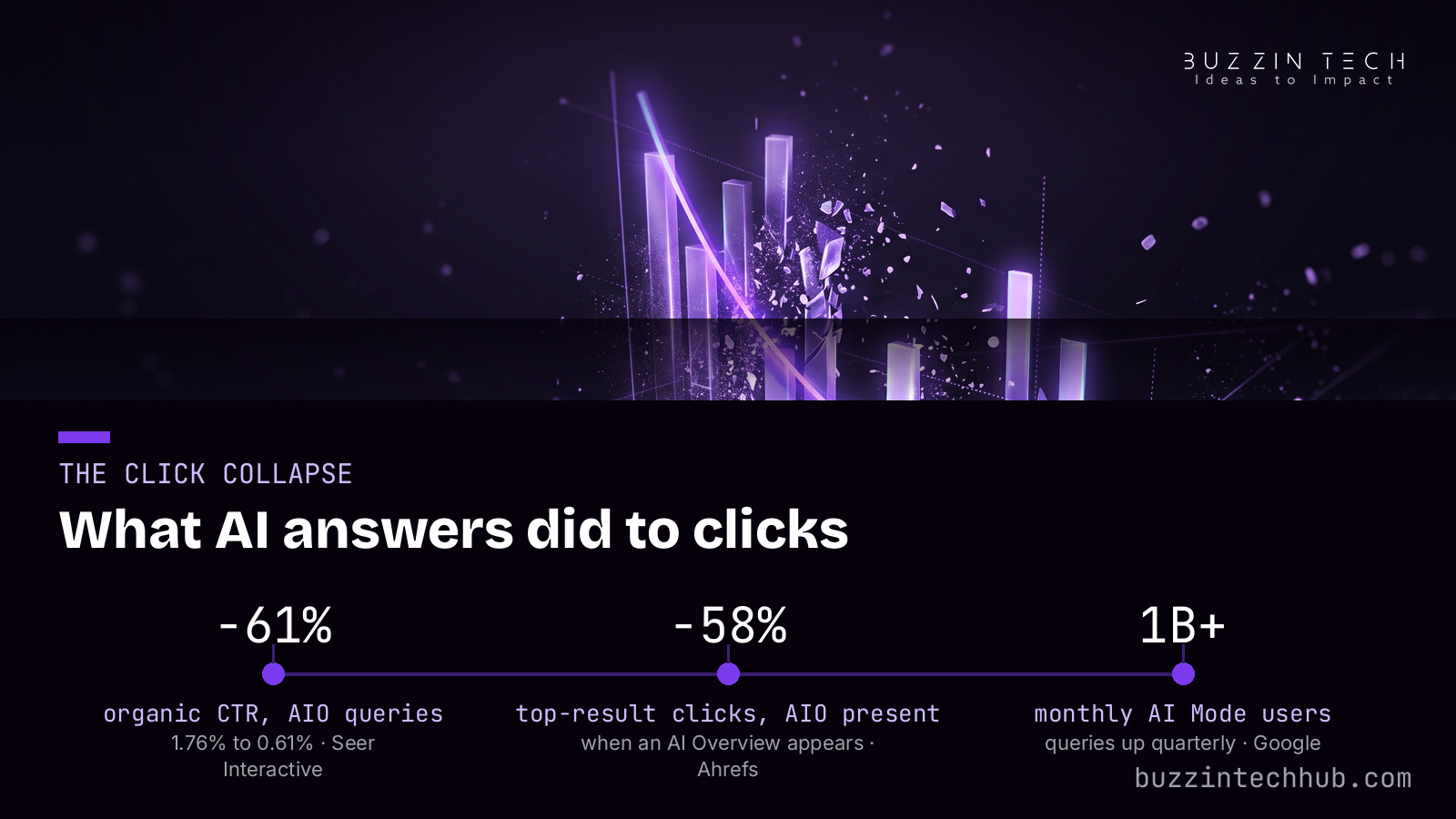
Start with the measurements, because they set the stakes. Seer Interactive analyzed 3,119 informational queries across 42 organizations — 25.1 million organic impressions from June 2024 to September 2025 — and published the results in November 2025. On queries showing an AI Overview, organic CTR fell from 1.76% to 0.61%, a 61% drop. Paid CTR on the same queries fell 68%, from 19.7% to 6.34%. Even queries without AI Overviews lost 41% of their clicks year over year. That is the problem our organic growth team watches every week: the interface changed, and the old traffic model went with it.
Ahrefs ran the same comparison on 300,000 keywords and found the top-ranking page earns 58% fewer clicks when an AI Overview appears (February 2026 study, December 2025 data). Pew Research tracked 900 real US adults in March 2025 and found they clicked a traditional result on 8% of visits with an AI summary, versus 15% without one.
Meanwhile the audience inside AI answers keeps growing. Google disclosed at Google I/O 2026 that AI Mode passed one billion monthly users, with queries doubling every quarter. AI Overviews reach 2.5 billion monthly users. The buying question behind all of this is simple: when the answer appears on Google's page, who gets named as the source? That naming is now the ranking.
Google published the rulebook this month
This is not a eulogy for SEO. Google's own guidance on generative AI in Search says the same thing it has always said: publish valuable, unique, non-commodity content, and know that normal SEO fundamentals remain relevant to AI Overviews and AI Mode. The fundamentals did not die. They gained a new surface.
What changed is the trust bar. Google tightened its written guidance in October: it now says it is critical to manually fact-check and review AI-generated content for accuracy and trustworthiness before publishing — and that review extends past the body copy to page titles, meta descriptions, structured data, and image alt text. Industry coverage of the same guidance notes that fabricated author profiles now count as deception.
The timing matters. Google's September 2026 spam update finished rolling out on October 8 — at 13 days and 16 hours, the longest spam rollout of the year, applied globally and to all languages. Google did not say what the update targeted. But it landed in the same quarter as the fact-checking guidance, and the message from both is the same: checkable, trustworthy content survives; vague, unverifiable content does not.
Small brands hold the structural edge
Here is the finding that makes this a playbook instead of a warning. In a peer-reviewed KDD 2024 study (Aggarwal et al., arXiv:2311.09735), researchers tested what actually earns a citation inside AI-generated answers. Content with authoritative quotations gained 41% more AI visibility. Content with specific statistics gained 36%. Traditional tactics like keyword stuffing had minimal or negative effect. Generative engines weight the quality of the passage, not the seniority of the domain.
That finding has a second witness. Azoma analyzed millions of shopping citations across AI answers in Q2 2026 and found 41% came from retailers, 37% from earned media, 15% from brand.com, and 7% from user content. Earned media gets cited more than twice as often as the brand's own site. Nobody trusts a brand that only cites itself, and neither do the models.
And the payoff for being cited is concrete. Seer's April 2026 update measured per-million impressions on informational queries: about 33,500 clicks with no AI Overview, about 20,700 when the brand was cited, about 9,400 when it was not. Being cited earns 120% more organic clicks than sitting outside the answer. You cannot opt out of the AI Overview. You can decide which side of that gap you land on.
The honest version of the opportunity: you cannot outspend a big domain on link building, but you can outwrite one on a single passage. Small teams ship faster. The brand that publishes the single best answer to a narrow buyer question — with a quote, a number, and a source — takes the citation. We saw the same mechanic in the insurance broker website we rebuilt for Ecovers: narrow pages, clear answers, and checkable claims beat broad, vague ones.
The 8-step GEO playbook
None of this requires new tooling. It requires writing and structuring content the way answer engines consume it. Work through the steps in order; each one compounds the last. (For the October context on the rest of tech, see our roundup of the five problems tech brought into October.)
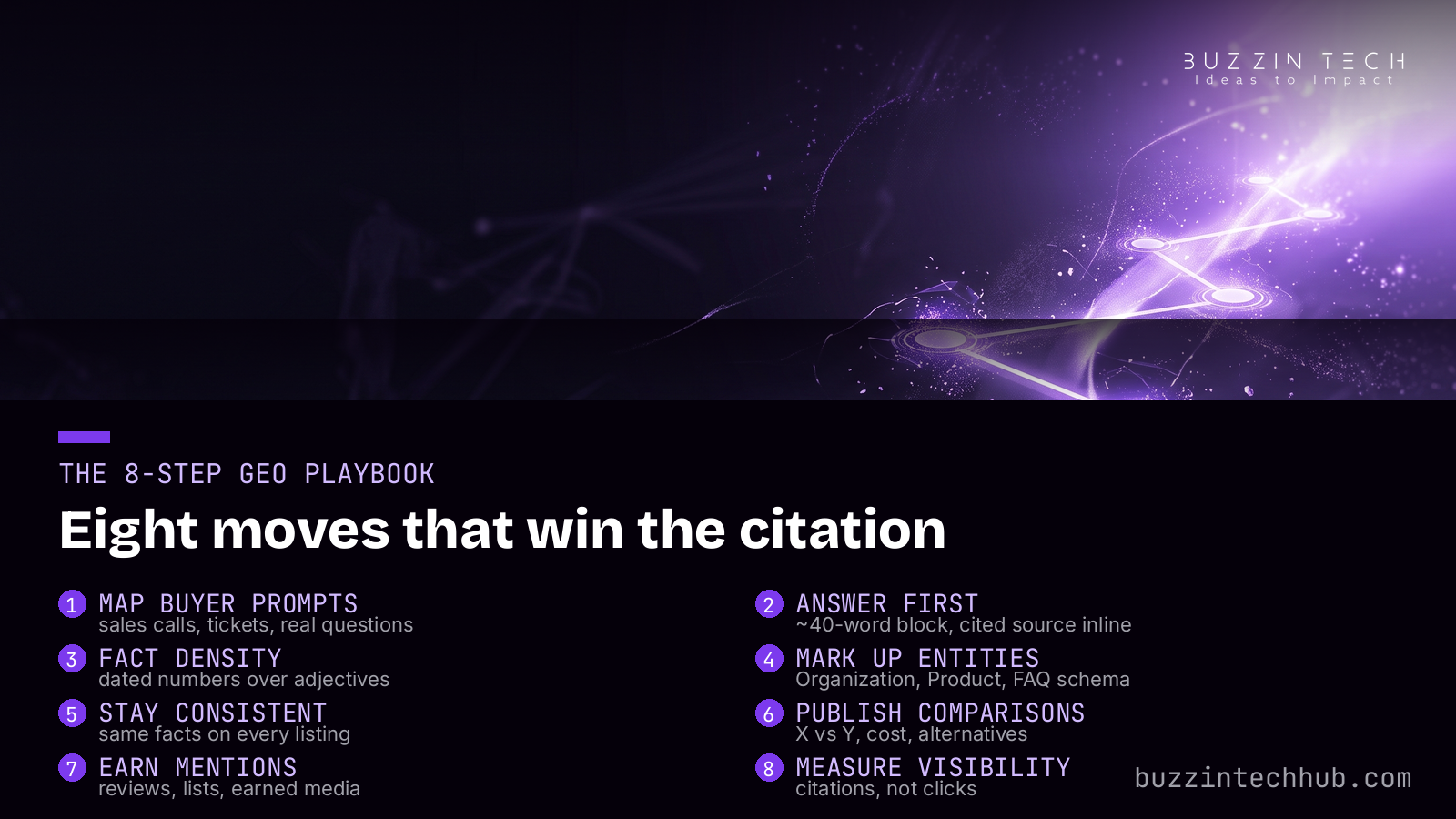
1. Map buyer prompts, not keywords. Pull the actual questions from sales calls, support tickets, and demo requests. AI Mode fans one question out into many sub-queries and answers each; own the cluster, not the keyword. If three prospects asked it this month, it belongs on your site.
2. Answer first, in about 40 words. Put the direct answer in the first paragraph under each heading, then the explanation. Keep the answer block self-contained with a cited source inline. Engines quote the block; readers click for the depth.
3. Trade adjectives for numbers. Replace "fast," "leading," and "best-in-class" with dated, checkable figures: dates, prices, percentages, sample sizes. Fact density is what gets quoted — the KDD study's 36% lift came from statistics, not superlatives.
4. Mark up the entities. Use Organization, Product, Article, and FAQ schema so machines can tell your company, your product, and your claims apart. Be honest about what schema does: it helps eligibility and disambiguation. It does not force a citation. The quotation does that.
5. Keep every fact identical everywhere. Name, address, phone, prices, specs, and product descriptions should match across your site, Google Business Profile, directories, and social bios. Entity consistency is the boring half of the job, and it decides whether the model trusts you.
6. Publish the comparisons buyers actually search. "X vs Y," "how much does X cost," "X alternatives" — decision tables and FAQ pairs. AI answers assemble from several pages, and the comparison page is the one they quote when a buyer is choosing.
7. Earn mentions where models look. Reviews, industry lists, partner pages, earned media, cited in research. Remember the Azoma split: earned media out-cites brand.com two to one. Third-party validation is a ranking factor in the answer, not just in the SERP.
8. Measure citations, not clicks. Track citation presence per buyer query, brand mentions across engines, branded search volume, and assisted conversions. CTR now reflects interface friction more than audience interest. Seer's advice is blunt: metrics shift from clicks to visibility and share of voice.
Reporting has to change too
Most marketing reports still open with sessions and click-through rate. That worked when the click was the unit of attention. The unit now is the citation.
A GEO report tracks four things: whether your brand appears in AI answers for its buyer questions, whether it appears as a cited source or an uncited mention, whether branded search is growing, and whether assisted revenue holds as direct clicks fall. Pair the AI-visibility numbers with the ones you already report — pipeline, close rate, deal size — and the story reads fine without the traffic chart at the top.
How we run it
Our process runs the same four steps on every engagement: 01 Discovery & Architecture, 02 Design & Prototyping, 03 Engineering & Build, 04 Deployment & Scaling. On a GEO engagement, discovery is prompt mapping and a citation audit against the competitors already in the answers. Design is answer-first content architecture. Engineering is the schema, the fact-density rewrites, and the entity cleanup. Deployment is the measurement dashboard and the publishing cadence. Senior engineers and marketers do the work; there is no account-manager layer in between.
Want your brand named in the AI answers?
We run GEO audits that map the buyer questions you should own, find where competitors already get cited, and ship the answer-first pages that take the slots.
See how we grow organic search
Frequently asked questions
Is SEO dead in 2026? No. Clicks are down — Seer measured a 61% organic CTR drop on AI Overview queries — but Google says normal SEO fundamentals still matter for AI Overviews and AI Mode. What changed is the unit of success: the citation matters more than the click. GEO is an extension of SEO onto a new surface, not a replacement for it.
What exactly is generative engine optimization? The discipline of making your brand citable inside AI-generated answers: Google AI Overviews, AI Mode, ChatGPT, Perplexity. Classic SEO optimizes for ranking positions; GEO optimizes for being quoted, with quotations, statistics, and clear entity markup doing most of the work.
How long does GEO work take to show results? Faster to test than classic SEO, slower to compound. Ahrefs found AI Overview citations are volatile — cited sources last about 2.15 days and 45.5% of sources are new at each observation — so experiments read out quickly. Durable visibility across a prompt cluster takes weeks of consistent publishing and measurement.
Does schema markup guarantee AI citations? No. Schema helps search engines disambiguate your entities and qualifies pages for rich results, and Google's own guide does not require it for AI features. The KDD 2024 study is clear on what moves the needle most: authoritative quotations and specific statistics. Markup supports the content; it does not replace it.
Can a small site beat big domains in AI answers? Yes, and the data says it happens regularly. The KDD 2024 paper found passage quality decides citations more than domain seniority, and Azoma's analysis showed earned media cited more than twice as often as brand.com. Publish the single best passage for a narrow buyer question and you take the slot.
Should we stop publishing blog content? The opposite. Google's guidance asks for valuable, unique, non-commodity content — the kind only a company with real experience can write. Commodity explainers that AI could generate anyway add nothing. First-hand data, real numbers, and honest answers are the content the engines need to quote.
More from Buzzin Tech Hub
- AEO vs SEO in 2026: Where to Spend Your Search Budget — last week's Growth comparison on splitting your search budget between rankings and citations.
- Google AI Mode update: what the October changes mean — how Google's October 15 update changed link visibility inside AI answers.
- Browse the full Buzzin Tech Hub blog