AI automation vs hiring staff cost comparison starts with a number Parklane Group could not ignore: 14 hours. That was the gap between an inquiry arriving after hours and a leasing agent answering it. The fix was an AI assistant that answers in under 20 seconds, qualifies the lead, and books the viewing.
TL;DR
- Parklane Group waited 14 hours to answer after-hours rental inquiries. High-intent renters signed with competing landlords first.
- We built an AI assistant that qualifies leads against five leasing parameters and books viewings into the CRM and calendar.
- Median response fell under 20 seconds. 68% of inquiries self-resolved. Confirmed viewings rose 3.4 times in the first 90 days.
- A single scoped workflow starts at $1,499. The honest limit: automation handles the repeatable 80%.
The 14-hour gap that cost viewings
Parklane Group manages a large portfolio of residential and commercial rental properties. Inquiries arrive late at night, on weekends, and from overseas time zones. Prospects expect an immediate answer on rental rates, deposit structures, parking, and viewing slots.
This is the exact problem our AI custom automations work is built to remove: the routine triage that keeps senior staff from the work only they can do.
Before the build, human leasing agents fielded every inbound chat, web form, and portal query by hand. That setup created two bottlenecks. Inquiries received outside business hours sat unattended until the next morning, a 14-hour speed-to-lead lag.
High-intent renters looking at competing listings signed lease agreements with other landlords before Parklane agents could reply.
The second bottleneck was repetition. Over 70% of inbound messages were basic questions about pet policies, utility inclusions, and square footage. Senior leasing consultants spent hours retyping factual brochure details instead of closing in-person lease viewings.
The work was necessary, and it was the wrong use of the people doing it.
Five questions decide whether a lead is real
We started with the record, not the model. The team analysed over 1,200 historic tenant chat transcripts to map real intents, friction points, and drop-off patterns. That analysis produced five mandatory parameters.
No inquiry counts as sales-qualified until the assistant holds all five: target move-in date, monthly budget ceiling, bedroom count, employment verification status, and pet requirements.
The assistant gathers them the way people actually talk. It uses natural language processing to extract parameters from fragmented sentences, even when a tenant mixes several requirements into one message. A tenant who writes "Looking for a 2-bed under 2500 next month with a cat" gives four data points at once, and the parser takes all four without asking four separate questions.
A state machine, not a chatbot
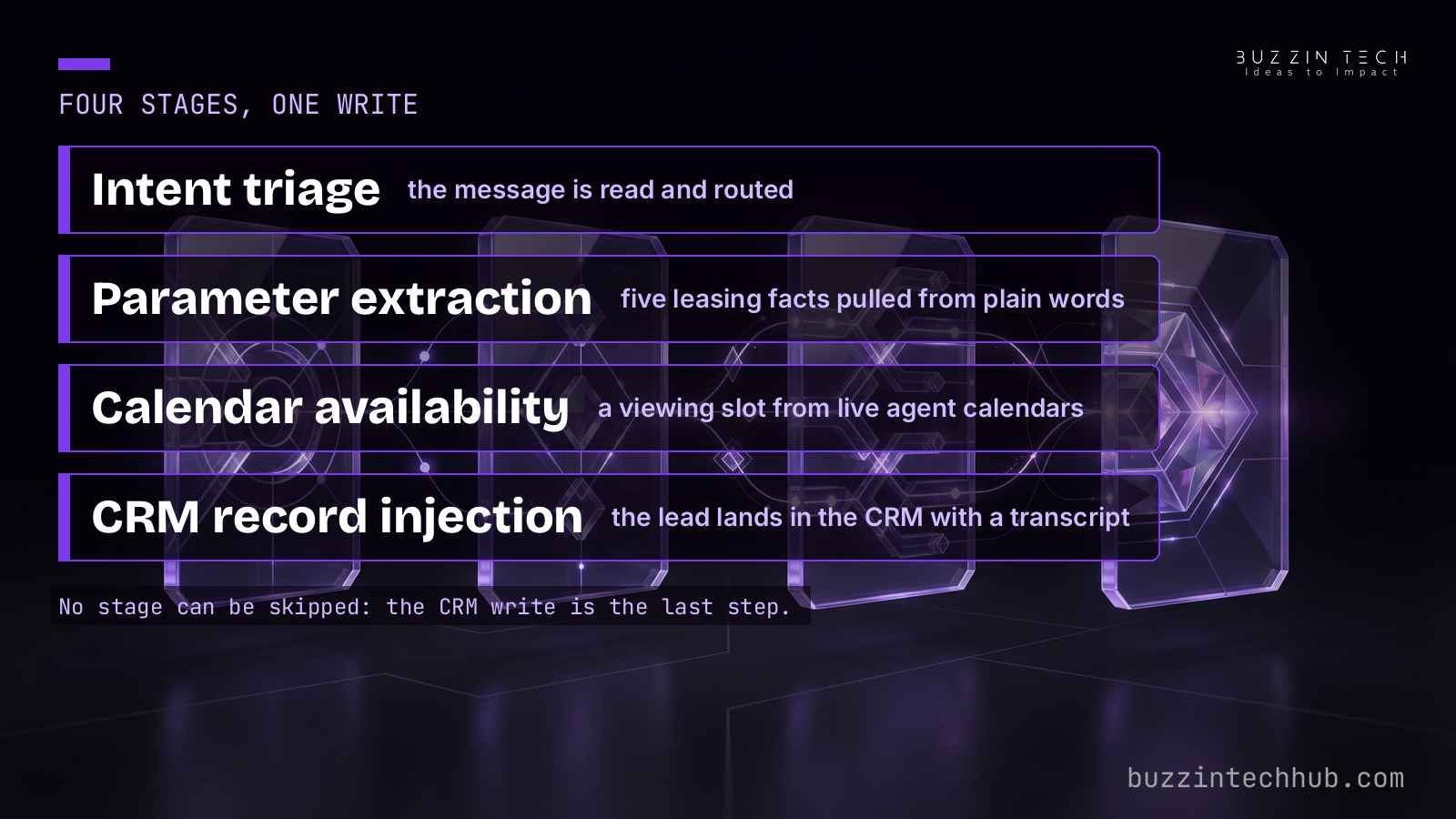
The assistant runs on a deterministic four-stage decision state machine: intent triage, parameter extraction, calendar availability, then CRM record injection. Each stage has one job, and the conversation cannot reach the CRM write until the earlier stages hold what they need. That is the same discipline our post on AI agent reliability sets out: grade the record after the run, not the reply.
The knowledge behind the answers is a RAG property knowledge base on PostgreSQL pgvector, holding verified unit inventories, rent prices, floor plans, and building bylaws. The model is constrained to that authoritative store, so it never guesses a price. The assistant also handles inquiries in English, Arabic, and Urdu, matching the tenants and investors who write in.
Guardrails sit on top. Sentiment analysis flags frustrated users, and edge cases such as corporate relocation packages trigger an immediate transfer to on-duty staff with full context. The assistant escalates; it does not improvise.
The build uses structured function calling so the model returns parameters in a fixed JSON Schema, and the pgvector store keeps retrieval inside verified records.
Wired into the CRM and the calendar
The assistant is a dedicated Python FastAPI backend, not a chat widget bolted onto a page. It interfaces with the OpenAI GPT API through structured function calling, streams tokens in under 1.5 seconds, and keeps conversation state in Redis session caching across page refreshes and multi-step dialogs.
It is wired directly into Parklane Group's internal CRM and the leasing agents' Google and Outlook calendars. Prospects pick viewing windows from real-time agent availability, with no phone tag.
Each qualified lead lands in the CRM as a contact card with contact details, move-in timeline, budget tier, and the full conversation transcript. Automated SMS confirmations send calendar invites and directions to the property two hours before the viewing.
The full build is documented as a case study on our projects page.
What changed in the first 90 days
The numbers come from the published project record. Median response time fell under 20 seconds, against the 14-hour lag before the build. Inquiries now get an instant answer 24 hours a day, and 68% of them self-resolve: routine policy, pricing, and availability questions answered with no human staff involved.
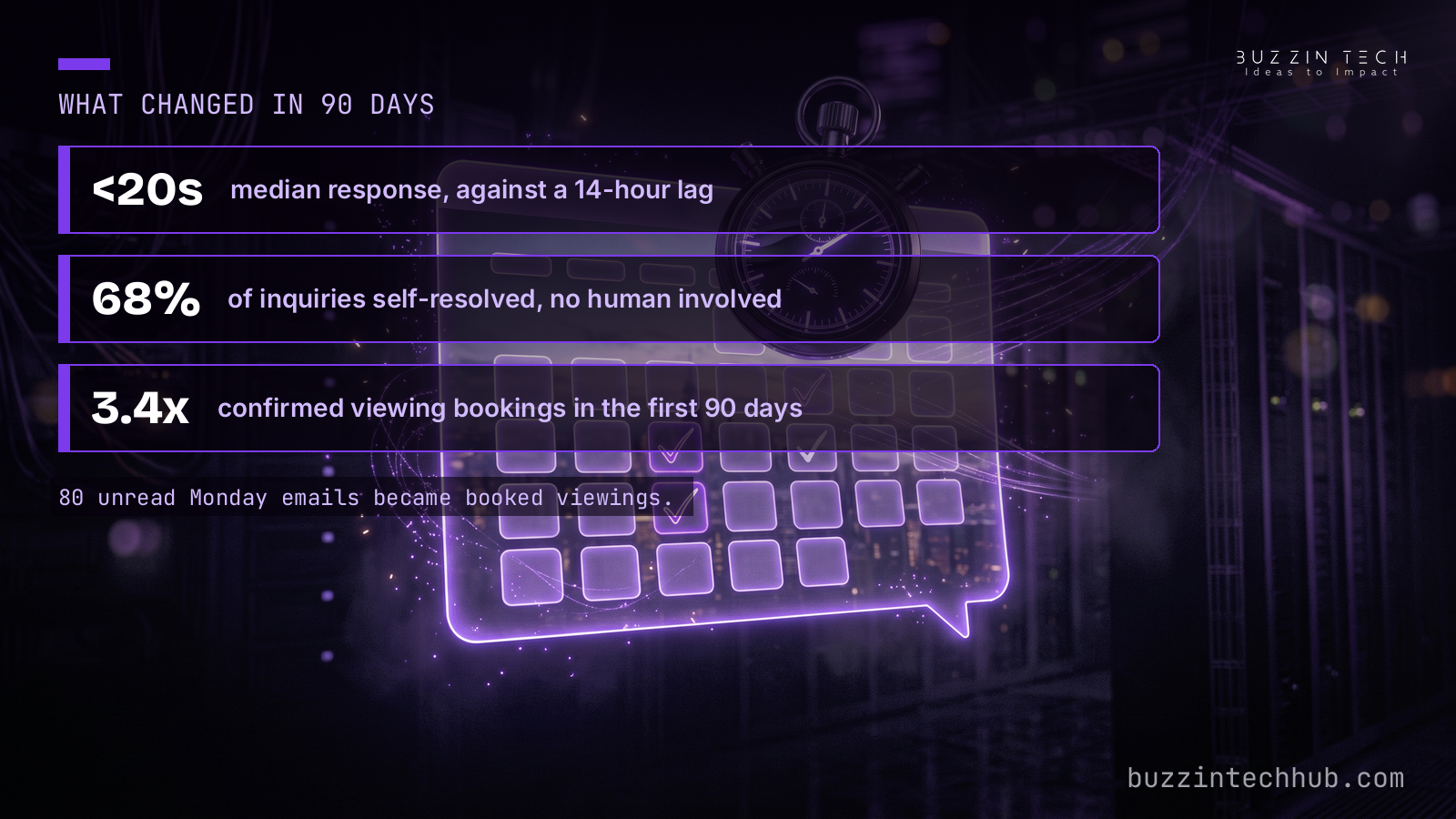
Confirmed viewing bookings rose 3.4 times in the first 90 days, because the calendar step happens inside the same conversation instead of after a callback. The change shows up in the team's Monday mornings too. Leasing Operations at Parklane Group put it this way:
"Our agents used to arrive on Monday mornings to 80 unread tenant emails. The assistant now qualifies them over the weekend, answers their questions, and has their viewings already booked into our calendar."
That is the number the cost comparison turns on. The assistant did not add a channel. It removed the overnight queue, and the bookings that used to leak to competing landlords now land in the calendar before the office opens.
The same build discipline appears in our earlier Flash Deals Mart case study, where the fix was measured the same way: before the build, after the build, on the record.
What the build cost, and what hiring would have cost
A single scoped workflow starts at $1,499 and ships in 2 to 3 weeks. A multi-system agent connecting CRM, calendar, and messaging starts at $4,999 over 6 to 10 weeks. Automation engineering beyond the base scope runs at $55 an hour, quoted upfront.
Those are the published starting prices on the service page, as of November 2026.
The service page states the comparison plainly: a $1,499 workflow handling lead triage runs daily for about two days of a junior salary. Hiring one more agent covers nights and weekends only with shifts, handover, and training, and the new hire still retypes the same brochure answers. The assistant answers at 2 a.m. with the same verified prices it used at 2 p.m.
The honest limit sits next to the price. Automation handles the repeatable 80%. If your process changes every week, you want a person, not a workflow, and we say so before we sell one.
Parklane's triage was stable enough to automate: five fixed parameters, one verified inventory, and one booking step. That is why the comparison favours the build here, and why it would not favour it everywhere.
The method, in four steps
The build followed the four-step method we run on every project. Discovery and Architecture mapped the 1,200 transcripts into five qualification parameters and the state machine. Design and Prototyping shaped the conversation and the RAG store before any production code.
Engineering and Build shipped the FastAPI service, the CRM and calendar wiring, and the escalation triggers. Deployment and Scaling put it live with a 60-day tuning window, so accuracy improves on real traffic instead of freezing at launch.
Does your team answer inquiries at 2 a.m.?
If your leads wait until morning for a reply, the cost is already on your books: every inquiry that signs elsewhere while your inbox sleeps.
See how we build AI automations that qualify and book
Frequently asked questions
How much does AI automation cost compared with hiring staff?
A single scoped workflow starts at $1,499 and ships in 2 to 3 weeks, as published on the service page in November 2026. A multi-system agent starts at $4,999 over 6 to 10 weeks. The service page puts it plainly: a $1,499 lead-triage workflow runs daily for about two days of a junior salary. Hiring still covers the cases automation cannot, so compare cost per handled inquiry, not cost per head.
What did the Parklane assistant actually do?
It answered tenant inquiries around the clock, qualified each one against five leasing parameters, and booked confirmed viewings into the CRM and the agents' calendars. Median response fell under 20 seconds, against a 14-hour lag before the build. In the first 90 days, 68% of inquiries self-resolved and confirmed viewing bookings rose 3.4 times.
How does the assistant avoid quoting the wrong rent?
Every price comes from a RAG knowledge base on PostgreSQL pgvector holding verified unit inventories, rent prices, floor plans, and building bylaws. The model never guesses a price. If the record is missing, the inquiry goes to a person instead of an invented answer.
What happens when a tenant is upset or the request is complex?
Sentiment analysis and edge-case triggers hand the live chat to on-duty staff with full context. Corporate relocation packages are one example the project page names. The assistant escalates. It does not improvise an answer it cannot stand behind.
How fast did the Parklane assistant answer?
Under 20 seconds median response, 24 hours a day, against a 14-hour speed-to-lead lag before the build. In the first 90 days, 68% of inquiries self-resolved and confirmed viewing bookings rose 3.4 times. The assistant also cleared the Monday backlog: 80 unread tenant emails became qualified leads with viewings already booked.
Can an AI assistant replace leasing agents?
No. It handles the repeatable 80%: policy questions, availability, and booking. Agents still run the viewings and close the leases. If your process changes every week, you want a person, not a workflow, and we say so before we sell one.