
A custom CRM for real estate developers is the backbone of this story. Eight Square sells luxury apartments in Dubai through brokerages and direct buyers, with installments stretching over months — and the team had no single view of who sold what, what was left, or who owed what.
TL;DR
• Eight Square, a Dubai developer behind the Noore luxury apartments, sold through brokerages and direct buyers with no single view of the money trail.
• BuzzinTech rebuilt eightsquare.com around the projects and built a full sales-and-financial CRM: brokerage registration, sale booking, installment follow-ups, sold-versus-remaining tracking, and aging reports for the CEO.
• Every deal now lives in one system, and social media runs on a monthly calendar built around the project.
The problem: brokerages, installments, and no single source of truth
Eight Square is a Dubai developer, and its Noore luxury apartments are the kind of launch a Meydan address deserves. Sales come through brokerages and direct buyers, and buyers pay in installments that stretch over months. That is a normal way to sell property in Dubai, but the team had no single view of the result: who sold what, what was left, who owed what, and how old each pending amount was.
This is the kind of build our web development team takes on when the website is only half the problem. Money moved through brokerages, spreadsheets, and memory. A brokerage registered a sale, a buyer paid three installments, the fourth went late, and nobody could say at a glance where the deal stood. The site itself did not present Noore the way a luxury launch should either. Two problems, one project.
Discovery: tracing the money before touching the site
Our method starts with discovery and architecture, and on this build that meant one exercise: follow a single sale from brokerage registration to the last installment and write down every handoff. Registration became brokerage management. The signed deal became sale booking and sale management. Each installment became a tracked event with its own follow-up. The unpaid ones became the aging report.
The rule that came out of discovery was plain: every deal lives in one system, and the CEO can see aging and pending amounts without asking around. Nothing in the build was decided before that rule. The modules, the screens, and the reports all trace back to it.
The website: Noore front and center
We rebuilt eightsquare.com around the projects, with Noore as the centerpiece. A property site for a Dubai launch has one job: present the development so a buyer or a brokerage takes the next step. The pages carry the project the way the project carries itself — the luxury apartments, the Meydan launch, the developer behind them. You can see the result on the live site.
Dubai's off-plan market runs on trust in the process as much as in the building. The official rules of that market sit with the Dubai Land Department, which registers and regulates property activity across the emirate.
The CRM: every installment has an address
The CRM is the build, not an add-on. It covers the whole money trail the discovery work mapped out:
• Brokerage registration: who is selling, and what they are allowed to sell.
• Sale booking and sale management: the unit, the buyer, the price, the plan.
• Installment follow-ups: each payment tracked, each late one flagged.
• Sold-versus-remaining tracking: the real inventory position, not a guess.
• Aging reports for the CEO: who owes what, and for how long.
A brokerage registers once and every sale it makes is tied to that registration. A unit is booked once and its whole payment plan is visible from that booking. When an installment goes late, the follow-up is not a favor someone remembers to do — it is a tracked event with an owner. The aging report is the page the CEO opens first, because it answers the only question that matters in the morning: what is pending, and how old is it.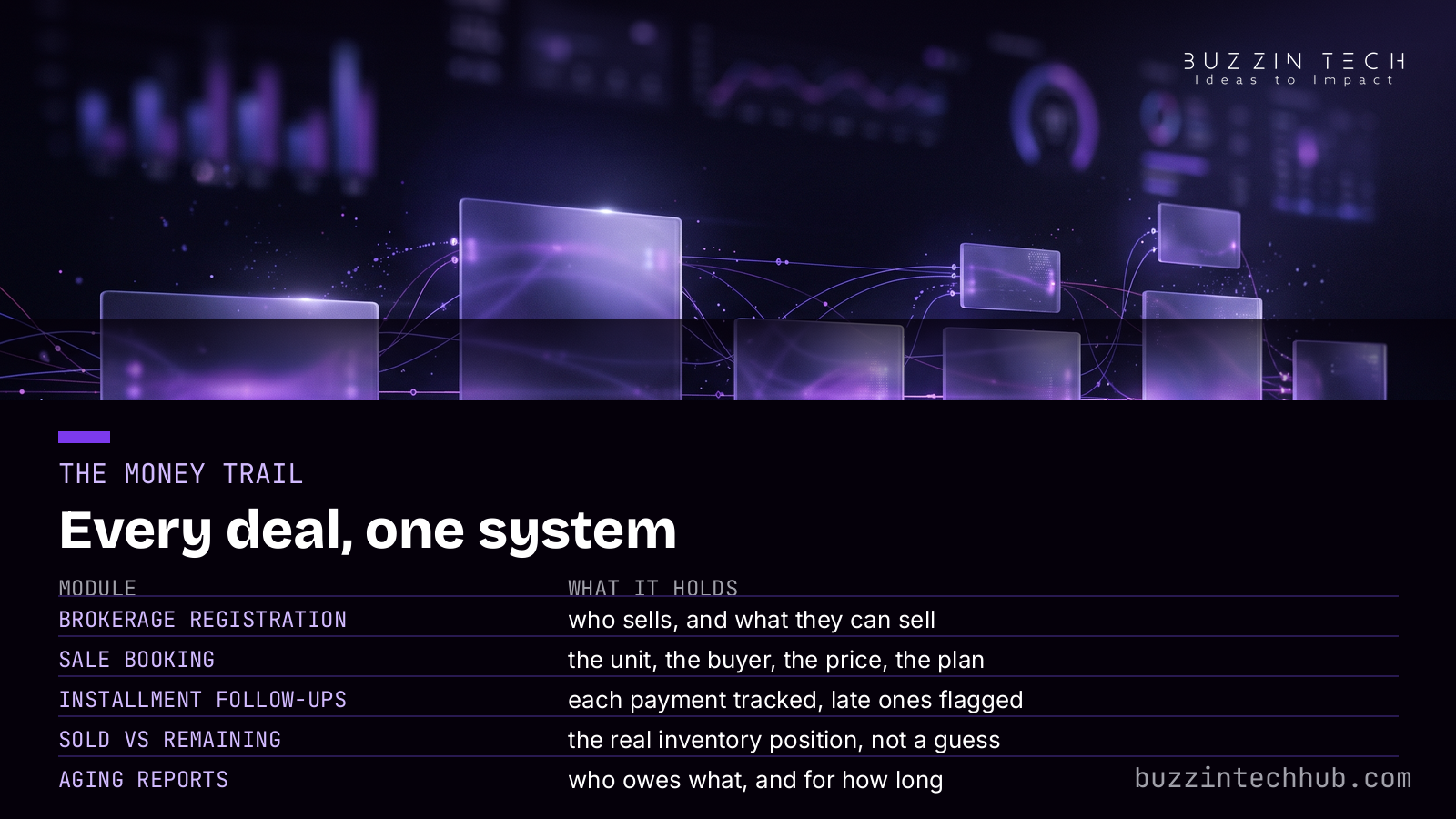
Social: a monthly calendar built around the project
A launch like Noore does not market itself, so we manage Eight Square's social media on a monthly calendar built around the project. The calendar gives the content a spine: the development, the milestones, the lifestyle the apartments sell. Each month's posts are planned in advance, produced in-house, and tied back to the site.
This is the same production discipline we run for our own brand — video shot, edited, and captioned in-house — applied to a client's launch. The social channels point at the site, the site presents the project, and the CRM catches whatever the combination brings in.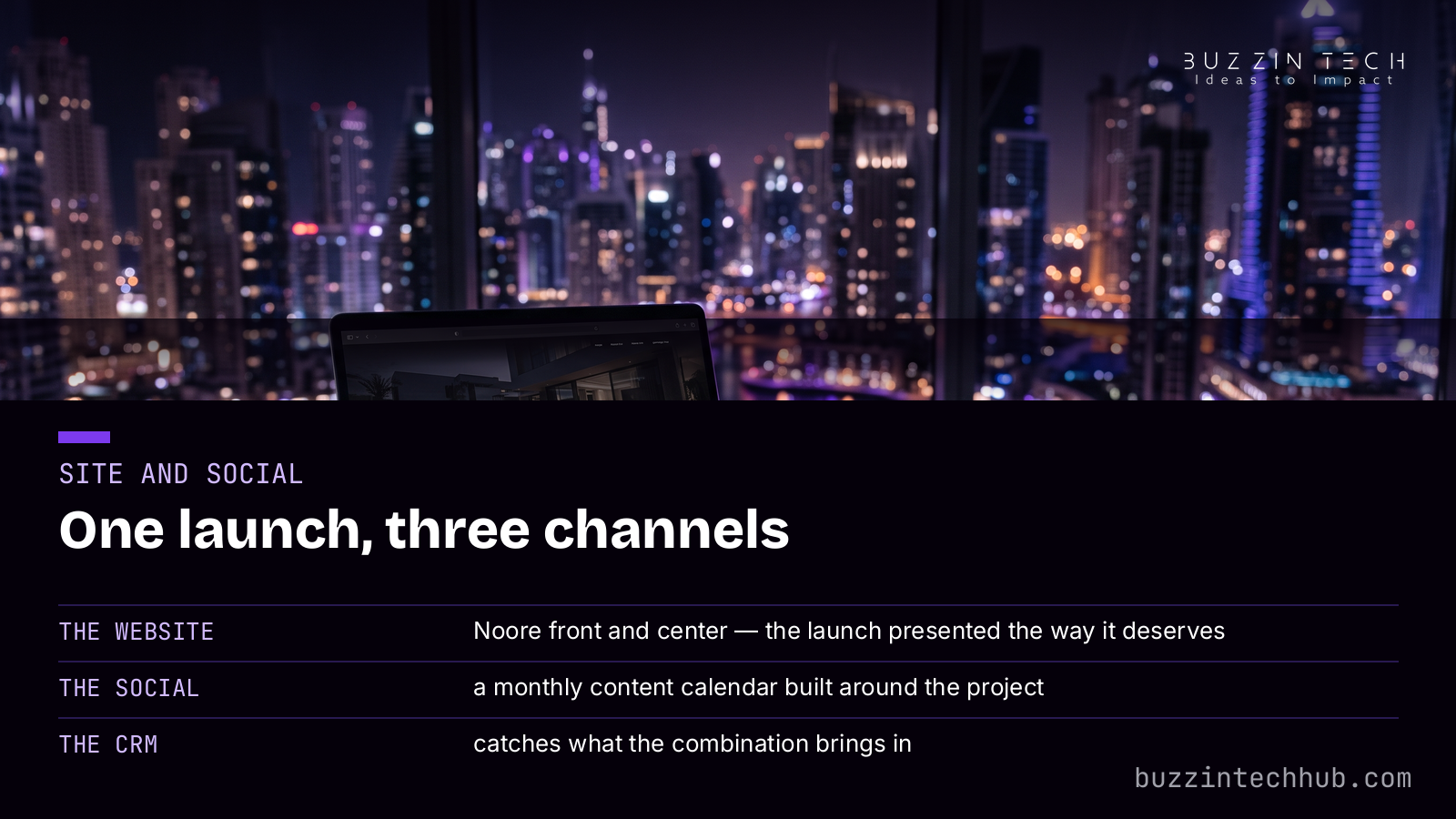
The outcome: the CEO stops asking around
The published result is plain: every deal, from brokerage registration to the last installment, lives in one system. The CEO sees aging and pending amounts without asking around. The site presents Noore the way a Meydan launch deserves.
Kamran Durrani, the COO of Eight Square, put it this way: "Very impressive team, working with them for more than a year on different projects and they never let us down."
We do not publish numbers for this project, so we describe the change as it is: a sales operation that ran on memory and manual work now runs on one system, and a launch that deserved a proper stage has one. The full published account is in the Eight Square case study.
This kind of build is not unique to real estate. A recent case study of ours rebuilt an insurance broker's website into a lead engine with full automation behind it — a different industry, the same idea of a site wired to the work behind it.
How we run builds like this
We build like it is our own company. Every project gets senior engineers and marketers — no account managers, a direct line to the people doing the work. The method has four steps: 01 Discovery & Architecture, 02 Design & Prototyping, 03 Engineering & Build, 04 Deployment & Scaling.
On this build, discovery mapped the money trail, design put Noore on stage, engineering built the CRM, and deployment put the whole thing in the client's hands. The same four steps run on every project, whatever the industry.
Selling property through brokerages and losing track of the money?
If your sales team runs on spreadsheets and memory, the fix is one system that follows every deal from registration to the last installment.
See how we build websites with a CRM behind them
Frequently asked questions
What did BuzzinTech build for Eight Square?
A new website for eightsquare.com built around the developer's projects with the Noore luxury apartments front and center, a full sales-and-financial CRM, and managed social media on a monthly calendar built around the project. The CRM covers brokerage registration, sale booking, sale management, installment follow-ups, sold-versus-remaining tracking, and aging reports for the CEO. It is the same three-piece combination — site, system, and content — we run on client builds.
What does the Eight Square CRM track?
The whole money trail. Each brokerage registers once and every sale ties back to it. Each unit booking carries the buyer, the price, and the full installment plan. Payments are tracked as they land, late ones are flagged for follow-up, and the sold-versus-remaining view shows the real inventory position instead of a guess. The aging report shows who owes what and how old each pending amount is.
What is an aging report, and why does a CEO need one?
It is a list of pending amounts ordered by how long they have been outstanding. For a developer selling on installment plans through brokerages, it is the single page that shows where the money is stuck. The CEO opens it first because it answers the morning's question — what is pending, and how old is it — without asking the sales team.
How is a custom CRM different from off-the-shelf real estate software?
It is built around the way this developer actually sells: brokerages and direct buyers, installment plans stretching over months, and a CEO who wants aging at a glance. Off-the-shelf tools force the business into their process; a custom build follows the process the discovery work mapped out. The trade-off is the obvious one — a custom build takes a team, not a subscription.
Does BuzzinTech handle the website and the marketing too?
Yes. This build included the website rebuild, the CRM, and social media management on a monthly content calendar built around the project. The three pieces are meant to work together: social points at the site, the site presents the project, and the CRM catches what the combination brings in. The technologies on the published case study are web development, custom CRM, and social media management.
How long does a build like this take?
We do not publish per-project durations. What we do publish is the method: discovery and architecture first, then design and prototyping, then engineering and build, then deployment and scaling — with senior engineers and marketers on the project and a direct line to the people doing the work, no account managers in between.
More from Buzzin Tech Hub
Another case study from the same pillar: Insurance broker website design: the Ecovers rebuild — a broker's site rebuilt into a lead engine with full automation behind it (verified live today).
Browse the full archive: Buzzin Tech Hub blog