Google Discover vs Search traffic is one report with three different stories inside it. In October 2026, site owners watched clicks fall while Google confirmed no new ranking update. The mistake was reading that fall as one event. Search, Discover, and Google News run on separate systems, and each one breaks in its own way.
TL;DR
-
Search, Discover, and Google News are separate systems, and Search Console reports each one separately.
-
No October 2026 ranking update is confirmed. The latest confirmed event is the September spam update, finished October 8.
-
A drop confined to one surface is a surface problem, and it needs a surface fix.
-
Check the surface first, then the page. A rewrite will not repair a feed problem.
Three channels, not one channel
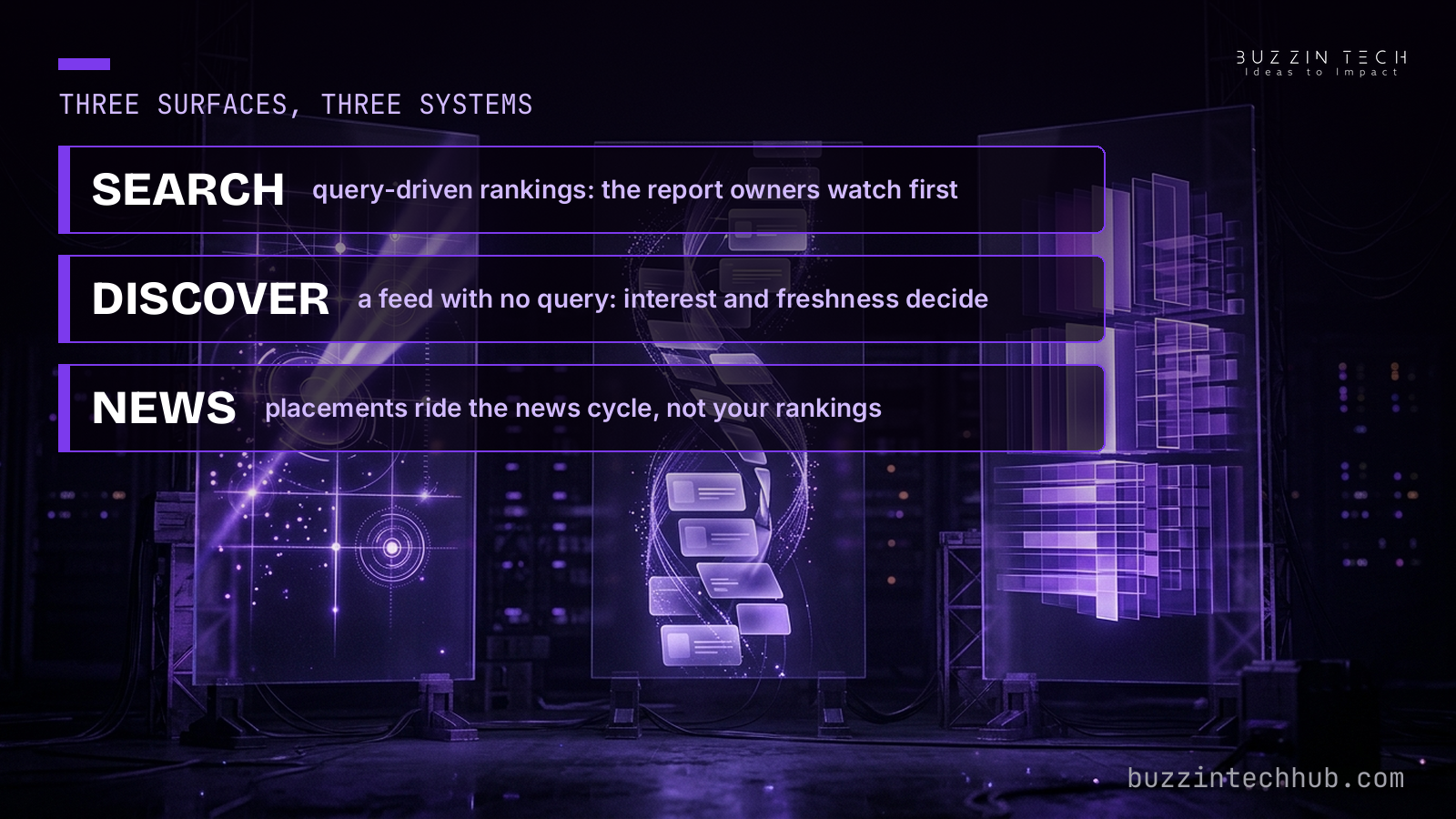
A search visit starts with a question. A person types a query, Google ranks pages, and the click goes to the page that answers best. That is the oldest channel, and it is the one most SEO advice still describes. Our search engine optimization work starts there, because a ranking is a durable asset: a page that earns a query keeps earning it until a better page or a confirmed change takes its place.
A Discover visit starts with no question at all. Google shows a feed of stories it expects a person to want, based on interests, past reading, and freshness. There is no query to rank for, and no fixed position to hold. A story can surge for a day and vanish the next, with nothing wrong with the page itself. The clock is short, the imagery matters more, and topic relevance decides what appears.
A Google News visit starts with the news cycle. Top Stories rewards prompt, original reporting on a live topic, and it moves faster than either of the other two channels. A story that is a day late is old news in this channel, even if it would still rank well in Search for months. The same page can therefore be healthy in one channel and invisible in another, on the same day, for reasons that have nothing to do with quality.
That split is the whole diagnosis. If you read the three channels as one traffic line, every feed swing looks like a ranking loss, and every ranking loss looks like a feed problem. Split them first, and the fix usually becomes obvious.
What October actually showed, surface by surface
Start with the confirmed record, because October produced a lot of noise around a small set of facts. Google's Search Status Dashboard lists the September 2026 spam update, which ran September 24 to October 8, as the latest ranking event. The last core update before it landed in May 2026. No update dated October appears in the ranking history. That is what Google has said, and it is the only part of the month's story that counts as an announcement.
The rest is observation, and the observations split cleanly by surface. In Search, tracking tools flagged sharp movement on October 16, October 20 and 21, October 24, and again on October 27. Search Engine Roundtable reported the October 27 spike as heated across tools, with Semrush readings near the top of its scale. None of these rounds is confirmed by Google, and trackers themselves have been unreliable this autumn: since September, vendors including Ahrefs and Semrush have confirmed receiving altered result pages and filtering them from reports. Our Tuesday diagnosis of that tracker problem still stands, and it is the reason a tracker chart alone proves nothing this month.
In Discover, the reports have a different shape. Forum threads describe Discover traffic as erratic since late August, with some publishers reporting days where it seemed to vanish. Then came a concrete, checkable event. On October 23, Discover researcher Damien Andell spotted a test in which tapping the sources button on a Discover AI summary card opened nothing, instead of the mini-feed of source articles it used to open. On October 27, Google's Rajan Patel said that was a bug in an experiment, that the experiment had been turned off, and that the experience worked as intended again. Andell checked the same day and found the old experiment replaced by another one, called "aio tap falls through to hero", whose workings nobody has explained. That sequence is a Discover story, not a Search story: an experiment on one surface, fixed on that surface, with a successor experiment still unexplained.
In Google News, the reports are thinner and should be handled with more care. Forum threads describe News placements going stale, with old stories sitting in results while newer stories wait. Search Engine Roundtable's October 27 report notes the same chatter: articles indexed within seconds and appearing in Top Stories, alongside spot checks showing outdated articles. One commenter's claim that the news system is broken is forum opinion, not a confirmed Google change, and this piece does not present it as one. The honest statement is narrower: News complaints exist, they are unconfirmed, and they point at freshness and eligibility rather than at rankings.
Read together, October looks like three small stories wearing one headline. Search had unconfirmed volatility plus unreliable trackers. Discover had a real, named experiment bug. News had freshness complaints with no confirmation behind them.
The comparison table
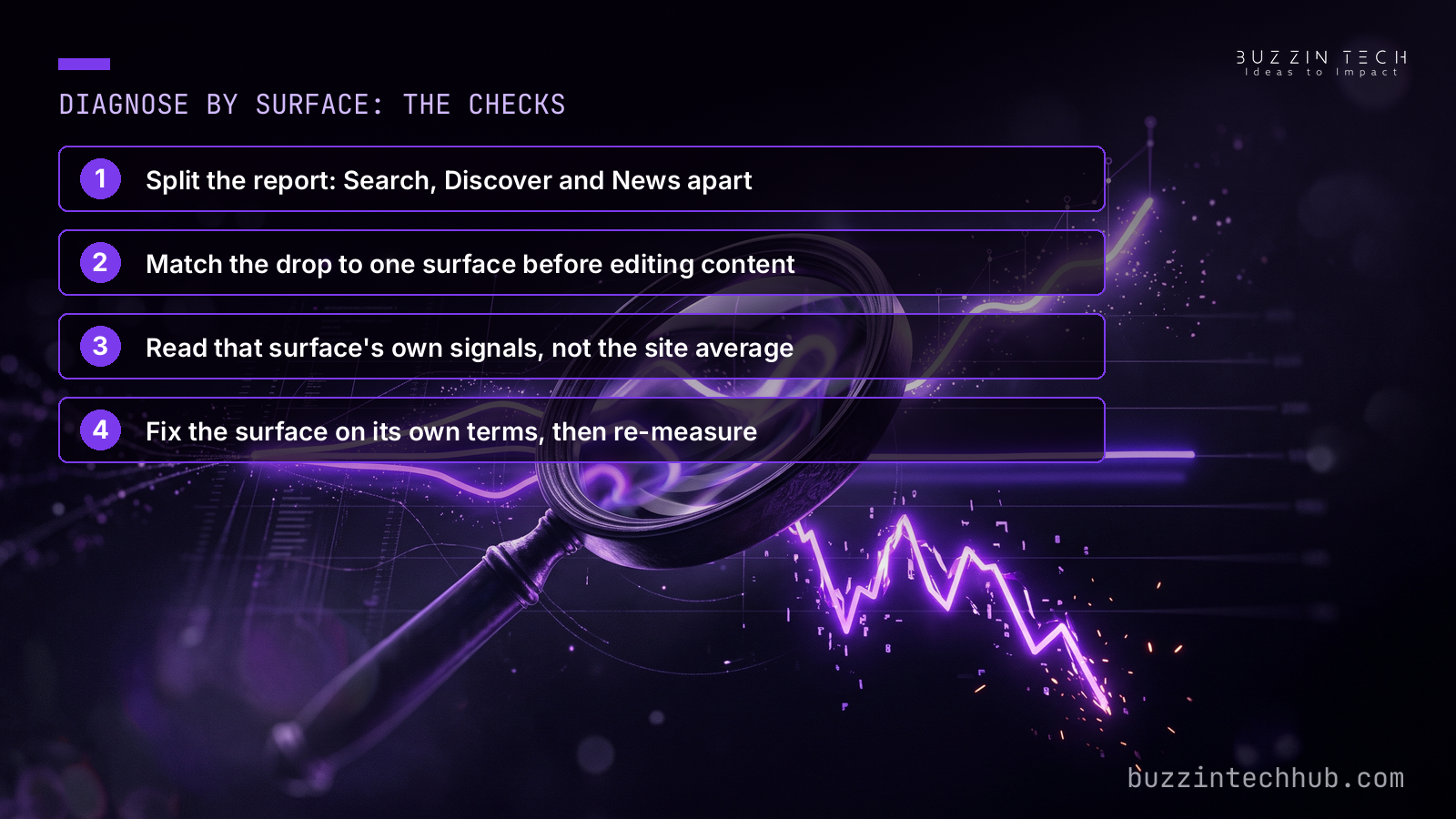
Use this table before you touch a page. Find your symptom, name the surface, run the first check, and only then choose a fix.
-
Search: symptom is impressions or average position falling on the page's own queries, sustained over weeks. First check is the Search performance report in Search Console, split by query and page over 30 days. Fix is the page itself: relevance, original value, and technical health, in that order.
-
Discover: symptom is clicks falling while Search impressions and position hold, often in sharp daily swings. First check is the Discover performance report, split by page over the same window. Fix is the feed package: freshness, topic relevance, and imagery strong enough to earn the tap.
-
Google News: symptom is a story that never surfaces in Top Stories, or an old story that will not leave it. First check is the Google News performance report, plus the story's own timestamp and originality. Fix is the newsroom habit: publish promptly, keep timestamps honest, and lead with original reporting instead of a rewrite.
-
Visibility without clicks: symptom is impressions rising while clicks stay flat. First check is the results page itself for the affected queries: a new AI Overview, a new ad block, or a local unit sitting above the listing. Fix is the click package: a title and opening that earn the visit even when an answer sits above the result. One publisher's visibility score rose sharply in October while traffic stayed flat, which is exactly what this row describes.
-
Tracker cliff only: symptom is a rank tracker falling while Search Console stays flat. First check is whether the vendor filters altered result pages, and whether Search Console impressions agree with the tracker. Fix is the measurement, not the site: trust Google's own logs over a scraped page, and ask the vendor what it filtered.
Why clicks fall while rankings hold
The results page around a listing changed faster this year than the rankings inside it, and October made that gap hard to ignore. Search Engine Roundtable's October 26 recap put AI Overviews on over 80 percent of Google searches, citing Semrush, SE Ranking, and seoClarity data, up from about 50 percent in June of last year. When an answer sits above the results, fewer people click anything below it. One widely cited figure puts position-one click-through near 13.0 percent on desktop, falling to about 4.0 percent when an AI Overview appears above the result. Ads and local units take clicks the same way, and Discover swings take clicks without any change to a ranking.
Search Console's own reporting now helps separate these layers. The Performance report covers Search, Discover, and Google News as separate reports, and Google's generative AI reports, rolled out worldwide on August 31, give Search and Discover each a dedicated view of visibility inside AI features. That view reports impressions, not clicks, so read it beside the main reports, not instead of them.
The practical point is simple. Rankings measure where a page sits. Clicks measure what a person did after seeing the page. When the page around the listing changes, the second number moves while the first stands still. That is not a penalty, and it is not a reason to rewrite a page that still ranks.
Fix each surface on its own terms
A Search fix starts with the page's own queries. Open the Search report, compare impressions, clicks, and average position over 30 days, and look for a loss that lasts longer than a week. If impressions fell on the page's own queries, the page earns attention: check indexing, check that the content still answers the query better than the pages above it, and check it against Google's October main-content guidance, which asks for effort, originality, talent or skill, and accuracy. If impressions held and only clicks fell, the page is probably fine and the results page changed around it. Leave the page alone and work on the title and the opening instead.
A Discover fix starts with the feed package. Open the Discover report and find which pages lost clicks, then look at those pages as a feed reader would: is the story still fresh, is the topic still live, and does the image earn a tap at phone size? Refresh the piece when the topic has moved on, lead with the newest fact, and use a large, clear image that reads at a glance. Discover is volatile by design, so judge a page over weeks, not over a single bad day, and do not rewrite a strong Search page to chase one Discover swing.
A News fix starts with speed and honesty. Publish while the topic is live, keep the timestamp accurate, and make the original reporting unmistakable in the first paragraphs. A rewrite of someone else's story, published late, has little to offer Top Stories, and no amount of SEO work after publication repairs a missed news cycle. When a story goes stale in News, that is the channel working as designed. The same story can still earn Search traffic for months, and that is the channel to measure it in.
How we run this diagnosis at BuzzinTech
At BuzzinTech, organic growth covers technical SEO plus content, with AI answers included, and a surface split like this one is the first step of any visibility engagement. Discovery maps the queries, the pages, and the surfaces that send traffic. Design shapes answer-first content that earns rankings and citations. Engineering handles schema, performance, and indexation. Deployment sets up measurement so the next swing gets read by surface instead of by panic. Senior engineers and marketers do the work, with a direct line to the people doing it.
The same method rebuilt Ecovers' site into a fast, lead-generating engine: a custom website built from scratch for SEO, GEO, and AEO, GoHighLevel automation, and a backend blog admin panel, with Google tags and leads connected. No ads were run for Ecovers, and this piece claims none. The outcome was a site built to be found and to convert, measured surface by surface from the start. See the full project list on our projects page, and judge the method by the work rather than by any single month's chart.
Is your traffic drop a Search problem, a Discover problem, or a News problem?
We audit your current rankings, your AI-answer presence, and your traffic by surface, then hand you a plan that names the surface, the first check, and the fix in that order. See how we run search and AI visibility.
Frequently asked questions
Has Google confirmed a new ranking update in October 2026? No. As of the latest reporting, Google's Search Status Dashboard still lists the September 2026 spam update, which ran September 24 to October 8, as the latest ranking event, and the last core update was in May 2026. Volatility reported on October 16, 20, 21, 24, and 27 is unconfirmed, so treat it as observation, not announcement.
Why did Discover traffic fall while Search stayed flat? Because the two channels run on separate systems. Search ranks pages for queries, while Discover picks stories for a feed based on interests, freshness, and topic relevance. A feed swing, an experiment, or a stale topic can cut Discover clicks while every ranking holds. Split Search Console by surface before deciding anything changed about the page.
What does the Discover source-click bug change for publishers? On October 23, a test stopped taps on the sources button of Discover AI summary cards from opening the source mini-feed. On October 27, Google said it was a bug in an experiment, that the experiment was off, and that the experience worked as intended again. A replacement experiment was spotted the same day, with no explanation of how it works. Watch your own Discover report rather than assuming a permanent removal.
How do I split traffic by surface in Search Console? Open Performance and read Search, Discover, and Google News as separate reports, each split by page and date over the same window. A drop confined to one report is a surface problem. Google's generative AI reports add a separate Search and Discover view of impressions inside AI features, rolled out worldwide on August 31, but they report impressions only, so read them beside the main reports.
Why do clicks fall when rankings hold? Because the results page around a listing changed. AI Overviews now appear on over 80 percent of searches by recent vendor data, and an answer above the results takes clicks from everything below it. Ads, local units, and Discover swings do the same. Check the query yourself before rewriting a page that still ranks.
When should I actually rewrite a page? Only after the Search report shows a real impression loss on that page's own queries, sustained over weeks, and after you have ruled out tracker error, layout changes, bot traffic, manual actions, and site changes. A rewrite aimed at a confirmed Search loss is an investment. A rewrite aimed at a Discover swing or a News cycle that already passed risks the ranking you already hold.