
A Google ranking drop diagnosis starts with one awkward question: did your rankings actually fall? In October 2026, plenty of site owners watched clicks slide while Google confirmed no new update at all. The gap between those two facts is where most bad SEO decisions get made, and it is the gap this piece closes.
TL;DR
- No new Google update is confirmed for October 2026; the latest confirmed event is the September spam update, finished October 8.
- Rank trackers have been served altered result pages since September, so a tracker cliff proves nothing.
- Clicks can fall while rankings hold: AI Overviews, ads, and Discover swings take the click.
- Split Search Console by Search, Discover, and News before rewriting a page.
- Act on October's one confirmed change: Google's main-content guidance on effort, originality, skill, and accuracy.
What Google confirmed, and what it did not
Start with the official record. Google's Search Status Dashboard still lists the September 2026 spam update as the latest ranking event. That update ran September 24 to October 8, and the last core update before it landed in May. Nothing dated October appears in the ranking history. That is the confirmed part, and it matters because everything else this month is observation, not announcement. Our search engine optimization work starts every traffic call here: the dashboard answers what Google said, and your own Search Console data answers the rest.
The observations are real, though. Tracking tools flagged sharp movement on October 20 and 21, and Search Engine Roundtable reported heated volatility again on October 24. Search Engine Watch's October reporting matches the dashboard: no October update confirmed as of October 19. Forum threads describe Discover traffic behaving oddly since late August, News results showing stale stories, and Search Console data lagging reality by days. None of that is a confirmed update. It is a set of symptoms with several possible causes, and treating it as one named update is the first mistake.
That split, what Google said versus what a tool showed, is the whole method. The dashboard answers the first question. Your own Search Console data answers the second. Everything in between is noise until proven otherwise.
Your tracker may be lying to you
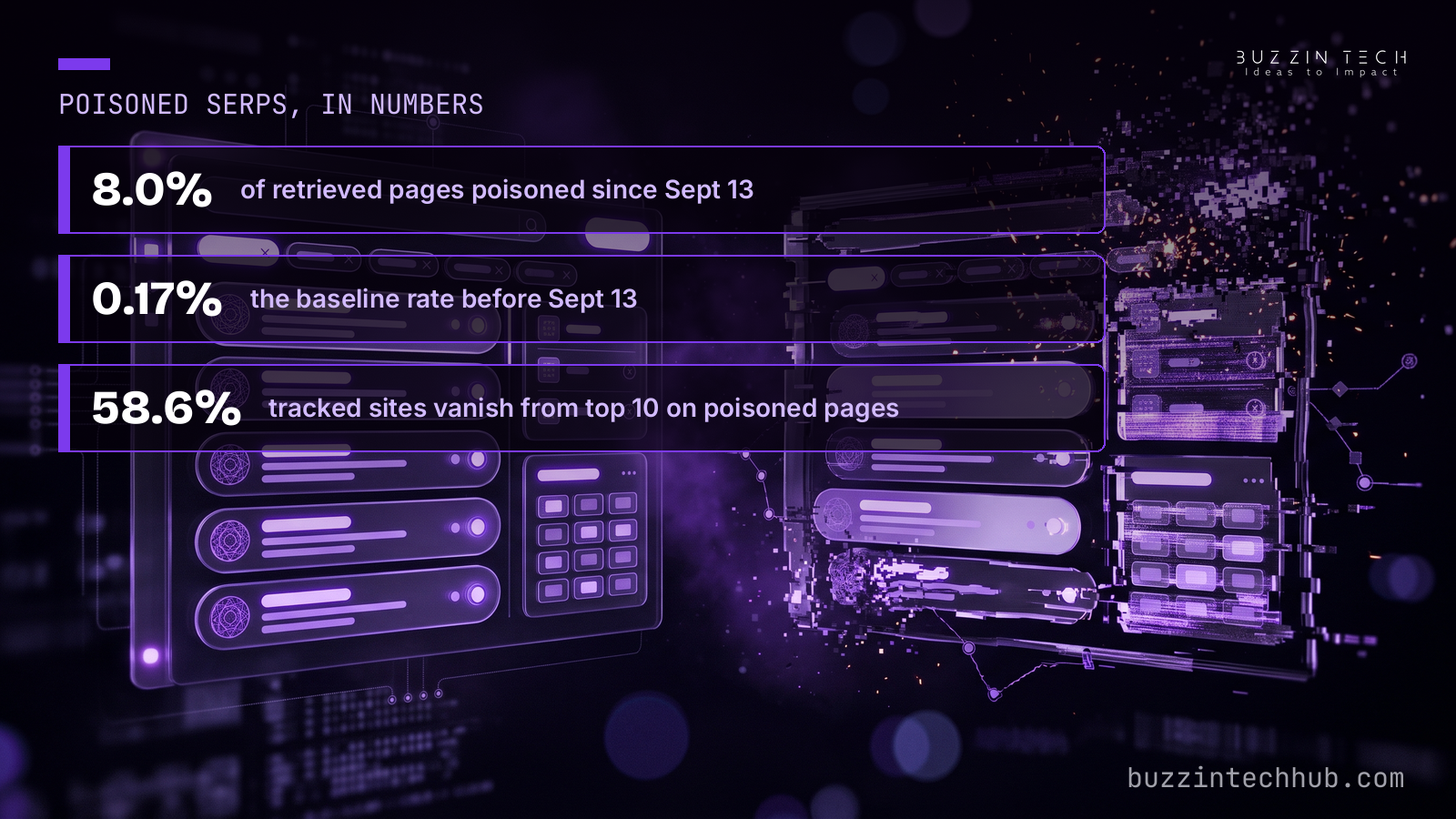
The strongest reason to doubt a tracker cliff this autumn comes from Nozzle, an enterprise rank-tracking firm. Its analysis of 27.5 million Google result pages across 49 countries, collected August 20 to October 9, found that from September 13 onward, 8.0 percent of retrieved result pages were not the pages a real user would see. The baseline before that date was 0.17 percent. The rate peaked near 25 percent between September 27 and 29, and ran 5 to 11 percent per day after October 1.
Nozzle calls these "poisoned" SERPs. A poisoned page carries no error and no captcha. It looks like an ordinary result page, but most of the listings are wrong: pages that match a single word rather than the query, or sites with nothing to do with the topic. On a poisoned page, the tracked site was missing from the top 10 in 58.6 percent of cases, against 2.7 percent on a normal page. A normal page repeated 88.5 percent of the previous page's sites on a second check; a poisoned page kept only 20.7 percent. Most of the damage is short-lived: 77.9 percent of affected pages had their usual sites back within three days.
Keep the caveats attached to those numbers. This is one vendor's measurement, and Nozzle sells rank tracking, so it has a commercial interest in explaining why tracker data diverges from what users see. The reading that Google serves altered pages deliberately to deter scraping is Nozzle's interpretation. Google has made no public statement on it. What is confirmed is narrower, and it is enough: Ahrefs, Semrush, SE Ranking, SISTRIX, and AccuRanker have each confirmed receiving altered pages, and each now says it filters them out. Ahrefs put the affected share at 5 to 20 percent depending on the data provider, as of October 22.
The practical point is plain. A tracker cliff in late October is weaker evidence than the same cliff would have been in August. Before you quote a tracker number to a client or a boss, check whether the vendor filters altered pages, and check the same queries in Search Console. If Search Console is flat while the tracker falls, you are looking at bad tracker data.
Clicks can fall while rankings hold
Even with clean data, clicks and rankings are different measurements, and October widened the gap between them. Search Engine Roundtable's October 26 recap put AI Overviews on over 80 percent of Google searches, citing Semrush, SE Ranking, and seoClarity data, up from about 50 percent in June of last year. When an answer sits above the results, fewer people click anything below it. One widely cited figure puts position-one click-through near 13.0 percent on desktop, falling to about 4.0 percent when an AI Overview appears above the result. The Verge's October 25 piece on AI answers and publisher clicks tells the same story from the publisher side: the answer satisfies the reader, and the visit never happens.
Ads and local units take clicks the same way, and Discover adds its own swing. Discover traffic has been erratic since late August by forum accounts, with some publishers reporting days where it seemed to vanish. A page can hold every ranking it had and still lose a third of its sessions to a results page that changed shape around it. The layout changed, and that calls for a different response: stronger titles, clearer answers, and pages worth the click.
Our October read on AI Mode links covers the other half of this shift: Google is rebuilding the exit routes from its AI answers, and placement inside an answer is now a separate contest from ranking beneath one. Measure both, or you will misread either.
Run the split before you touch a page
Here is the diagnostic, in order. It takes under an hour, and it stops most bad rewrites before they start.
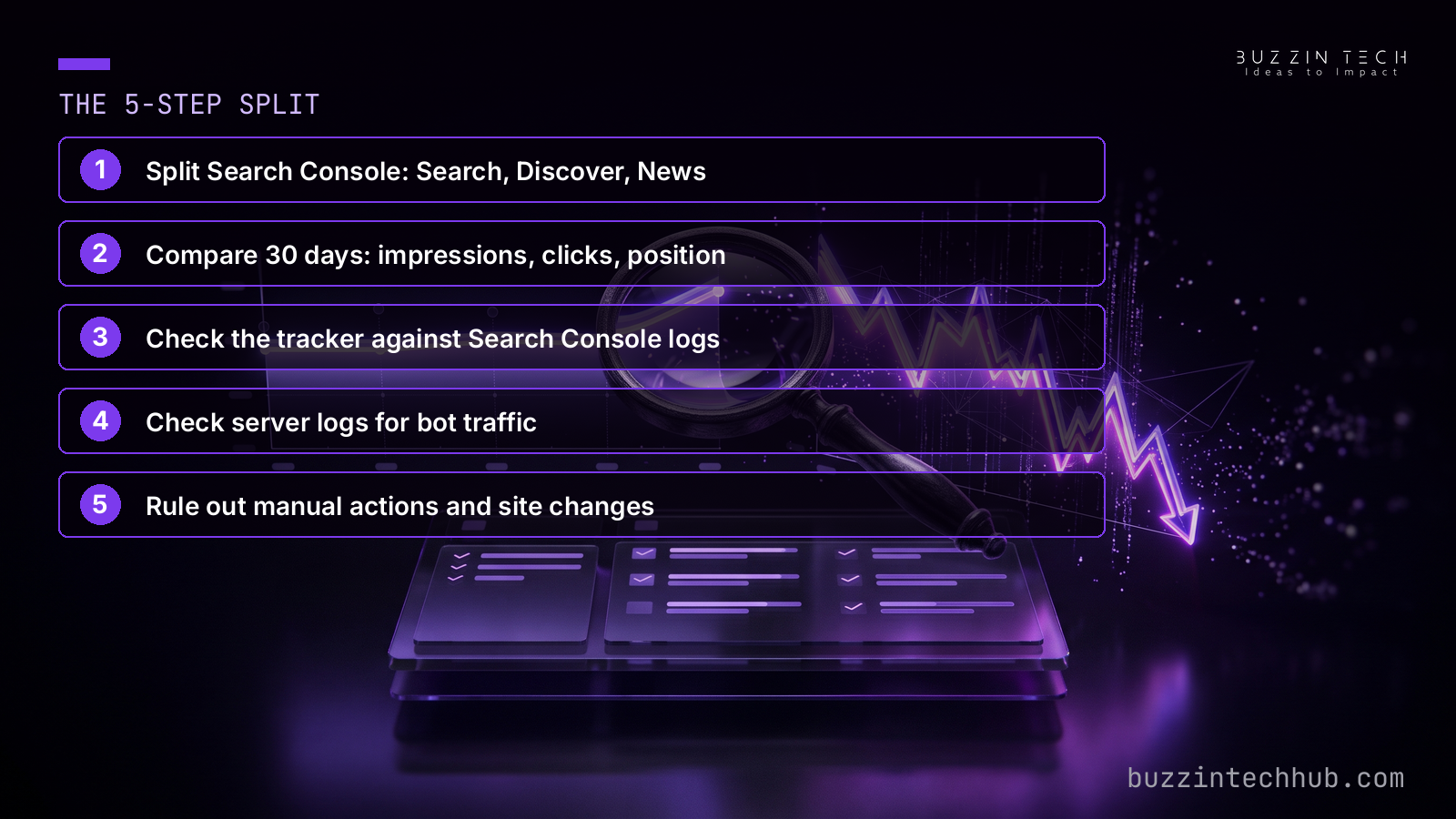
First, open Search Console and split performance by Search, Discover, and Google News. A drop confined to Discover is a distribution problem, not a ranking problem. A drop confined to News points at freshness or eligibility. Only a drop in Search is a ranking conversation at all.
Second, for the affected queries, compare impressions, clicks, and average position over 30 days. Averages over a single day punish you for normal variance and for reporting lag. If impressions and average position hold while clicks fall, the results page changed around you. Check the query yourself: a new AI Overview, a new ad block, or a local pack can explain the whole gap.
Third, check the tracker against Google's own logs. Search Console impressions and average position come from Google's records. If they are flat while the tracker shows a cliff, trust Search Console and ask the vendor whether altered pages are filtered from your reports.
Fourth, check server logs when analytics and Search Console disagree. Bot traffic inflates sessions, breaks conversion rates, and makes a healthy site look sick. A spike in bot sessions during the same window explains plenty of October complaints, and it is fixed at the server.
Fifth, rule out the unglamorous causes: a manual action in Search Console, an indexing slip after a deploy, a robots change, a sitemap error, or a site change nobody logged. These cause real drops, they are quick to check, and they are embarrassing to miss after a week of update theories.
Only after those five steps does a rewrite enter the conversation. If the data shows a real impression loss on a page's own queries, that page earns attention. If it does not, leave the page alone. Rewriting a page that still ranks risks the ranking you already have.
The one October change worth acting on
October did produce one confirmed, actionable change, and it was documentation, not an algorithm. On October 1, Google's generative AI guidance gained an unambiguous instruction: manually fact-check and review all AI-generated content for accuracy and trustworthiness before publishing, including titles, meta descriptions, and alt text. On October 2, its helpful-content guide gained a "Main content" section, defining main content as any part of the page that directly helps it achieve its purpose, and naming the four attributes quality raters evaluate: effort, originality, talent or skill, and accuracy. Pages with little or no effort or added value get the lowest rating.
Read that against the September spam update and the pattern is clear. Mass-produced pages with thin oversight are exactly what the year's spam updates targeted, and Google has now written down how raters judge them. The fix is ordinary work. Audit the pages built at scale with generative AI: add original analysis, check every fact, cut passages that say nothing new, and keep the byline honest. A page that shows real work survives this guidance. A page that only rearranges other pages does not, and no rank tracker will warn you before that bill arrives.
What not to do this week
Do not rewrite ranking pages on tracker evidence alone. Do not disavow links, change titles across a template, or noindex sections while the data is still unclear. Do not buy a vendor's shortcut for AI visibility, and do not treat a forum thread as a diagnosis. Each of those moves costs real rankings, and each is hard to undo cleanly. The cheapest action this week is a careful read of your own data, and the most expensive is a confident rewrite of a page that was never broken.
How we run a ranking-drop diagnosis
At BuzzinTech, organic growth covers technical SEO plus content, with AI answers included, and a diagnosis like this one is the first step of any visibility engagement. Discovery maps the queries, the pages, and who already owns the answers. Design shapes answer-first content that earns both rankings and citations. Engineering handles schema, performance, and indexation. Deployment sets up the measurement dashboard and the publishing cadence. Senior engineers and marketers do the work, with a direct line to the people doing it.
The same method rebuilt Ecovers' site into a fast, lead-generating engine: a custom website built from scratch for SEO, GEO, and AEO, GoHighLevel automation, and a backend blog admin panel, with Google tags and leads connected. The outcome was a site built to be found and to convert. A diagnosis first, a rebuild second, and measurement throughout: that order is the whole method.
Clicks down but rankings flat?
We audit your current rankings, your AI-answer presence, and the off-site signals engines cite, then hand you a plan that separates real losses from tracker noise and layout changes.
See how we run search and AI visibility
Frequently asked questions
Has Google confirmed a new ranking update in October 2026? No. As of the latest reporting, Google's Search Status Dashboard still lists the September 2026 spam update, which ran September 24 to October 8, as the latest ranking event, and the last core update was in May 2026. Volatility reported by tracking tools on October 20, 21, and 24 is unconfirmed, so treat it as observation, not announcement.
What is a poisoned SERP? It is a normal-looking Google result page whose listings have been swapped for the wrong sites, with no error and no captcha. Nozzle's analysis of 27.5 million result pages found 8.0 percent poisoned from September 13 onward, against a 0.17 percent baseline. A rank tracker that stores such a page reports a ranking crash that no real user ever saw.
How do I tell a tracker error from a real ranking drop? Compare Search Console impressions, clicks, and average position for the same queries over 30 days. Search Console reflects Google's own logs, not scraped pages. If it is flat while the tracker falls, the tracker data is suspect. Also check whether your vendor now filters altered pages, as Ahrefs, Semrush, SE Ranking, SISTRIX, and AccuRanker say they do.
Why do clicks fall when rankings hold? The results page around your listing changed. AI Overviews now appear on over 80 percent of searches by recent vendor data, and click-through drops sharply when an answer sits above the results. Ads, local units, and Discover swings take clicks the same way, without any change to your rankings.
What does Google's October main-content guidance change? It defines main content and names effort, originality, talent or skill, and accuracy as the attributes raters evaluate. It also requires manual fact-checking of AI-generated content before publishing. Pages built at scale with little oversight or added value now have a written standard working against them.
When should I actually rewrite a page? Only after Search Console shows a real impression or click loss on that page's own queries, sustained over weeks, and after you have ruled out tracker error, layout changes, bot traffic, manual actions, and site changes. A rewrite aimed at a confirmed loss is an investment. A rewrite aimed at a rumor risks the ranking you already hold.