
To get cited in Google AI Overviews, a page must first be eligible to appear at all, then answer the narrower question hiding inside the search. Google's own guidance makes the first part plain. The second part is where most pages fail, and where this playbook starts.
TL;DR
- Semrush tracked 400 US desktop commercial keywords: AI Overviews appeared on 88% by August 2026, up from 46% a year earlier.
- Google's rule is simple: a page must be indexed and eligible for a snippet. No special schema is needed.
- AI Mode fans one query out into many sub-questions. Pages that answer the sub-question get cited.
- November adds more links, higher in the answer. Clear pages get quoted; vague pages get summarised vaguely.
The citation is the ranking now
Semrush tracked a fixed panel of 400 commercial keywords across banking, software, and ecommerce from September 2025 to August 2026, using US desktop data. By August 2026, AI Overviews appeared on 88% of those keywords, up from 45.75% a year earlier.
The "best X for Y" group finished highest at 96.12%, and reviews climbed from about 30% to nearly 90%. Weighted by search volume rather than keyword count, coverage reached 97.08%. Read the full study in Semrush's commercial modifiers research.
In our search engine optimization work, the question clients ask has changed. It used to be how to rank first. Now it is how to get named inside the answer.
Those numbers come with limits that belong in the same paragraph as the numbers themselves. The panel is 400 decision-stage keywords, US desktop only, and the study measured presence, not clicks, traffic, or conversions. The 88% figure is not a share of all Google searches.
But within its limits the finding is blunt: on the queries where buyers compare, price, and choose, the AI answer is now the first thing they read, and the cited sources are the only organic links they reliably see.
The click data behind that shift is sobering. Pew Research Center tracked 900 US adults in March 2025 and found users clicked a traditional result in 8% of visits when an AI summary appeared, against 15% without one. Links inside the summary itself were clicked in only 1% of visits.
That is Pew's finding, attributed to Pew, and it is not an AI click-through rate. It is the shape of the problem: fewer clicks reach the results below the answer, so the citation slot matters more than the position below it.
Eligibility comes first, and it is ordinary SEO
Google's Search Central guide on AI features and your website states the eligibility rule in one sentence: to be shown as a supporting link in AI Overviews or AI Mode, a page must be indexed and eligible to be shown in Google Search with a snippet. Then it adds the sentence that should end a whole category of sales pitches: "There are no additional technical requirements."
No special schema is needed, and no special markup. Google's optimisation guide says the same thing from the other side: structured data is not required for generative AI search, and there is no special schema.org markup to add. The work that qualifies a page is the foundational work: crawlable, indexed, text content Google can read, internal links that make the page findable, a decent page experience, and structured data that matches the visible text.
The trap sits in the controls that limit how content appears. The nosnippet, data-nosnippet, max-snippet, and noindex controls limit what Google can show from a page, and a page that blocks its own snippet blocks its own citation.
Audit the pages you want cited before you rewrite a word of them. Open each one in Search Console URL Inspection and confirm Google can show a snippet for it.
A page Google cannot show a snippet for cannot be cited, however good the copy is.
Query fan-out decides who gets quoted
Google calls the mechanism query fan-out. One broad question becomes many related searches across subtopics and data sources, issued while the answer is being built.
While the response is generated, Google's models identify more supporting pages, and the answer displays a wider and more diverse set of links than a classic web search would. That sentence, from Google's own guide, is the whole playbook in miniature.
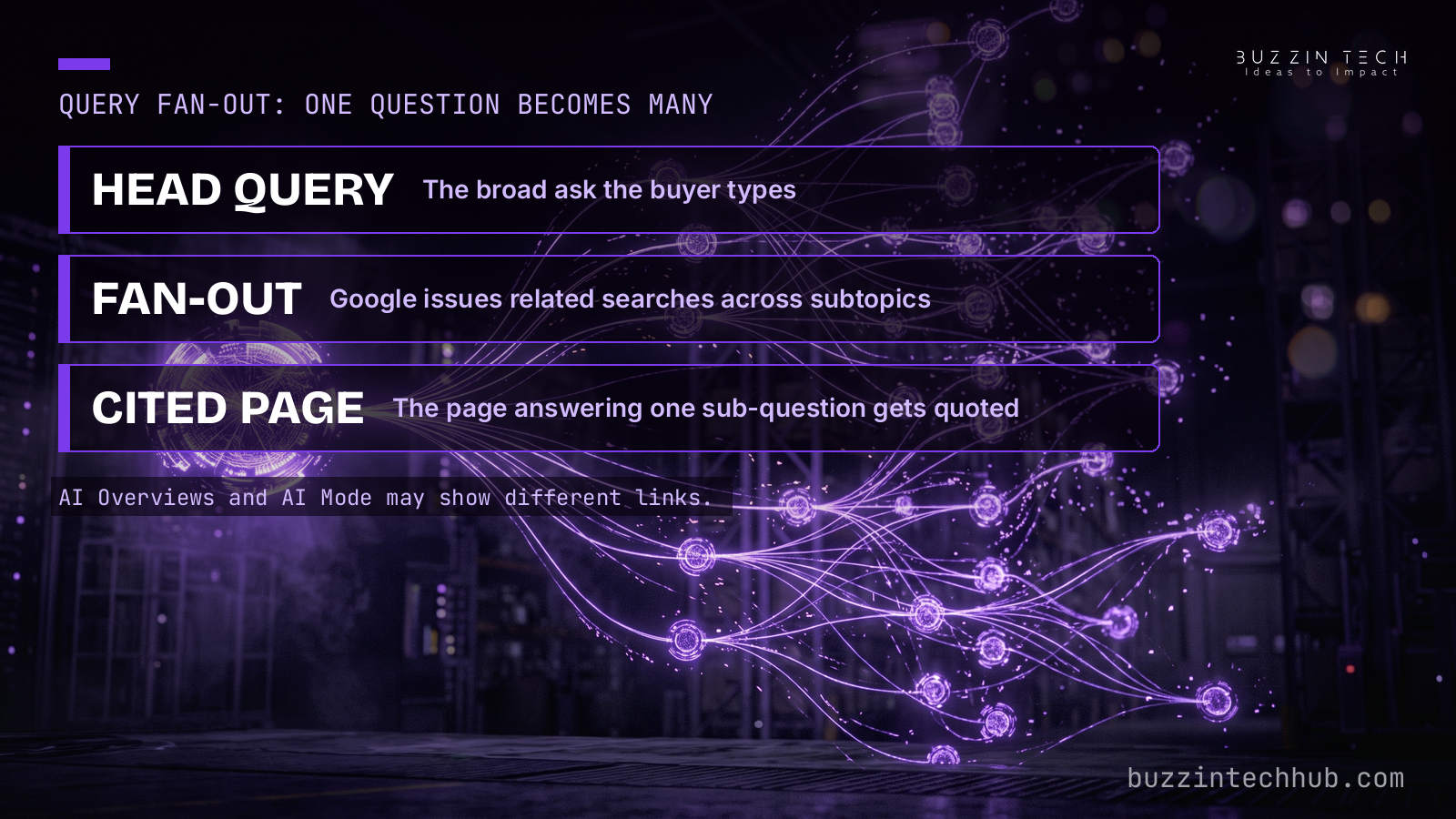
The practical consequence is a change in how pages get planned. A page that answers one of the narrower questions inside a broad ask can be retrieved even when it does not rank for the head query itself.
The work shifts from writing one page per head keyword to mapping the sub-questions a buyer asks on the way to a decision: the comparison, the price, the setup step, the failure mode, the renewal term. Each sub-question gets its own page, with the direct answer in the first paragraphs and a short passage Google can lift whole.
Take a buyer asking for the best CRM for a small estate agency. Fan-out pulls the questions behind it: what it costs for five users, how it compares with a spreadsheet, how long setup takes, whether it handles instalments.
The page that answers "how long does setup take" with a plain number and a dated source gets cited for that slice, even if it never ranks for "best CRM". The page that answers the head query in general terms, with no number and no source, gets summarised instead of quoted, or skipped entirely.
The passage rule follows from the mechanism. Keep the answer self-contained under each heading, about 40 words, with the fact and its source inside the block.
If the passage needs the rest of the page to make sense, it will not be lifted. If it stands alone, it can travel into the answer with your link attached.
Write pages an answer can quote
Structure is the retrieval mechanism. Clear headings, one idea per section, facts stated plainly with attribution, and structured data that matches the visible text.
Google's AI optimisation guide lists exactly these fundamentals and says specific optimisation for AI Overviews and AI Mode is not required. There is no trick to buy and no markup to add. The advantage goes to the page a model can read, split, and trust.
Proof is what separates a quoted page from a summarised one. Unique content with real examples, prices, results, or process detail gives the answer something checkable to cite. Vague pages get vague summaries, because the model has nothing solid to repeat.
We saw the same pattern on the Ecovers rebuild, where narrow pages with clear answers and checkable claims did the citing work instead of tricks. A price with a date, a result with a sample, a step with a screenshot: each one is a quotable fact, and quotable facts are the currency.
Cut the material that cannot be quoted. Adjectives in place of numbers, claims with no source, introductions that bury the answer under three paragraphs of scene-setting. The passage-level habits that make this work are the same ones in our small-brand GEO playbook: answer first, trade adjectives for numbers, keep every fact identical everywhere it appears.
What changed in November
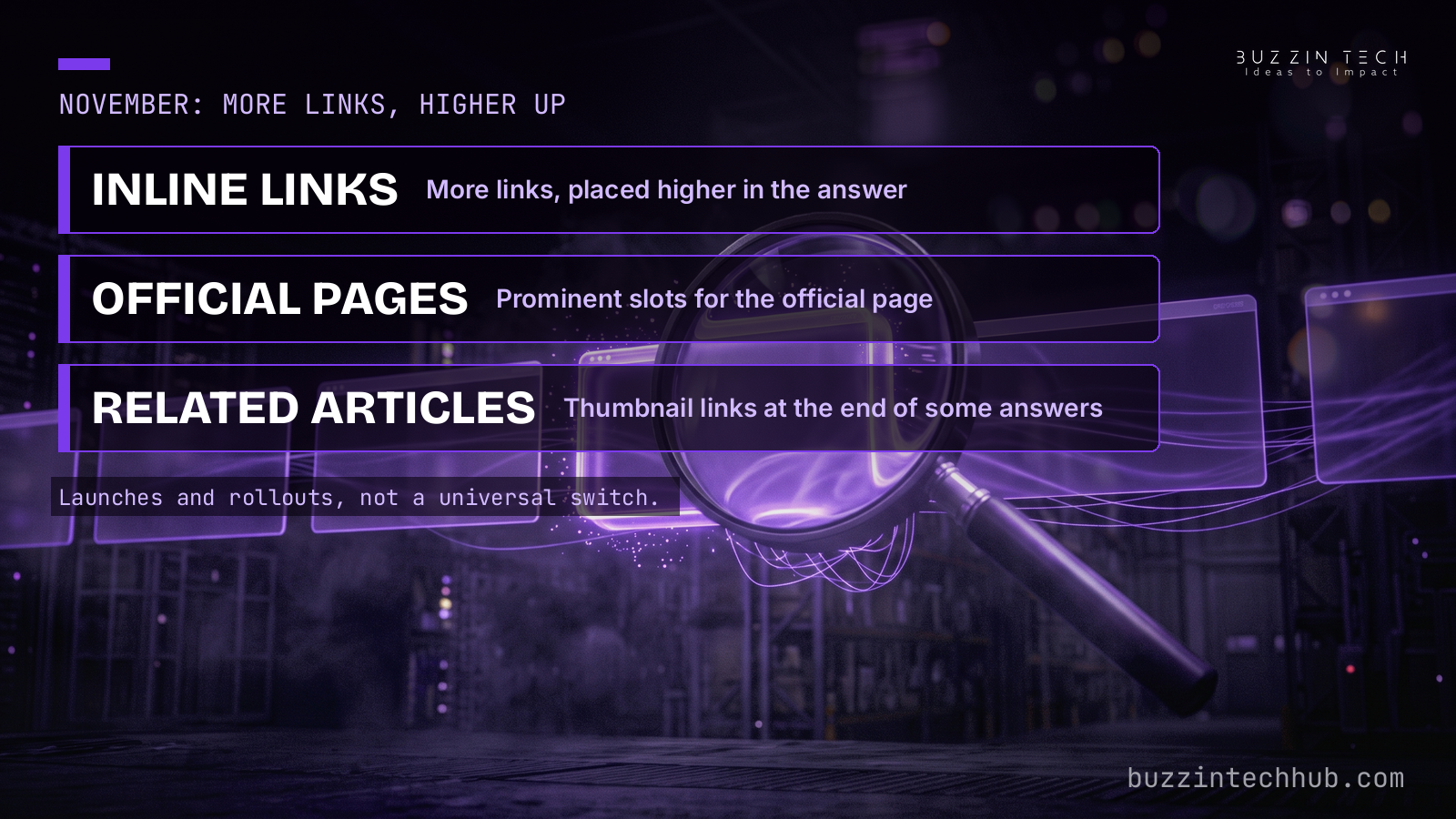
November made the citation slot more valuable, and the change is visible in the answer itself. Google is showing more clickable links, higher in AI Mode and AI Overview responses, plus prominent official-page slots and thumbnail related-article links at the end of some answers, according to the November 2026 SEO and AI search news roundup. These are launches and rollouts, not a universal switch, and the October changes they extend are worth naming: the October 15 update already put publisher links higher in AI Mode and AI Overviews, and November pushes the same direction further.
Two tests are worth watching without assuming they have rolled out. Google is testing AI-written summary descriptions inside AI Overview citation cards, spotted by Brodie Clark: the card text is written by Google's AI from what it judges most relevant to the query, not pulled verbatim from the page.
The owner controls nothing here directly. The lever is page clarity in the first paragraphs and headings, so the summary has clear material to work from.
Google is also testing a "Source preferences" button inside the AI Mode citations sidebar, spotted by Damien Andell, opening the Preferred Sources list in place. A site a reader adds as a Preferred Source gets more prominent placement in their results, including carousels and AI Mode.
The practical step is to implement Google's Preferred Source prompt on the site and earn the add by being genuinely helpful. It cannot be bought or forced.
Check both surfaces separately, because they do not show the same links. Google's guide says AI Mode and AI Overviews may use different models and techniques, so the set of responses and links they show will vary. A page cited in one is not automatically cited in the other.
For local and brand queries, the official page and the Google Business Profile both matter, and AI Mode has been seen citing Business Profiles where AI Overviews cite service pages. Treat that as a check-the-two-surfaces point, not a rule, and run the same query through both surfaces before judging a page.
One context note closes this section. As of November 10, no Google core update is confirmed in progress.
The most recent confirmed update is the September 2026 spam update, which finished on October 8, and the most recent core update is May 2026. Predictions of a late-October or mid-November update are forecasts, not Google statements, and this playbook does not depend on one landing.
Measure the citation, then the click
The measurement close is one paragraph, because the measurement post already exists. Search Console's Generative AI report counts impressions in AI Overviews and AI Mode, and those impressions already sit inside your classic Web totals, so never add the two reports together.
There are no clicks, no click-through rate, and no average position in that report. Our guide to measuring AI search traffic without click data gives the full routine: sort cited pages by impressions, compare page-level clicks over the same dates as correlation rather than proof, and check the answers yourself for placement.
Bing gives a second view of the same question. Bing Webmaster Tools launched Topics Portfolio in beta inside its AI Performance report, grouping the queries where a site is cited in Bing AI answers into topic clusters, with grounding queries where you are already cited and opportunity queries where you could be.
It is beta, and its topic classification is AI-generated, so some queries land in the wrong cluster. Use it as the "where do I already show up" check, and keep the Search Console routine as the record.
Is your brand the one the AI answer names?
We run citation audits that check which money pages are eligible, which sub-questions they fail to answer, and what each rewrite must fix. Then we ship the pages.
See how we run SEO and AEO audits
Frequently asked questions
What does Google require for a page to be cited in AI Overviews?
The page must be indexed and eligible to be shown in Google Search with a snippet. Google states there are no additional technical requirements. Check the page in Search Console URL Inspection first. If Google cannot show a snippet for it, the page cannot be cited, and no amount of rewriting will change that until the eligibility problem is fixed.
Do I need special schema markup for AI Mode?
No. Google's optimisation guide says structured data is not required for generative AI search and there is no special schema.org markup to add. Keep whatever structured data you have matching the visible text on the page, because mismatched markup undermines trust. Schema helps search engines disambiguate your entities. It does not force a citation. The passage does that.
Why is a page cited in AI Overviews but not in AI Mode?
Google says the two surfaces may use different models and techniques, so the responses and links they show will vary. They also fan queries out differently, so each surface retrieves a different set of supporting pages. Check your most important queries in both surfaces separately. A page cited in one and missing from the other needs a check of what the second surface's fan-out is asking for.
How do I find the sub-questions behind my main keywords?
Start with the questions buyers already ask you: sales calls, support tickets, demo requests, and the queries in Search Console. Add the comparison, the price, the setup step, and the failure mode for each money keyword. Give each sub-question its own page with the direct answer in the first paragraphs. If three prospects asked it this month, it belongs on your site.
Can a small site get cited ahead of a big domain?
Yes. Fan-out retrieves the best passage for each sub-question, not the biggest domain. A small site that publishes the single clearest answer, with a checkable fact and a source, takes that slot. The advantage of a small team is speed: it can ship the narrow page this week while a large site is still routing the same page through review.
How do I measure whether my pages are being cited?
Open the Search Console Generative AI report and sort the Pages view by impressions over the last three months. That shows where your links appeared inside AI answers. Pair it with Bing Webmaster Tools Topics Portfolio for topic-level citation shape. Then check your most important queries by hand in both AI Overviews and AI Mode, and note where your link sits: inline in the text, in a card, or in a carousel. Placement decides whether a click is plausible.