A real estate developer CRM should answer one question each morning: what is sold, what is pending, and who owes what. DCC Developers sells units across several projects in Pakistan, and the team had no view of any of it. BuzzinTech rebuilt the website and built two systems around it: a sales CRM and a building management system.
TL;DR
- DCC Developers sold units across several projects, but sales, payments, and building billing ran on manual work.
- BuzzinTech rebuilt dccdevelopers.com and built two systems around it: a sales CRM and a building management system.
- The sales CRM tracks each unit, each buyer instalment plan, payments in, reminders out, penalties, and cancellations.
- The billing system generates bills per building or company-wide and sends each bill by email and WhatsApp.
- Social media runs on a monthly calendar, keeping the projects visible.
The problem: sales across projects, records across desks
DCC Developers sells units across multiple projects. Around each sale sat a chain of manual work: which units were sold, what money had come in, what was still pending, and where each buyer stood on an instalment plan. No single record answered all four questions. Building-level billing ran the same way, by hand, bill by bill.
That is the kind of project our web development work covers when a website alone will not fix the operation. The site had to present the projects properly, and the systems behind it had to carry the sale from booking to the final instalment. One without the other would have left the manual work in place. DCC Developers is part of the Dascon group, a construction group whose child companies also include Eight Square, so the build had to look like a developer of that size, not a single-project brochure.
The website first: one home for every project
We rebuilt dccdevelopers.com as the home for their projects. A buyer or broker lands on one site and finds the developer's projects in one place, instead of chasing details across channels. The site presents the projects properly, which matters when the sale itself runs on instalment plans and trust built over months.
The website was the front door, not the whole job. Its real test was whether it could sit on top of systems that knew the state of every unit. A pretty project page means little if the sales team still cannot say which units are left.
The sales CRM: every unit, every instalment, in one place
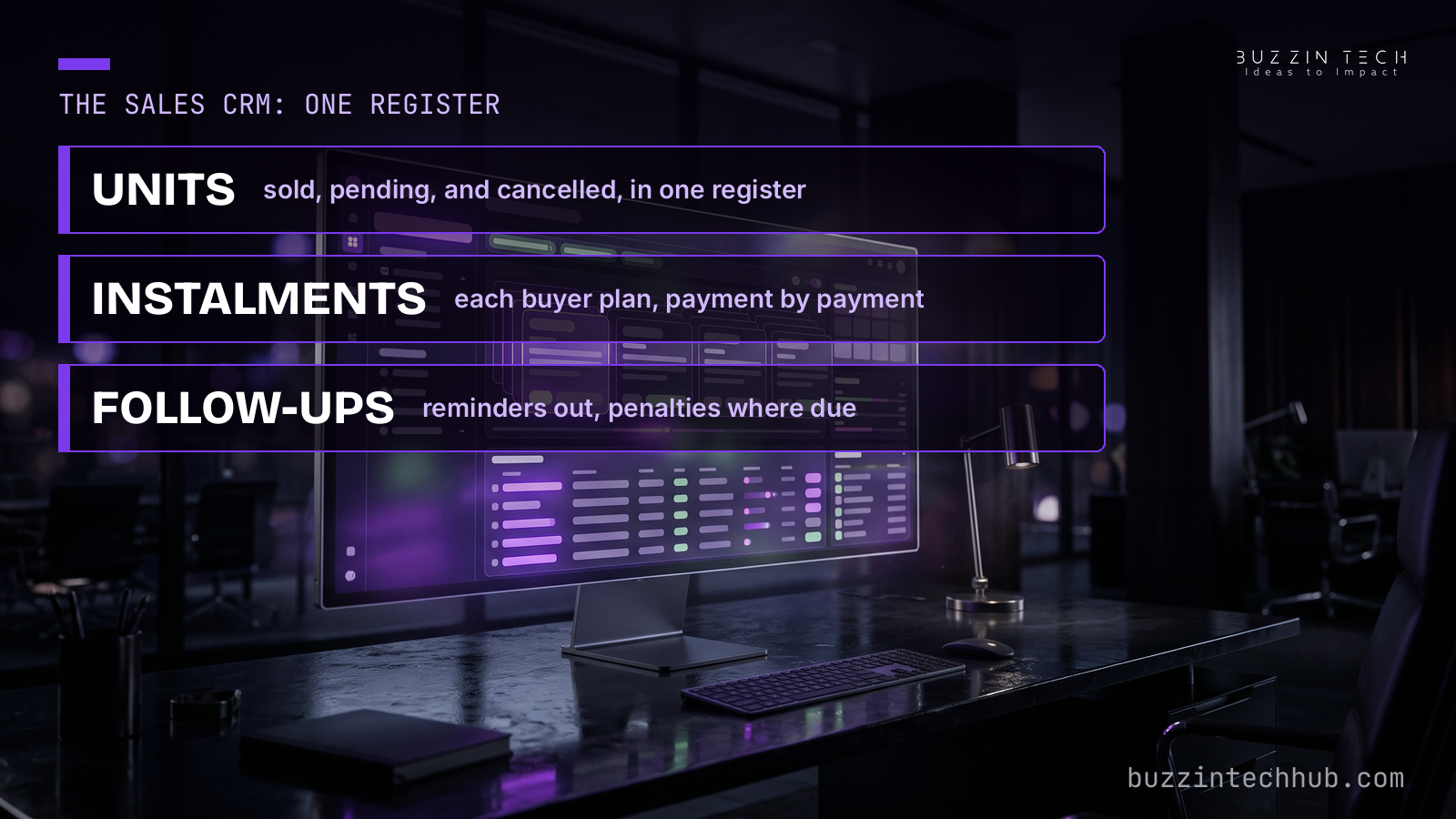
The sales CRM tracks every unit: what is sold, what is pending, each client's instalment plan, payments in, reminders out, penalties where due, and cancellations when they happen. Nothing about a sale lives only in one person's head or one spreadsheet. When a buyer pays, the payment lands against the right unit and the right plan. When a payment goes late, the reminder goes out and the penalty rule applies.
For the sales team, the result is plain: every unit, every payment, and every pending instalment sits in one place.
The building system: bills out on time, without chasing
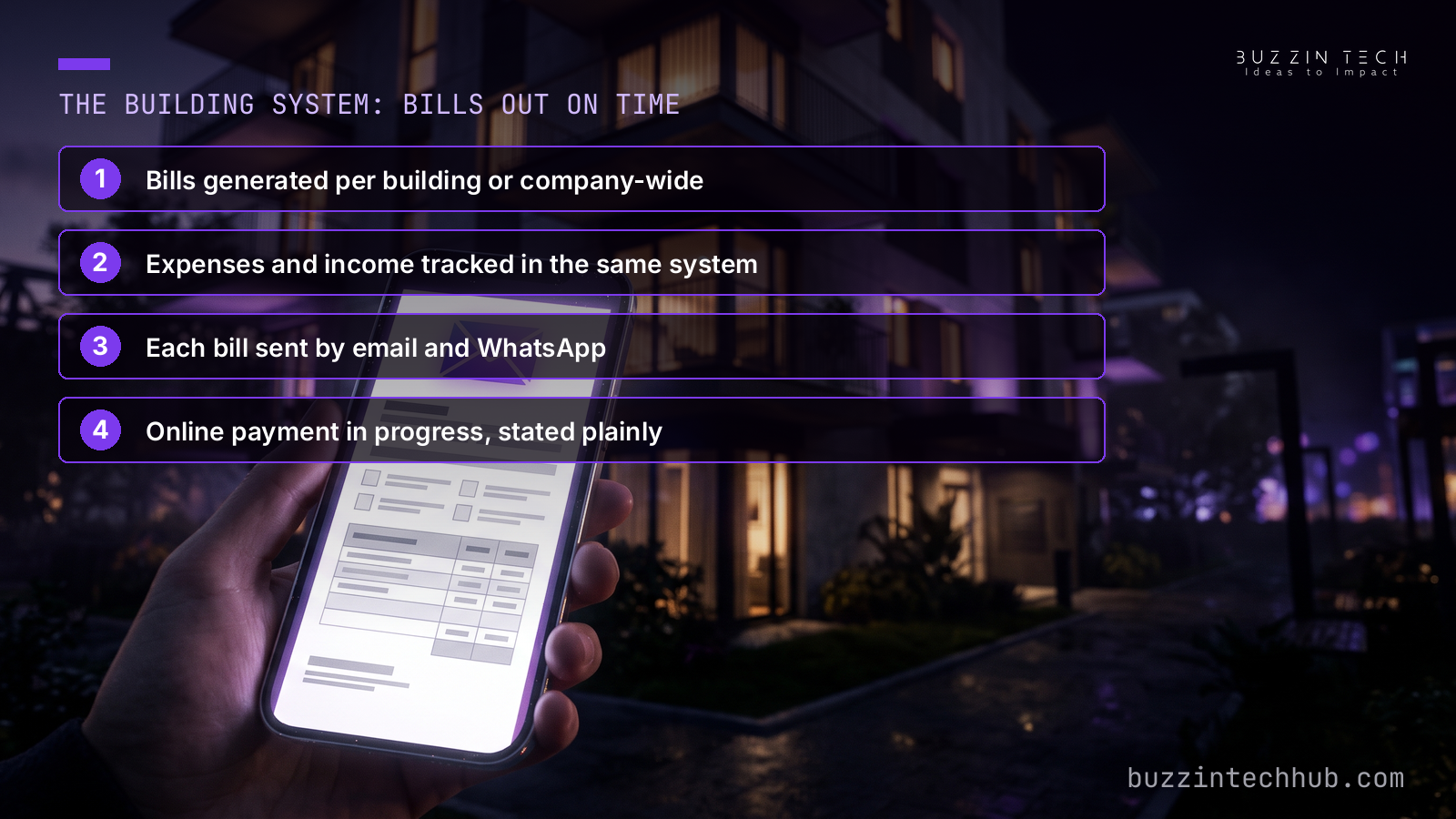
The second system handles the buildings after the sale. It generates bills, tracks expenses and income per building or across the company, and sends each bill straight to the customer's email and WhatsApp. The bill reaches the buyer on the channel the buyer already reads, so the team stops chasing paper and phone calls.
Online bill payment is still in progress, and we say so plainly: the billing system today generates, tracks, and delivers the bill, and the payment step is being added. Bills go out on time, without manual chasing.
What changed for the sales team
The morning question now has one answer. The team opens the CRM and sees what is sold, what is pending, and who owes what, without asking three people and checking two files. Reminders go out on schedule, penalties follow the rule instead of memory, and a cancellation is recorded in the same system as the sale it ends.
The CRM follows the sale the way the team already talked about it, unit by unit and instalment by instalment, instead of forcing a new vocabulary on people who sell property for a living.
We built a similar system for Eight Square, a Dubai developer, where the CRM follows brokerages, bookings, and instalment aging for a luxury launch. The DCC build is the Pakistan-side version of the same idea: the sale is the unit of work, and the system follows it to the end.
The method: four steps, applied to a developer's back office
We build like it is our own company. Every project gets senior engineers and marketers, no account managers, and a direct line to the people doing the work. The method has four steps: 01 Discovery and Architecture, 02 Design and Prototyping, 03 Engineering and Build, 04 Deployment and Scaling.
On this build, discovery mapped the sale and the bill before anything was built: the unit, the instalment plan, the payment, the reminder, and the bill. Design shaped the website and the two systems around those flows. Engineering built them. Deployment put the website, the CRMs, and the monthly social calendar in the client's hands, with online bill payment still to come.
The DCC project sits in our case study list alongside the other Friday builds, including the Beldiglam packaging system. Each one follows the same method and the same rule: the system must match the way the client actually works, or it will not get used.
Selling units across more than one project?
If the sale, the instalment plan, and the building bill live in three different places, the website is not the only fix. See how we build developer websites and CRMs: web development services
Frequently asked questions
What does a real estate developer CRM track?
Each unit, each buyer, and each payment. For DCC Developers, that means what is sold, what is pending, each client's instalment plan, payments in, reminders out, penalties where due, and cancellations when they happen. The point is one record per sale that the whole team can read, instead of separate notes held by separate people.
How is the sales CRM different from the building management system?
The sales CRM follows the sale: units, buyers, instalment plans, payments, reminders, penalties, and cancellations. The building management system follows the building after the sale: bill generation, expense and income tracking per building or company-wide, and delivery of each bill to the customer. Two systems, two jobs, one developer.
Does the system handle instalment plans and penalties?
Yes. Each client's instalment plan lives in the sales CRM, payments are recorded against it, reminders go out when a payment is due, and penalties apply where they are due. A late payment is a tracked event with a follow-up, not a note someone has to remember to send.
How do buyers receive their bills?
Each bill goes straight to the customer's email and WhatsApp from the building management system. The buyer gets the bill on channels already in daily use, which is why bills go out on time without manual chasing from the team.
Is online bill payment available yet?
Not yet. Online bill payment is in progress. The billing system today generates bills, tracks expenses and income per building or across the company, and delivers each bill by email and WhatsApp. The payment step is being added, and the published case study states that plainly rather than claiming it as done.
What else did BuzzinTech build for DCC Developers?
A rebuilt website at dccdevelopers.com as the home for the developer's projects, and social media management on a monthly content calendar. The published case study lists three areas: web development, custom CRM, and social media management. The website and the content present the projects; the two systems carry the sale and the billing behind them.
More from Buzzin Tech Hub
- Another case study from the same pillar: Custom CRM for real estate developers: Eight Square
- Browse the full archive: BuzzinTech blog