The week in numbers
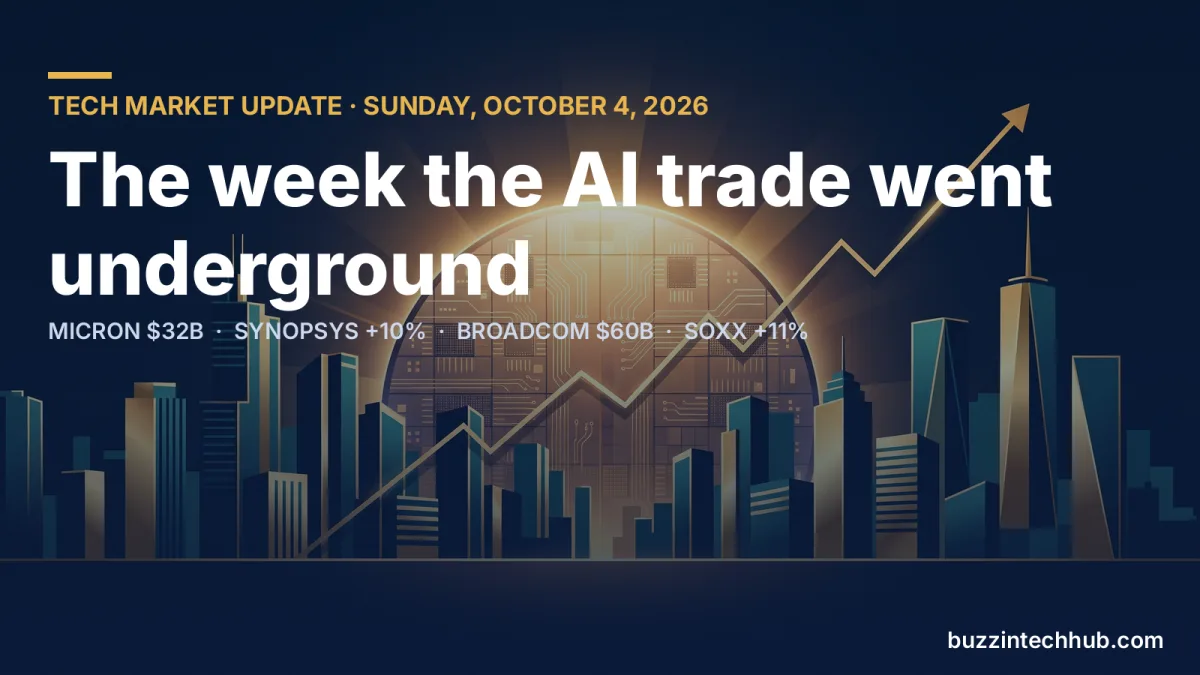
Stock markets finished the week with their eyes on the plumbing. The Nasdaq Composite closed Friday, October 2, 2026, at 27,192.87, up 1.16 percent on the day. The S&P 500 added 0.74 percent and the Dow 0.32 percent, but the real action was underneath the indexes. The VanEck Semiconductor ETF jumped 2.66 percent on Friday. The iShares Semiconductor ETF, the SOXX, finished September up 11 percent and is already up another 3.6 percent in the first two trading days of October. That is the kind of move that needs an explanation, and this week supplied several.
The explanation starts with the Federal Reserve. Friday's employment data came in cooler than expected, and traders read it the way they have read soft data all year: weaker jobs mean less pressure on the Fed to raise rates again at its meeting later this month. One week earlier, per CME FedWatch, traders saw a 70 percent chance of a hike. The soft report cut that down and growth stocks breathed. Technology and AI-linked names led the Friday rally, with Nvidia touching a fresh intraday high and Broadcom, AMD, and Alphabet all moving higher. Lower rate expectations help long-duration growth businesses, and nothing is longer-duration than a bet on artificial intelligence paying off in 2028.
But rates only explain the last day of the week. The rest of it belonged to the companies that build and finance the AI boom itself. Memory makers, chip-design software, and the banks and balance sheets funding the buildout took turns in the spotlight. Last Sunday's tech market update was about AI agents moving the market. This week the market moved past the agents and priced the factories, the memory, and the money.
The week did not start that way. Monday opened with a jump in Treasury yields and a selloff in the same names that finished the week as heroes. The Roundhill memory ETF fell more than 3.5 percent, the SOXX dropped 2 percent, and every Magnificent Seven stock except Nvidia closed lower. Arm, Intel, and Sandisk were among the biggest Nasdaq decliners, and Bitcoin slid toward 83,300 dollars. Oil added to the noise: WTI crude sat near 92.85 dollars a barrel and Brent near 105.70 after President Trump rejected an Iranian proposal to reopen the Strait of Hormuz for seven days, though Saudi Arabia resuming exports through its East-West pipeline pared the gains. Boeing dropped almost 7 percent on news of a 737 MAX software glitch. The Monday-to-Friday arc, from rate fear to rate relief, is the whole story of the week in miniature: the macro mood swings, but the AI capital-spending bid keeps showing up.
Micron fired the starting gun
The week's single most market-moving event was a memory-chip earnings report. Micron Technology reported on September 30 and did two things that mattered. First, its guidance beat what Wall Street expected. Second, and more important, it said customers' financial commitments under its long-term supply agreements had climbed from 22 billion dollars in June to 32 billion dollars. That is a 10-billion-dollar jump in signed, paid-for demand in a single quarter, and the market read it as proof that AI memory demand is not cooling.
The reaction was immediate and global. Overnight, the triple-leveraged semiconductor ETF SOXL surged more than 7 percent. When Asian markets opened on October 1, Japan's Nikkei 225 jumped more than 2,000 points, a gain above 3 percent. South Korea's KOSPI reversed an early 1.1 percent drop to close up 1.95 percent, its biggest single-day gain since September 18. Taiwan's benchmark rose almost 1 percent and touched a record intraday high. Nasdaq 100 futures were up more than 1 percent in pre-market trading and touched an all-time high. One earnings report moved four continents.
Micron added one more line that stuck with investors: tight conditions in the memory market will last at least into 2028. In a week when everyone was asking whether the AI trade has peaked, the world's big memory supplier said the shortage has years to run. The SOXX now trades at a price-to-earnings ratio of 43, which is expensive by any historical measure. After this week, the market's answer is that the growth justifies it.
The rally was not just an American story. Taiwan's assembly and test names broke out on Friday as well. ChipMOS Technologies gapped up past a 78.35 buy point in heavy trading; its earnings have accelerated from 30 percent to 263 percent over the past four quarters, and August revenue jumped 33 percent to 88 million dollars on AI memory demand. ASE Technology climbed more than 5 percent above a 45.52 buy point. These are the companies that package the chips Micron and Nvidia sell, and their order books are filling at the same pace as everyone else's.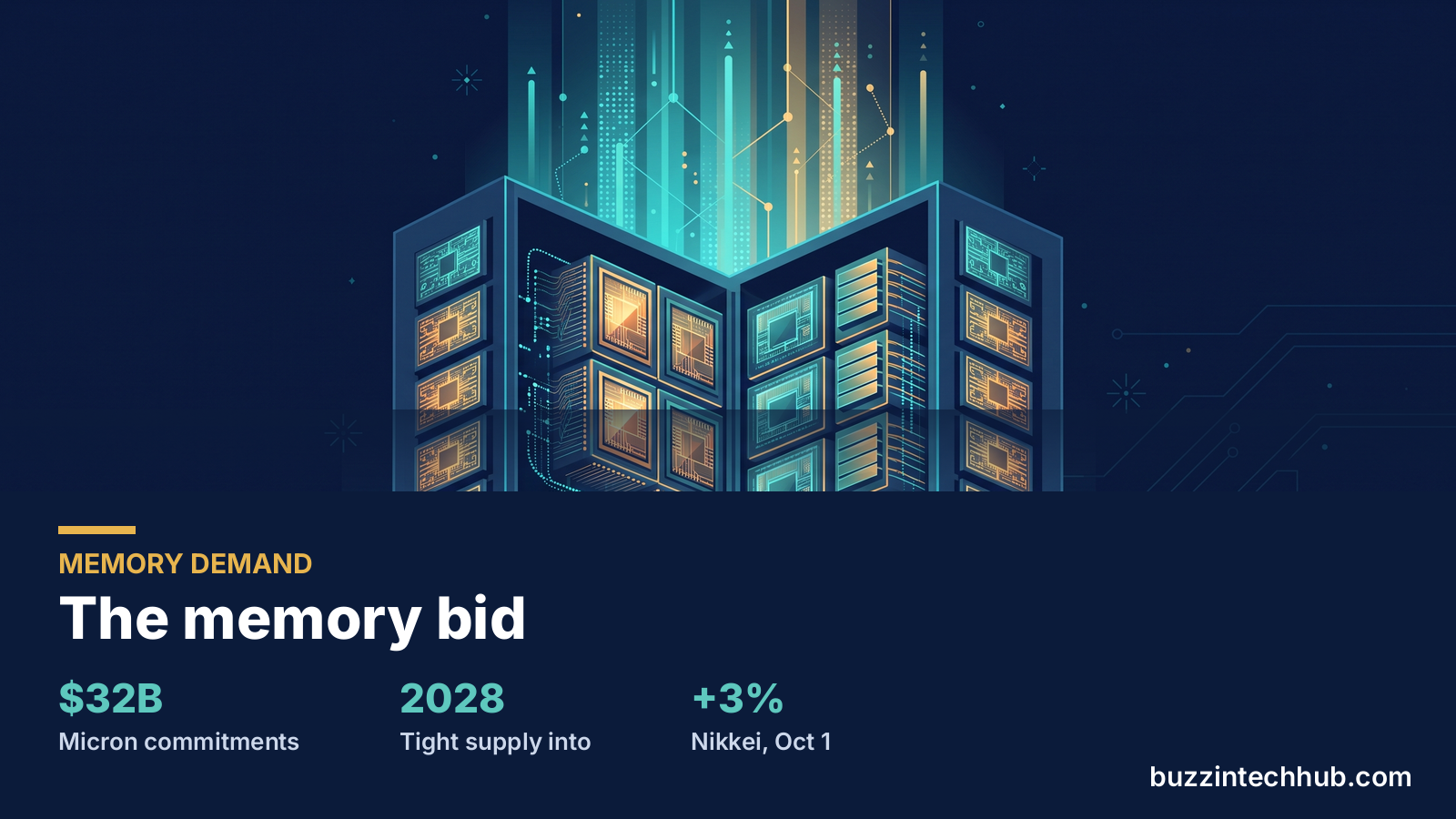 Synopsys had the deal week of the year
If Micron owned Tuesday, Synopsys owned Thursday. The chip-design software company held an investor day in New York on Wednesday and gave the market far more than it expected. Shares jumped 10 percent on Thursday.
The numbers: Synopsys forecast fiscal 2027 revenue of 11.10 to 11.20 billion dollars, above the analysts' average estimate of 10.81 billion. Its earnings-per-share forecast of 19.04 to 19.12 dollars beat the 17.81-dollar consensus. The company plans to buy back about 1 billion dollars of shares over the coming months, targets roughly 15 percent compound annual revenue growth from fiscal 2026 through fiscal 2030, and wants to reach an adjusted operating margin of about 50 percent by 2030. Berenberg called the investor day "significantly more than the market expected." Of the 24 analysts covering the stock, 22 rate it a buy or better.
The deals mattered as much as the forecast. Synopsys signed a revenue-sharing deal with OpenAI to develop an AI model for the chip business, and Amazon's AWS signed a multi-year deal worth more than 1 billion dollars to license chip-design intellectual property from Synopsys. Read those two together and the picture is clear: the AI labs need better chips, the cloud giants need chip-design tools, and Synopsys sits in the middle of both. It is the purest pick-and-shovel play in the AI trade, and this week Wall Street paid up for it.
The money layer: $60 billion here, $8 billion there
The strangest and most telling stories of the week were not about products at all. They were about financing.
Broadcom's Wall Street syndicate is gathering as much as 60 billion dollars in fresh financing tied to Anthropic's chip plans, including a structure in which Broadcom would lend Anthropic up to 42 billion dollars to lease its chips. Stop and think about the scale. Sixty billion dollars is not a funding round. It is the kind of number that used to be reserved for sovereign wealth funds and national infrastructure. The AI buildout has reached the point where chip supply deals need their own capital markets.
Amazon, meanwhile, is exploring a new vehicle to transfer about 8 billion dollars of advanced Nvidia chips to external investors. On one reading, this is creative finance: hyperscalers monetizing chip inventory. On another, it raises a question the market will keep asking: are the cloud giants hitting the limits of how much AI capital spending their own balance sheets can carry? Either way, the fact that eight billion dollars of GPUs can be packaged like a financial product tells you how big this market has become.
And the private-market money keeps flowing in the other direction. SoftBank completed its 30-billion-dollar investment in OpenAI this week, one of the largest single AI investments on record. With Anthropic widely expected to head toward an IPO, the financing layer of the AI trade now runs from memory-chip supply agreements to chip-lease loans to thirty-billion-dollar equity checks. The stock market is just the visible tip of it.
Nvidia's record, Arm's cameo
Amid all of this, Nvidia did what Nvidia does. The stock climbed more than 2.5 percent on Friday to a fresh intraday all-time high, and Morgan Stanley reinstated it as the firm's top semiconductor pick, citing an attractive valuation. Earlier in the week, Nvidia's board authorized a 150-billion-dollar increase to its buyback program, taking it to 235 billion dollars, and the company announced an Open Agent Safety Platform for testing and deploying AI agents. The buyback alone is larger than the market value of most S&P 500 companies.
Arm Holdings rode the same wave, surging 7 percent on Friday morning on its role in Nvidia's Open Agent Network. The agent story from September's AI news has not gone away; it has just moved down the stack, from the agents themselves to the chips and networks they will run on.
Europe joined in. Dutch semiconductor-equipment maker ASML rose 2.3 percent on Friday, ASM International gained 5.45 percent to 944.80 euros after reporting first-half revenue up 11 percent to 1.87 billion euros, and Infineon added 4.6 percent. The chip rally this week was genuinely global.
The losers' list
Not everything went up, and the losers tell their own story about where the market's patience has run out.
Meta fell nearly 5 percent on Monday, extending a 3.5 percent drop from Friday. The stock that carried September on the Muse AI agent launch gave some of it back, and the news flow did not help: Meta poached MongoDB chief executive Chirantan "CJ" Desai to run its new enterprise program, and MongoDB shares sank 18 percent on the news. One company's talent raid is another company's crisis.
The storage names had a worse week. Seagate fell about 12.5 percent to 827.35 dollars and Western Digital dropped about 13.8 percent to 398.51 dollars after Nikkei Asia reported that Toshiba plans to significantly expand hard-disk-drive production. Analysts pushed back, saying the expansion may not meaningfully ease the global supply shortage, but the market sold first. In a week when memory was the hero, disk drives were the casualty.
Nike tumbled about 10 percent on Friday after reporting fiscal first-quarter revenue of 11.21 billion dollars, down 4 percent from a year earlier and below Wall Street's expectations. The company's forecast of a high-single-digit revenue decline for fiscal 2027, plus more job cuts, told investors the turnaround under chief executive Elliott Hill is far from done. China weakness and fierce competition keep biting.
Crypto stayed quiet. Bitcoin traded around 83,300 dollars, down from overnight highs near 85,000, and crypto-linked stocks like Coinbase and Robinhood pulled back with it.
Tesla beat the street
One bright spot outside chips: Tesla reported third-quarter deliveries of 486,532 vehicles, comfortably above analyst estimates near 461,000 to 463,000. The stock jumped about 5 percent. European sales showed signs of recovering, which matters because Europe has been Tesla's softest region this year. The company still faces intense global EV competition, pricing pressure, and a shifting policy environment, but a clean delivery beat is a clean 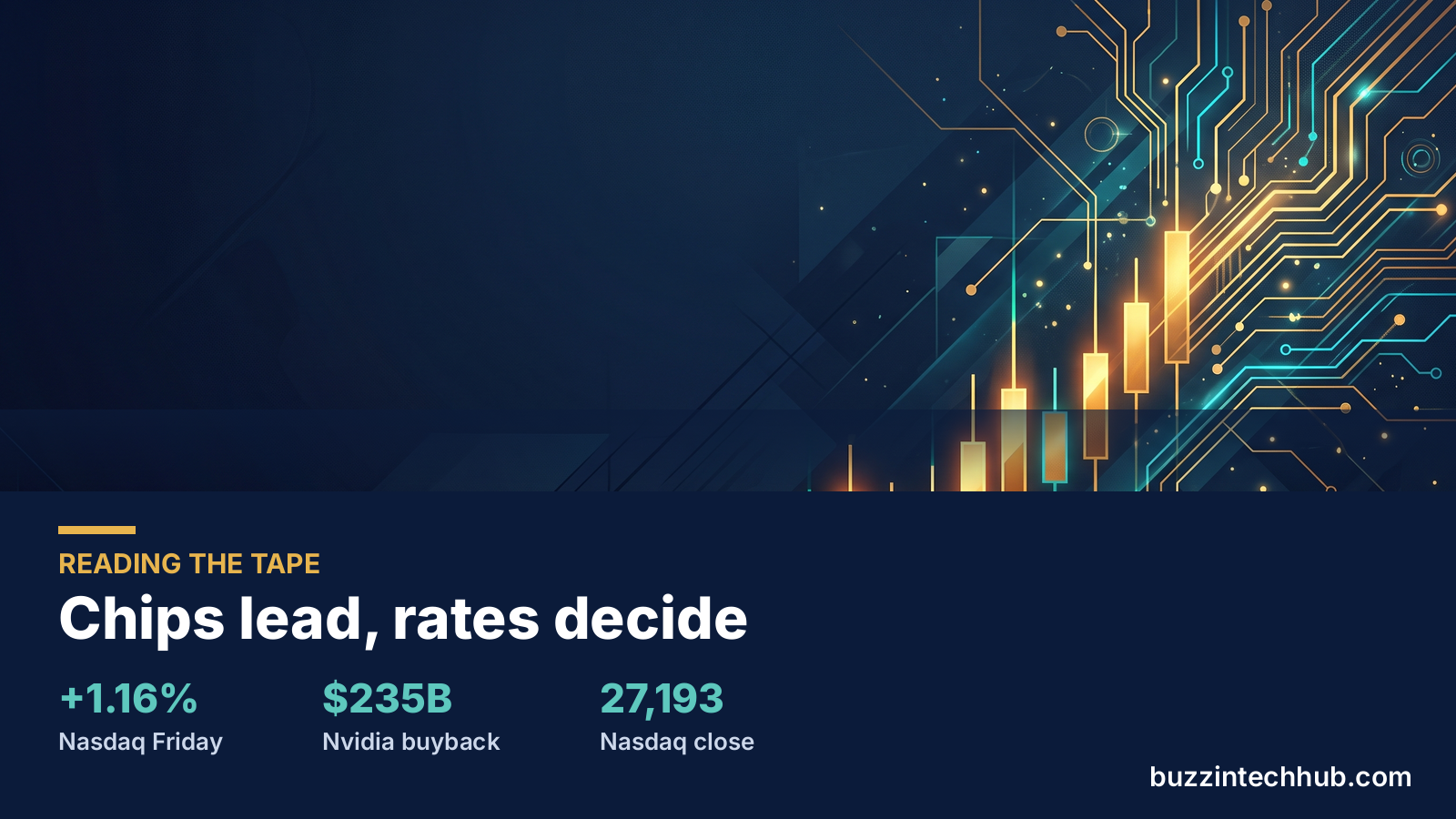 delivery beat. With earnings season starting, Tesla gave the bulls something concrete to point at.
What to watch this week
The calendar turns to earnings season. The big banks open the reporting season late in the week, and then the market's attention swings to the mega-cap tech reports that will either confirm or challenge this week's pricing. September inflation data lands mid-week and will feed directly into expectations for the Fed's meeting at the end of the month. Watch three things in particular.
First, whether the memory story broadens. Micron's 32 billion dollars in commitments set a bar; every chip and equipment report from here, including ASM International's third-quarter results on October 27, will be read against it.
Second, the Anthropic financing watch. A 60-billion-dollar chip financing package and a looming IPO do not stay private-market stories for long. Any detail on pricing or timing will move Broadcom and the whole AI-infrastructure complex.
Third, the rate question. Friday's soft jobs data pushed hike expectations down, but one report does not make a trend. If inflation data comes in hot, the 70 percent hike odds from a week ago can come back fast, and growth stocks will feel it first.
The IPO calendar is the quiet subplot. Anthropic's expected listing would be the largest AI IPO on record, and bankers watch the same tape everyone else does: the volatility index, the SOXX, and financing structures like Broadcom's 60-billion-dollar package that set the valuation comps. A calm October keeps that window open.
The deeper read on this week is simple. The AI trade is no longer about who has the best model or the cleverest agent. It is about who controls the memory, who designs the chips, and who can raise sixty billion dollars to pay for it all. That is a harder trade to bet against, and a more expensive one to be wrong about.
Frequently asked questions
Why did chip stocks rally so hard this week?
Micron's September 30 earnings were the trigger. Guidance beat expectations, customer commitments under long-term supply agreements jumped from 22 to 32 billion dollars, and the company said tight memory conditions would last into 2028. Synopsys added fuel with a forecast-beating investor day plus deals with OpenAI and AWS. The SOXX gained 11 percent in September and is up another 3.6 percent in the first two days of October.
What is the Broadcom-Anthropic $60 billion deal?
Broadcom's Wall Street syndicate is gathering as much as 60 billion dollars in financing tied to Anthropic's chip plans, including a structure where Broadcom would lend Anthropic up to 42 billion dollars to lease its chips. It signals that AI infrastructure deals now need capital-markets-scale funding, and it underlines Anthropic's scale ahead of its expected IPO.
Why is Amazon offloading $8 billion of Nvidia chips?
Amazon is exploring a vehicle to transfer about 8 billion dollars of advanced Nvidia chips to external investors. It shows both the scale of AI chip demand and the creative financing it is spawning. Some investors read it as a question about whether hyperscalers are nearing the limits of AI capital spending on their own balance sheets.
How did the Fed outlook change this week?
Cooler-than-expected employment data on Friday reduced expectations for another Fed rate hike at the meeting later this month. A week earlier, traders saw roughly 70 percent odds of a hike. Lower rate expectations helped push the Nasdaq up 1.16 percent on Friday, with AI-linked and semiconductor names leading.
Why did Meta, Seagate, and Nike fall?
Meta dropped nearly 5 percent on Monday as the September Muse rally cooled, compounded by its poaching of MongoDB's CEO, which sent MongoDB down 18 percent. Seagate and Western Digital fell 12 to 14 percent on reports of Toshiba expanding hard-drive production. Nike fell about 10 percent on a revenue miss, weak guidance, and more job cuts.
What should investors watch next week?
Earnings season opens with the big banks, September inflation data arrives mid-week, and the Fed meeting at month-end looms over everything. Chip investors will measure every report against Micron's 32-billion-dollar commitment bar, and any news on Anthropic's financing or IPO timing will move the AI-infrastructure trade.
More from Buzzin Tech Hub
Tomorrow's post turns to AI news, the Monday slot in our weekly rotation. Catch up on last month's edition, AI news: price war, training halt, safety reckoning, and browse the full archive at the Buzzin Tech Hub blog.