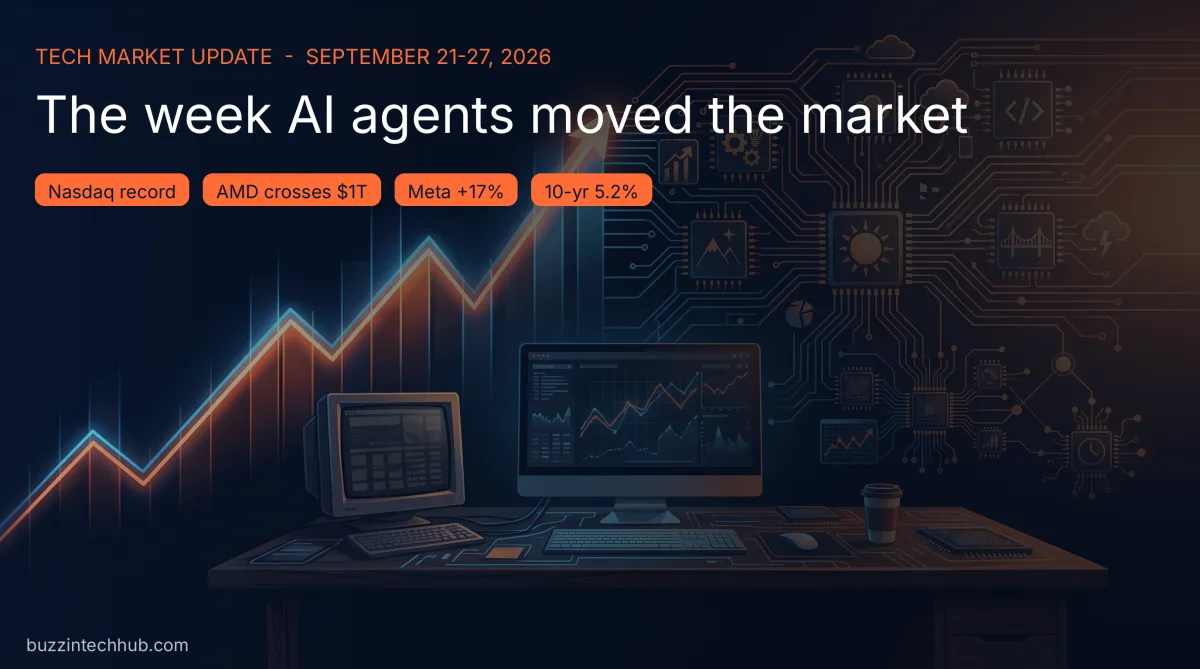
For four and a half months, technology stocks had been doing nothing. The Nasdaq traded in a choppy range just below its all-time highs, absorbing one scare after another: the blowup of an AI-focused hedge fund, a 30 percent correction across semiconductors, renewed tension in the Middle East, and interest rates grinding toward multi-decade highs. Each selloff was bought. Each rally faded. Nothing resolved.
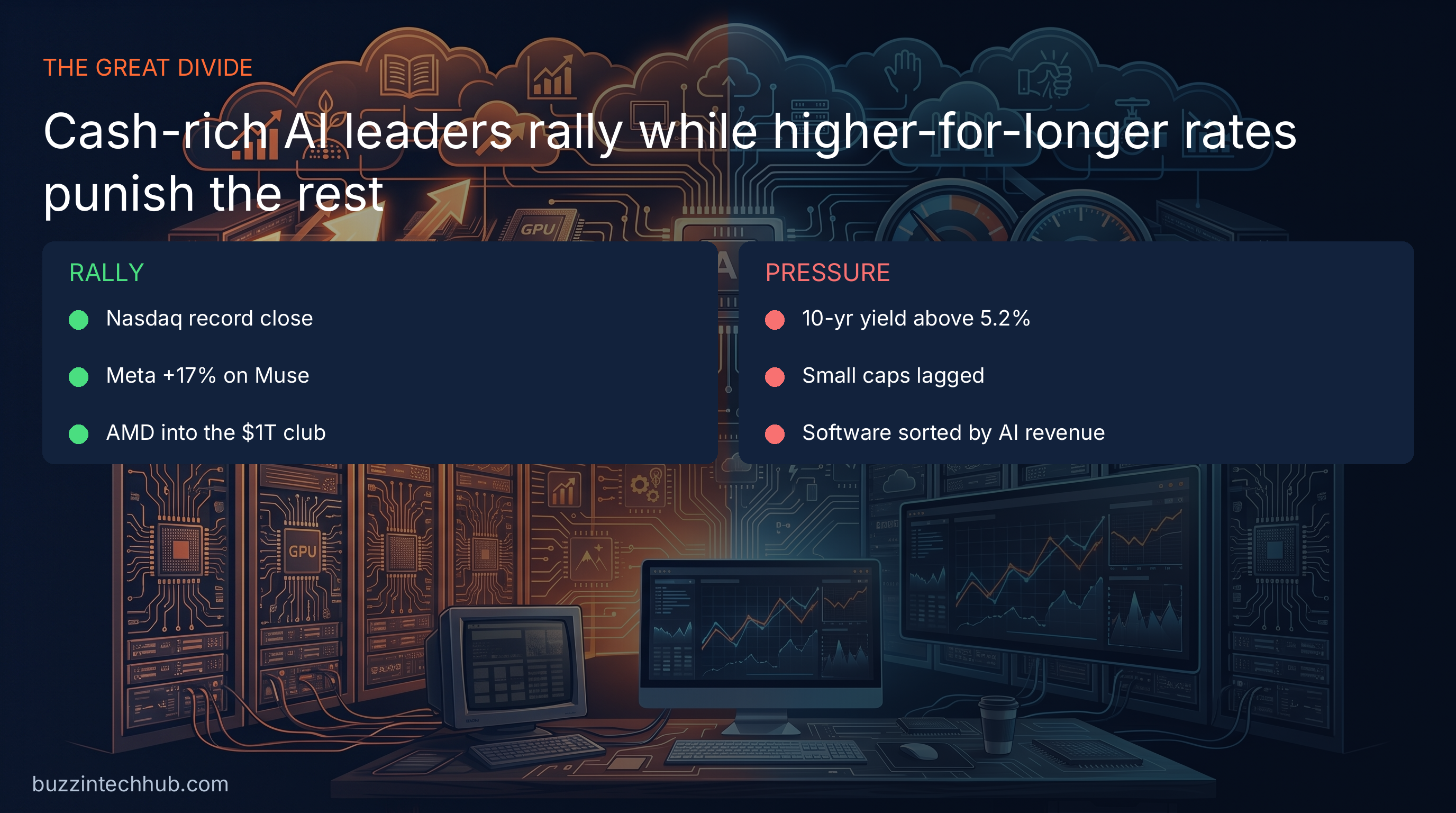
The week of September 21 changed that. A single product launch, Meta's Muse personal AI agent, gave the market the catalyst it had been waiting for, and the technology sector broke out to the upside. The Nasdaq Composite closed at a record. The S&P 500 gained 1.2 percent on the week. Technology was the best-performing sector in the market, up 3.1 percent, with healthcare a distant second at 1.57 percent, while the iShares Semiconductor ETF jumped 6.2 percent. Large caps beat small caps, growth beat value, and energy and utilities brought up the rear, down more than 3 percent each. All of this happened with the 10-year Treasury yield sitting above 5.2 percent, its highest level since June 2006. That combination, surging tech stocks alongside surging yields, tells you everything about where this market's conviction now sits: proof of AI revenue is outweighing the cost of money.
This is the Sunday market update for the week ending September 25, 2026: the Muse rally, AMD's entry into the trillion-dollar club, a $11.6 billion AI infrastructure deal, the rate squeeze that refuses to matter, and the warning from inside the Federal Reserve that the AI buildout is getting big enough to break things.
Meta's Muse gives the market its catalyst
Two weeks after launch, Meta's Muse had done something no AI product had managed in months: it gave analysts a concrete revenue story to point at. Muse is a personal AI agent that runs inside a dedicated cloud-based virtual machine, which means it creates persistent computing demand rather than the one-shot queries of a conventional chatbot. Early consumer adoption was strong enough that Meta shares jumped more than 11 percent on Monday, September 21, the stock's best single-day performance since the market turmoil of April 2025. By Thursday the shares were up 17 percent on the week.
The move mattered less for what it said about Meta than for what it implied about everything around Meta. If personal AI agents catch on, the infrastructure math changes. One widely cited estimate put the CPU-to-GPU ratio for agent workloads at anywhere from 4:1 to 40:1, depending on the task, compared with the GPU-heavy setups built for training and running conventional generative models. That single ratio repriced the entire chip complex in a week, because it meant the next phase of AI spending might need vastly more server CPUs alongside GPUs. The agent era, as we explored in our piece on inference scaling laws and autonomous coding agents, shifts compute from training clusters to persistent inference, and the market just got its first tradable proof point.
AMD crosses $1 trillion as the chip complex runs
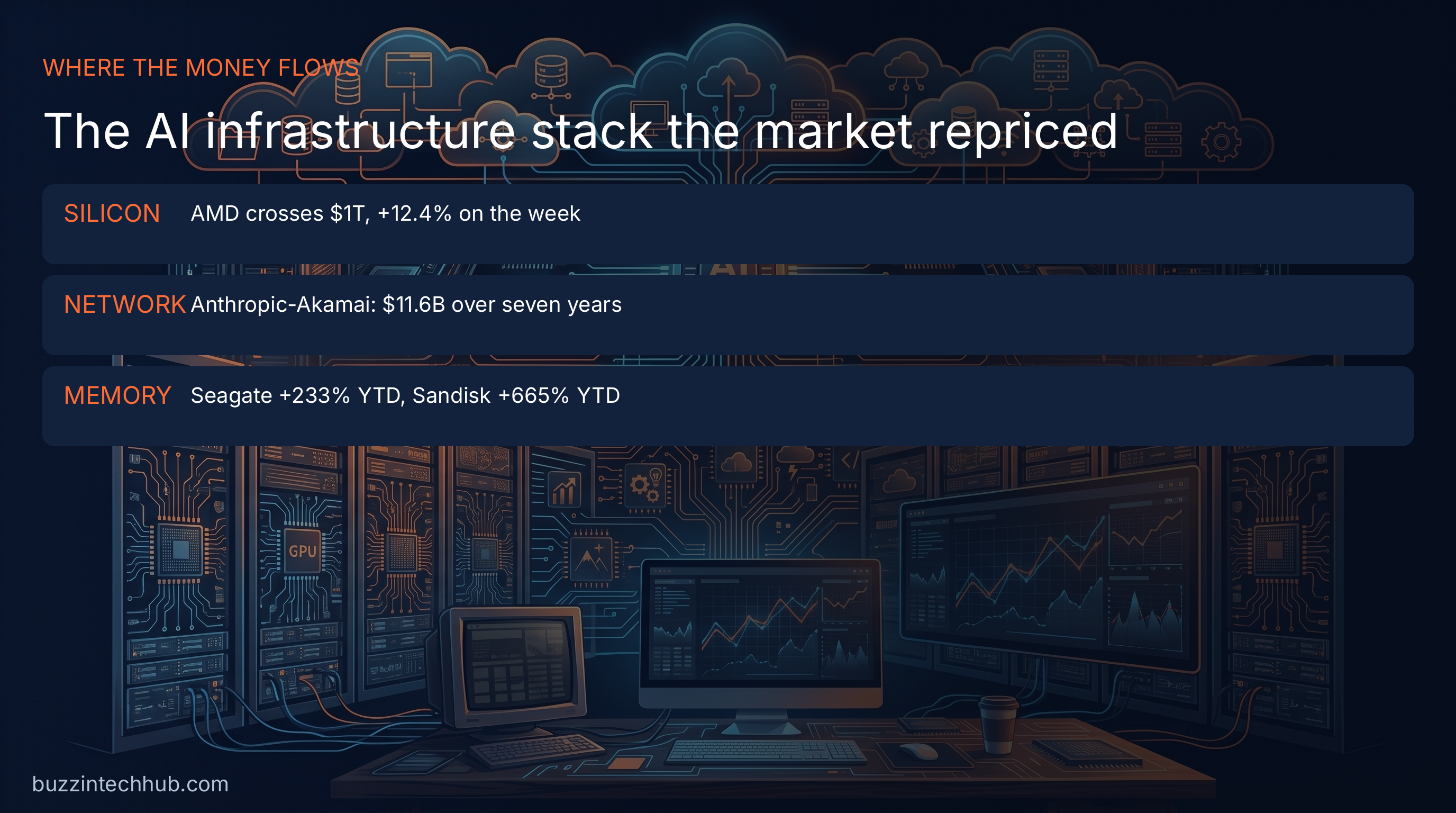
Advanced Micro Devices crossed a $1 trillion market capitalization for the first time this week, capping a year-to-date gain of roughly 185 percent. The stock rose 12.4 percent on the week. Bank of America raised its price target from $620 to $720, arguing that AMD's server CPU total addressable market could nearly triple to $211 billion by 2030 as AI agents drive demand for computing infrastructure. Some forecasts now reach $750 a share.
AMD was not alone. Intel gained 17 percent on the week, a notable move for a company whose AI narrative has lagged its rivals for two years. A CPU-demand story flatters Intel more directly than a GPU-demand story, since its AI positioning leans on Xeon server chips and client silicon rather than discrete accelerators. Arm Holdings added 17 percent in a single session, which is arguably the most structurally interesting move of the group: Arm licenses architecture rather than selling finished chips, so a one-day surge of that size implies traders are betting on royalty and licensing volume across a widening base of AI-capable devices, not just a handful of hyperscaler contracts.
The memory trade kept running underneath it all. A global shortage of memory chips has turned the sector into one of 2026's strongest: Micron kept climbing, Seagate Technology is up 233 percent this year, and Sandisk is up an extraordinary 665 percent. When storage manufacturers become momentum leaders, it tells you the AI buildout is still supply-constrained at the most basic physical layer. Our Q3 2026 tech market update mapped this dynamic in detail: hyperscalers are spending at a $228 billion annualized pace, and the semiconductor supply chain is capturing the cash flow first.
Anthropic signs an $11.6 billion deal with Akamai
The week's largest AI infrastructure headline was not a chip order. Anthropic agreed to pay Akamai Technologies at least $11.6 billion over seven years for cloud infrastructure and software, with provisions for a $9 billion expansion that would take the total commitment to around $20 billion. Akamai will also grant Anthropic warrants representing roughly 5 percent of its outstanding stock. The announcement sent Akamai shares up more than 17 percent after hours; the stock finished the week up 6.8 percent.
The deal matters for what it says about where frontier AI workloads are going. Scaling these systems is creating enormous demand beyond GPUs: CPUs, networking, and distributed cloud capacity. Akamai's edge network, built for content delivery, turns out to be well suited to serving inference workloads close to users. It adds to upwards of $2.8 billion in multi-year cloud commitments Akamai had already announced this year, and it confirms the pattern from our Q3 analysis: the infrastructure layer keeps finding new buyers while application software waits for its monetization moment.
Oracle's Stargate snag shows the other side
Not every AI infrastructure story went up. Oracle shares fell 3 to 4 percent in the September 24 session on signs of delay risk at a Stargate data-center site in New Mexico. The episode captures the industry's growing execution problem: turning enormous investment commitments into actual operating data-center capacity is getting harder, not easier, as power constraints, permitting, and construction timelines bind.
This is the risk the bull market keeps underpricing. Announcements of hundred-billion-dollar buildouts are easy; energizing them is not. Every week that capacity slips, the gap between committed capital and revenue-generating compute widens, and the market's patience for that gap is the variable to watch into year-end.
The constraint is physical before it is financial. Advanced AI data centers now draw power at a scale that strains local grids, and the queue for electrical interconnects, transformers, and permits stretches years in the hottest markets. TSMC's advanced packaging lines are running at full utilization, memory is allocated, and construction crews are booked. In that environment, a delay at one flagship site is not an isolated mishap; it is a preview of the frictions every large build will face. The stocks priced for flawless execution are the ones with the most to lose when the ground shifts.
The rate squeeze that refuses to matter
Here is the genuinely strange part of the week. The 10-year Treasury yield climbed above 5.2 percent, its highest since June 2006. The 30-year pushed above 5.5 percent. The 2-year briefly topped 4.9 percent. Weak demand from foreign buyers at a five-year Treasury auction on September 23 added to the pressure, and Fed officials kept sounding notes that rates could stay higher for longer. By the conventional playbook, richly priced technology stocks should have sold off hard. Instead they rallied.
The market's logic, whether you buy it or not, goes like this: the largest technology companies are now treated as cash-flow havens, uniquely able to absorb elevated capital costs that smaller, debt-reliant growth firms cannot. The immediate spark was Muse's viral adoption, but beneath it sits a real shift in how institutions categorize Big Tech. When Microsoft, Meta, and Alphabet generate tens of billions in quarterly free cash flow, a 5 percent discount rate is an annoyance, not a threat. The pain lands instead on smaller software names and unprofitable growth, which is exactly where this week's losers clustered.
Energy fell 3.07 percent and utilities dropped 3.04 percent on the week, the two worst sectors, while growth stocks gained 2.33 percent and value fell 0.35 percent. West Texas Intermediate crude dropped 6.86 percent to $92.70 a barrel. Gold inched up 0.54 percent to $4,321.30. The tape is telling a consistent story: capital wants AI exposure and is willing to pay up for balance-sheet safety to get it.
There is a reasonable debate about how long the decoupling lasts. Bond investors are pricing a world where inflation stays sticky and the Fed stays tight; equity investors are pricing a world where AI productivity bails everyone out. Both can be right for a while, but they cannot both be right forever. If yields keep climbing toward 5.5 percent on the 10-year, even cash-rich mega-caps start to feel the discount-rate math, and the first place it shows up is usually the multiple, not the earnings. For now, though, the market has voted: proof of AI revenue beats the cost of money.
Software's split screen
Beneath the index-level calm, software had a week of sharp dispersion. Microsoft was the best performer in the Dow, rising 3.7 percent to $516.17 for its highest close since November, after announcing new capabilities for its Copilot app. The push to monetize AI inside the world's most-used productivity suite is the software story the market wants to hear: real distribution, real pricing power, real revenue.
The losers told the other story. Zscaler fell after announcing management changes. Twilio lost ground on an analyst downgrade. Costco pulled back after earnings, as investors fixated on slower membership growth rather than the revenue and profit beats. None of these are AI-infrastructure names, and that is the point. In a 5-percent-yield world, software companies are being sorted into two buckets: those with a credible AI revenue line and those without one. The median public SaaS multiple sits near 5.8 times forward revenue, down from 12 to 15 times in the 2020-2022 peak, and the market is in no mood to pay up for growth that cannot point at AI.
A Fed president says the quiet part out loud
Kansas City Fed President Jeff Schmid gave the week its most sobering quote. He warned that the rapidly expanding AI and data-center ecosystem is becoming interconnected enough to pose systemic risks, drawing an explicit parallel with the lessons of the 2008 financial crisis. The phrase making the rounds: parts of the AI boom are getting "too big to fail."
It is worth sitting with that for a moment. The same buildout driving the rally, hundreds of billions in committed CapEx, circular deals between labs and cloud providers, warrants and equity stakes binding customers to suppliers, is creating the kind of dense counterparty web that regulators learned to fear eighteen years ago. Nobody is predicting a 2008 repeat. But when a Fed president starts using that vocabulary, it belongs in your risk file. The market, for now, shrugged: the Dow rose 407 points on Friday to 51,756.66, the S&P added 0.44 percent to 7,737.70, and the Nasdaq gained half a percent to 27,074.78.
Asia and crypto confirm the risk bid
The rally was not a US-only story. In Singapore, the Straits Times Index gained 1.0 percent on the week as bank stocks climbed: OCBC rose 2.0 percent, UOB 1.9 percent, and DBS 1.5 percent, with market concerns about their net interest margins easing as rates rose. Singapore REITs stayed under pressure from the same higher yields, with Frasers Logistics and Commercial Trust down 2.8 percent. The pattern rhymes with the US tape: capital is paying for assets that benefit from higher rates and AI spending, and selling anything that merely suffers from them.
Crypto joined the risk bid as well. Bitcoin held near $84,000 even as more than $15 billion in options expired, and Strategy, the former MicroStrategy, followed Bitcoin sharply higher off its recent lows. Strength in speculative technology alongside crypto-linked assets is the classic signature of returning risk appetite. It also fits the week's deeper theme: when investors decide the AI story has fresh legs, the bid starts at the highest-beta corners and works inward.
Bonds, for their part, kept flashing amber. The 10-year yield's climb to 5.17 percent from 5.01 percent the prior week came with the 2-year at 4.81 percent, and the curve's message is unambiguous: the market expects the Fed to stay restrictive. Large-cap stocks gained 1.25 percent on the week while small caps managed only 0.05 percent, another sign that this is a balance-sheet rally, not a broad one. When money is expensive, investors rent safety from the companies that print cash.
What to watch next week
The calendar gives the rally a few near-term tests. Progress Software reports third-quarter results after the close on Wednesday, September 30, with analysts expecting $1.52 in earnings per share on about $246.7 million in revenue. It is a small name, but in this market every software print is a referendum on the AI-monetization story. Investors are also tracking US-China talks for signals on Taiwan and semiconductor trade, and another round of Treasury auctions will show whether foreign demand stabilizes after the soft five-year sale. August durable goods orders rose 8.4 percent year over year, a reminder that the industrial economy underneath the market narrative is still running hot, which is itself a reason yields may stay elevated.
Bitcoin held near $84,000 into more than $15 billion in options expiries, and crypto-linked names like Strategy rode the risk bid higher alongside speculative tech. If risk appetite is genuinely returning, that corner of the market usually confirms it first.
The bottom line: this was the week the AI trade found its second wind. Not on promises of future models, but on a shipping product with users, a $20 billion infrastructure contract, and a trillion-dollar chipmaker. The open question is whether Muse-level adoption spreads to the rest of the software complex or stays concentrated in the companies that already own the balance sheets. Watch the yields, watch the software prints, and watch whether the agents keep computing.
Frequently asked questions
Why did tech stocks rally so hard this week?
Meta's Muse personal AI agent saw strong early adoption after its launch two weeks ago, which revived investor enthusiasm for agentic AI. Meta rose 17 percent through Thursday, and the buying spread to chipmakers as investors bet that AI agents will drive major new demand for server CPUs alongside GPUs.
What does AMD crossing $1 trillion in market value actually mean?
It marks AMD's arrival as a trillion-dollar company after a roughly 185 percent gain this year. Bank of America raised its price target to $720, arguing the server CPU market could nearly triple to $211 billion by 2030. The milestone also raises the bar: future AI deployments and margins now have to justify the valuation.
Why are Treasury yields above 5 percent a problem for tech stocks?
Higher yields raise the discount rate applied to future earnings, which hurts richly valued growth stocks most. The 10-year yield topping 5.2 percent, its highest since June 2006, would normally pressure tech. This week the market decided Big Tech's cash flows were strong enough to absorb it, but smaller and unprofitable software names still sold off.
What is the Anthropic deal with Akamai?
Anthropic agreed to pay Akamai at least $11.6 billion over seven years for cloud infrastructure and software, with a possible expansion to $20 billion. Akamai also granted Anthropic warrants for about 5 percent of its stock. It shows frontier AI demand extending beyond GPUs into CPUs, networking, and distributed cloud capacity.
Why are memory chip stocks like Micron, Seagate, and Sandisk surging?
A global shortage of memory chips has collided with AI data-center demand. Seagate is up 233 percent this year and Sandisk 665 percent. When storage becomes a bottleneck asset, it signals the AI buildout is still supply-constrained at the physical layer.
What did the Fed's Jeff Schmid warn about?
The Kansas City Fed president warned that the AI and data-center ecosystem is becoming interconnected enough to pose systemic "too big to fail" risks, explicitly invoking lessons from the 2008 financial crisis. He was pointing at the dense web of deals, equity stakes, and counterparty links forming around AI infrastructure.
What should investors watch next week?
Progress Software's earnings on September 30, US-China talks touching Taiwan and semiconductor trade, Treasury auction demand after the weak five-year sale, and whether software companies outside the mega-caps can show real AI revenue.
More from Buzzin Tech Hub
Next up in the rotation, Monday's AI news edition, plus the full archive at https://buzzintechhub.com/blog.php. For the deeper numbers behind this week's move, read our Q3 2026 tech market update and our explainer on inference scaling laws and autonomous coding agents.