An AI search visibility audit asks one question for a set of prompts: which surfaces cite us, with which URL, and for which question? November changed the answer twice in three days. Google started a core update on November 10 and swapped the model under AI Mode on November 12, while OpenAI handed brands their first ChatGPT numbers that week.
TL;DR
- Record citations: cited or not, the URL cited, and whether the brand name or the site got named.
- Check four surfaces with the same prompt set: Google AI Overviews, Google AI Mode, ChatGPT, and Perplexity.
- AI Mode and AI Overviews cited the same URL only 13.7 percent of the time, in an Ahrefs study of 730,000 response pairs.
- Search Console's Generative AI report shows impressions only, and its November 9 to 11 data is a logging error.
Rankings stopped answering the question
Google started the November 2026 core update on November 10 at 10:06 AM Pacific time. It is the third core update of 2026, it applies globally and to all languages, and Google said the rollout may take up to two weeks. As of November 23, the Search Status Dashboard still listed it as rolling out, with no completion notice posted.
That timing matters for any audit run this month: the ground is still moving. In our search engine optimization work, we treat a live core update as a freeze on conclusions, not a freeze on measurement.
Two days after the update began, Google made Gemini 4 Hydrogen the default model in AI Mode for all users worldwide, and the model also answers the hardest AI Overview questions. Google lists four changes: better reading of intent in multi-part questions and typos, improved query fan-out that connects to a broader range of links, more visual answers with images and comparison tables, and better language understanding. Google published no click data for Hydrogen, so any traffic claim about it is guesswork.
Fan-out is the part that changes the audit. One broad question becomes many related searches, and a page can be cited for one sub-question even when it does not rank for the full query. Google's own guide says AI Mode and AI Overviews may use different models and techniques, so the responses and links they show will vary.
Ahrefs measured how far that varies: in a September 2025 study of 730,000 response pairs, the two surfaces cited the same URL only 13.7 percent of the time, even though the answers were 86 percent similar in meaning. SE Ranking measured 10,000 queries and found 9.2 percent URL overlap across repeated AI Mode searches, with 21.2 percent sharing no URL at all.
A rank tracker cannot see any of that. It checks one surface, once, and reports a position. The audit replaces the position with a record: for each prompt, which surface cited the page, with which URL, and whether the citation named the brand or linked the site. That record is the whole audit.
Pick the prompts buyers actually ask
The prompt set is the audit. Start with the questions buyers already ask: sales calls, support tickets, demo requests, and the queries in Search Console.
Add the comparison, the price, the setup step, the failure mode, and the renewal term for each money keyword. A set of 15 to 30 prompts covers a small site. A larger catalogue needs more, but the set stays fixed once it is written down.
Write prompts the way buyers type them, not the way a keyword tool lists them. "How much does n8n automation cost?" is a prompt. "n8n automation agency" is a keyword.
The audit runs the prompt, because the answer cites pages that answer the question. Buyers do not search for how to appear in Google AI Overviews. They search for the price, the comparison, and the setup step, and our guide to getting cited in AI Overviews and AI Mode sets out why the sub-question wins the citation.
Include prompts that name the brand and prompts that do not. A brand prompt shows whether the answer names you at all.
A non-brand prompt shows whether the answer names you when the buyer has not decided yet. Both go in the same sheet, and both get the same weekly run.
Run the same set across four surfaces
Run every prompt through AI Overviews, AI Mode, ChatGPT, and Perplexity in the same week. The same prompts, the same recording sheet.
For each prompt, write down four facts: cited or not, the URL cited, whether the brand name or the site got named, and where the link sat: inline in the text, in a card, or in a carousel. Placement decides whether a click is plausible, and the report never shows it, so the hand check is part of the audit.
Check the two Google surfaces separately, because they do not show the same links. The 13.7 percent overlap means a page cited in Overviews is usually missing from AI Mode, and the reverse. A Google AI Overviews citation audit that checks one surface and reports it as the answer is measuring half the question.
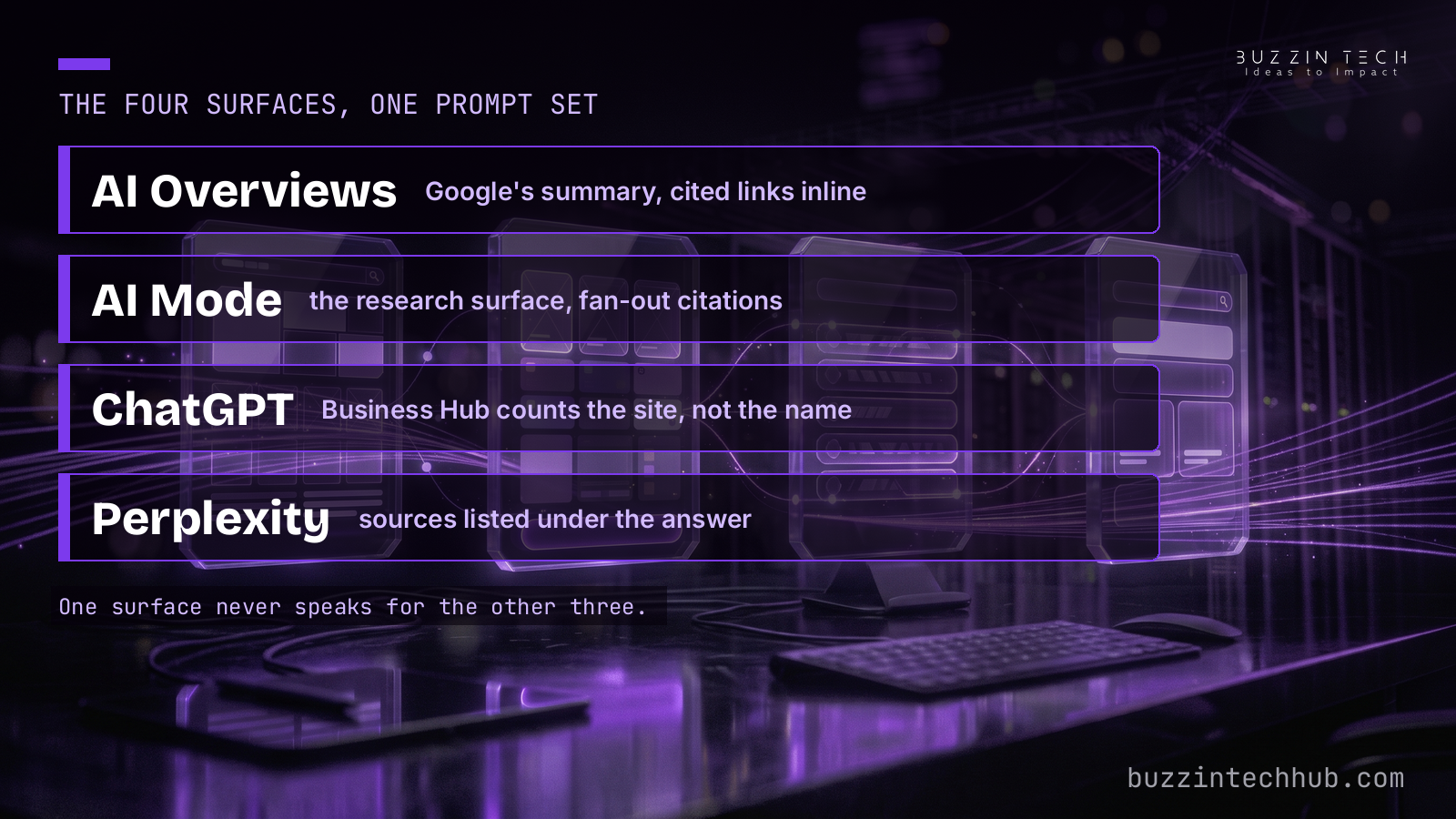
ChatGPT needs its own reading. A brand name in the prose is not a citation.
ChatGPT's Business Hub counts a mention only when an answer references the business's own website, and the brand name alone does not count. Perplexity shows its sources under the answer, so record the source list, not the text of the answer itself.
Read the numbers Google and OpenAI give you
Search Console's Generative AI report is the only first-party record Google gives you, and it shows impressions only: how often links to a site appeared inside AI Overviews and AI Mode, split by page, country, device, and date. It shows no clicks, no click-through rate, no average position, and no queries.
It does not split AI Overviews from AI Mode. Google announced the report on June 3, 2026, and rolled it out to all properties on August 31, 2026. Our guide to measuring AI search traffic without click data gives the full routine for reading it alongside the classic Performance report.
November carries a trap inside that report. Google's data-anomalies page records a logging error that cut impressions on the Generative AI report for data from November 9 to 11, 2026. The note says the issue affects data logging only.
An impressions dip on those three dates is a reporting artefact, not a visibility loss, so exclude those dates from any before-and-after comparison and annotate them in the dashboard next to November 10, when the core update began, and November 12, when Hydrogen went live.
OpenAI's Business Hub is the first first-party record from ChatGPT. It opened in beta on November 10, 2026, and it reports mentions, profile views, website clicks, and discovery topics over 7- and 28-day views.
The limits matter as much as the numbers: a mention counts only when an answer references the business's own website, insights appear only above an unpublished volume threshold, and a blank metric does not necessarily mean zero. There is no share of voice and no competitor benchmark in this beta. Claiming a profile does not change visibility in ChatGPT, and Business Agents are open to US ecommerce and online-service businesses only for now.
One early estimate puts a number on the click side. A small opt-out study reported by Similarweb in November 2026 puts click-through from AI Overviews and AI Mode near 0.9 percent.
Treat it as a single early reading. It is not a settled rate.
The Seer Interactive study from April 2026 gives the other half of the picture: across 53 brands, pages cited inside an AI Overview earned about 120 percent more clicks per impression than uncited pages on the same Overview, and still 38 percent fewer clicks than queries with no Overview at all. Seer states the gap is correlation, so quote the pair together, never the 120 percent alone.
AI Overviews tracking tools can run the same prompt set across more queries than a person would check by hand, and that is worth paying for once the Search Console routine runs every month without fail. A tool can track which answers cite you. It cannot see Google's click split either, so a tool that promises the missing number is estimating, not measuring.
Repeat weekly and re-baseline on every model change
Run the same prompt set every week, on the same day, and record the result in the same sheet. A weekly run is frequent enough to catch a move and slow enough to keep the work honest. The audit earns its keep in the third or fourth week, when the sheet shows which citations hold and which ones flicker.
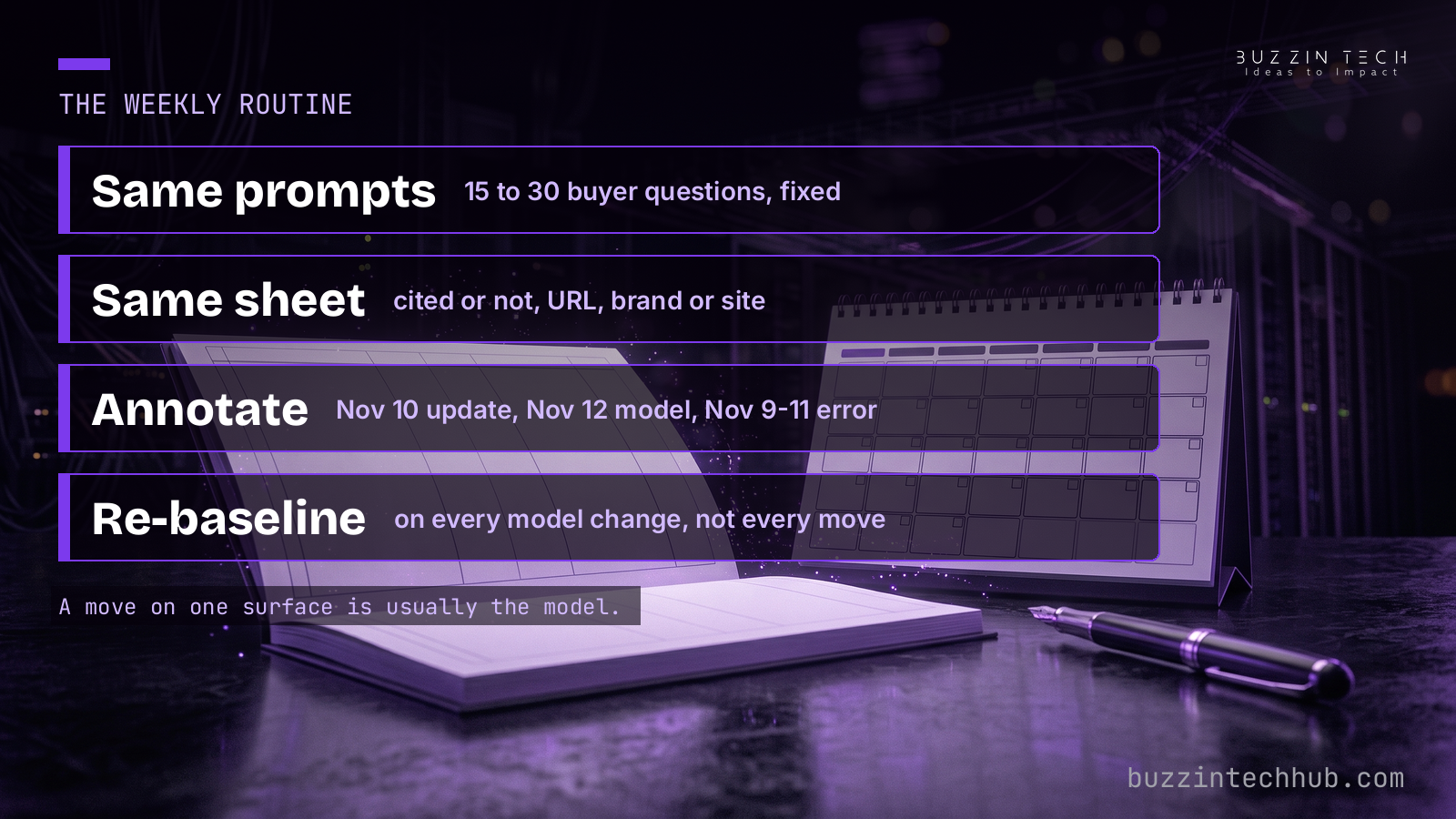
Re-baseline whenever the model underneath changes. Google swapped AI Mode's model on November 12, in the middle of a core update that began on November 10. SE Ranking's numbers explain why that matters: with 21.2 percent of repeated AI Mode searches sharing no URL at all, a citation can move week to week while the page stays the same. A move that shows on one surface only is usually the model. A move that shows on all four surfaces at once is the one to investigate.
Google's own advice sets the pace for Search Console comparisons: confirm the rollout has finished on the Search Status Dashboard, then wait at least a full week before comparing data with the week before the rollout began. As of November 23, the November update had no completion notice, so no comparison window has opened yet. Annotate November 10 and November 12 in every dashboard now, and add November 9 to 11 for the logging error, so the next person reading the chart knows what moved and what was broken.
What an audit cannot tell you
An audit cannot give you an AI click-through rate. Search Console reports AI impressions only, and the clicks from AI answers stay pooled in the classic Performance report under the Web search type, with no way to separate them.
GA4 groups those visits under Organic Search as well. Any vendor report that claims a precise AI click-through rate from those two sources is estimating, not measuring.
It cannot prove a citation caused a click. A cited page can earn more clicks because the citation put it in front of the reader, or because stronger pages get cited and clicked anyway. Seer states its 120 percent gap is correlation.
The audit records what happened. It does not name the cause.
It cannot tell you where you stand against a named competitor, at least not from the first-party tools. The Business Hub beta has no share of voice and no competitor benchmark, and Search Console shows your own pages only.
A prompt-level check across the four surfaces shows whether a competitor is cited for the same prompt. That check is a hand count. No dashboard reports it.
One control sits outside the audit. On October 30, 2026, Google said it will honour a shared robots.txt token for AI training preferences, with support expected in early 2027. That token governs training use, not citation, and it belongs in the site's controls file, not in the audit sheet.
The audit measures what the answers show. The token decides what the models may train on.
Want to know where your brand stands in AI answers?
We run a citation audit that checks which money pages are eligible, which sub-questions they fail to answer, and what each rewrite must fix. Then we ship the pages.
See how we run AI search visibility audits