An AI search visibility service sells one outcome: your brand named inside the answer. The work behind that outcome is a process with six steps. Here is the process we run, step by step, with the numbers we can and cannot report at the end of it.
TL;DR
- A citation retainer runs six steps: audit, quotable pages, entity schema, sprints, decay refreshes, and reporting.
- Seer Interactive found cited pages earned about 120 percent more clicks per impression than uncited pages on the same Overview, still 38 percent fewer than no Overview at all.
- The Generative AI report shows impressions only: no clicks, no queries, no split between AI Overviews and AI Mode.
- We run the same share-of-voice check on our own channels every month, and report it alongside the client's numbers.
Why the citation is the job now
Pew Research Center tracked 900 US adults through March 2025, across 68,879 Google searches. Users clicked a traditional result in 8 percent of visits when an AI summary appeared, against 15 percent without one.
Links inside the summary itself were clicked in only 1 percent of visits. Google publicly disputed Pew's method, so the numbers belong to Pew, and they describe March 2025, before AI Overviews reached their current share.
The shape of the problem is plain even with those limits: fewer clicks reach the results below the answer, so the citation slot matters more. That shift is what our SEO and AEO service is built around. A page can rank first and still sit below an answer that names someone else.
Seer Interactive's April 2026 study measured the other side of the same shift. Its study of 53 brands, 5.47 million queries, and 2.43 billion organic impressions from January 2025 to February 2026 found pages cited inside an AI Overview earned about 120 percent more clicks per impression than uncited pages on the same results.
The same study found cited pages still earned 38 percent fewer clicks than on queries with no Overview at all. Seer states the gap is correlation, and the study cannot prove citation causes it: stronger brands are more likely to be cited and to earn clicks anyway. Quote the pair together, never the 120 percent alone.
Two numbers frame the rest of this post. The first is the 120 percent: a citation is worth real clicks. The second is the 38 percent: a citation is not a return to the old click rates.
Step one: the audit comes before a word of content
Every engagement starts with a 30-point technical crawl and an AI-visibility audit. The audit checks indexing, crawlability, schema, Core Web Vitals, canonical setup, and redirects, and benchmarks how the site appears in Google SERPs, AI Overviews, and ChatGPT.
The output is a 20- to 30-page report with a prioritised fix list and a six-month roadmap. No content is written before the crawl, because a page Google cannot index cannot be cited.
The eligibility rule behind that order is one sentence from Google: a page must be indexed and eligible to be shown in Google Search with a snippet, and there are no additional technical requirements. We covered that rule and the checks around it in the citation playbook we published last week. The audit applies it to every money page first.
The audit also sets the baseline the monthly report measures against. It records which pages are cited already, which sub-questions they fail to answer, and which queries show an AI Overview at all.
Without that baseline, a later report can claim any movement it likes. With it, the client can check every claim in the report against a page they can open.
Step two: build pages an answer can quote
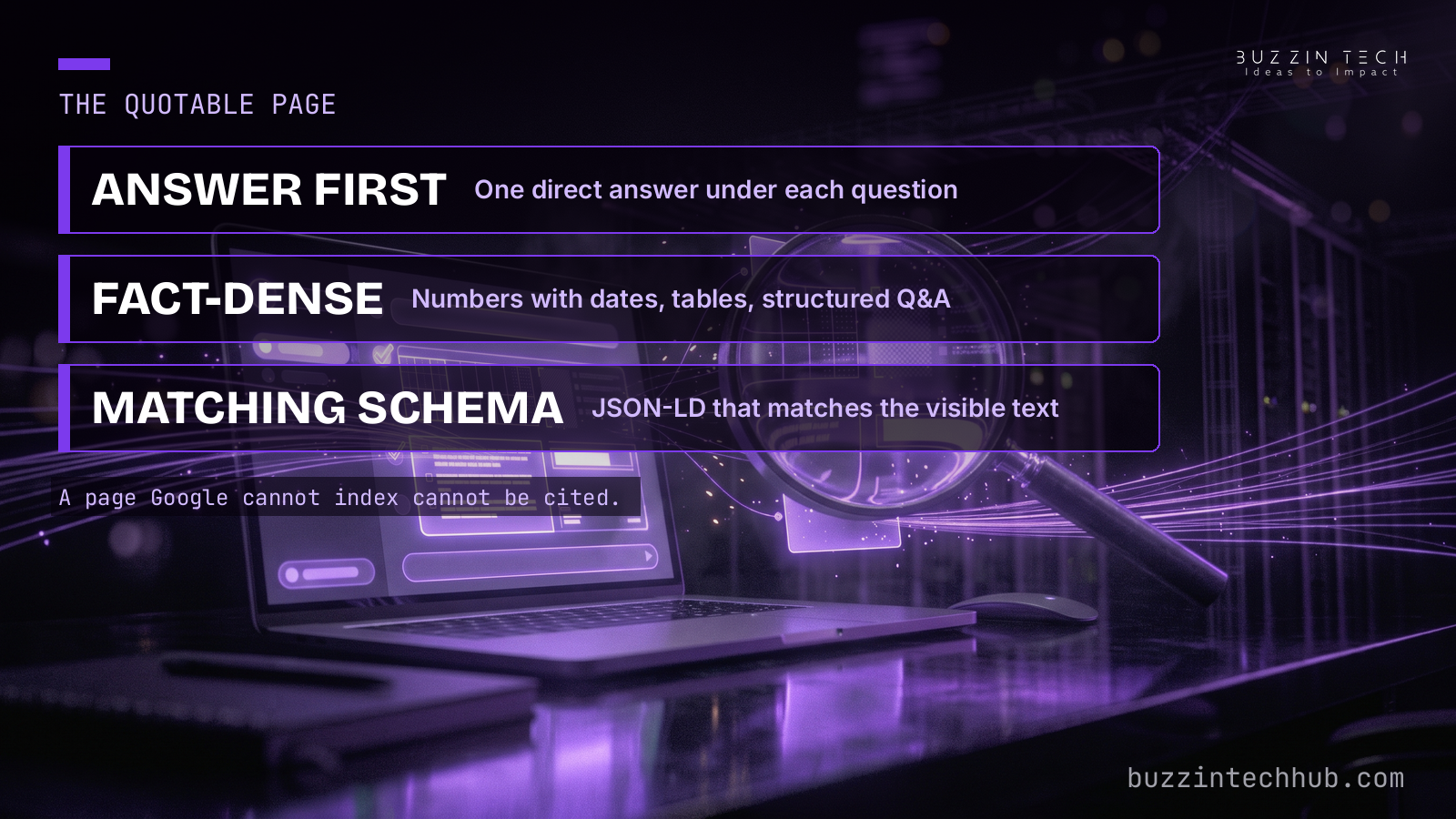
The quotable page is built answer-first. Each question heading gets one short direct answer under it, then the detail. The page carries fact-dense blocks a model can lift whole: a number with a date, a comparison table, a structured question-and-answer section.
A passage that needs the rest of the page to make sense will not be lifted. A passage that stands alone can travel into the answer with the link attached.
We learned the value of that shape on live builds. A custom website we rebuilt with a 4-stage automated quote pipeline (dimension input, instant quote generation, automated follow-up, production triage) now delivers quotes in under 30 seconds, against up to 24 hours by hand before the rebuild, and loads in under 0.9 seconds on UK mobile connections, with 100 percent automated follow-up.
Narrow pages with clear answers and checkable claims did the citing work on that site. The same shape works at thousands of pages. A site we re-architected to generate programmatic store pages for thousands of retail brands, with Schema.org Coupon markup on every page, cut database query latency from 5 seconds under load to under 5 milliseconds, and holds 100,000 plus active codes with 100 percent Black Friday uptime.
Its 301 affiliate redirect gateway answers in under 50 milliseconds. Each page is quotable because it answers one narrow question with a checkable fact.
Speed is part of quotability. A slow page still gets cited sometimes.
A fast page gets crawled more often and read in full, so the citation picker sees the whole answer. That strip-out work is the subject of the WooCommerce speed case study we published last week.
Step three: the entity layer, and the llms.txt argument
The entity layer is code-level JSON-LD that matches the visible text: Organization, Service, FAQPage, HowTo, Article, and BreadcrumbList schema, written in the markup itself. The rule is matching, not extra. Markup that says something the page does not say undermines trust, and Google's guide to AI features says structured data must match the visible text.
Schema helps search engines tell one entity from another. The passage is what earns the citation.
The llms.txt file sits in the same layer, and it needs a straight answer. Google's guide says Google Search does not use llms.txt or similar files, and its June 2026 clarification adds that keeping one will neither harm nor help visibility in AI Overviews or AI Mode.
We still publish the file for clients, for GPTBot, ClaudeBot, and PerplexityBot. Google Search ignores the file, and the file is aimed at the crawlers that read it. The log data backs the split: Ahrefs tracked 137,000 sites in May 2026 and found 97 percent of llms.txt files received no requests at all that month.
The file is a map for the crawlers that read it. Its value is that it costs minutes to publish and maintain, and it helps the assistants that do read it.
Step four and five: the cadence, and the decay watch
Content ships in two-week sprints, 4 to 8 briefs or articles a month, aimed at the sub-questions behind a buyer's search. AI Mode fans one broad question out into many related searches, and the page that answers one sub-question gets cited for that slice, even when it never ranks for the head query.
Each brief targets one sub-question: the comparison, the price, the setup step, the failure mode, the renewal term. One question per page, one direct answer at the top.
The work runs in six stages: technical crawl and AI-visibility audit, keyword and topic cluster blueprint, code-level technical and schema fixes, high-intent content and landing page ship, authority building and digital PR, then pipeline attribution and iterative scaling. The stages repeat every month.
Content without the audit stage guesses at which pages can be cited. A retainer that stops after the content stage never learns which pages earned a citation.
Citations decay. A cited page that goes stale stops being cited, because the answer moves to a fresher source.
Quarterly content-decay refreshes re-check the numbers, the dates, and the claims on every cited page, and update the ones that moved. A price from last year, a statistic with no date: each one is a reason for the answer to quote someone else next month.
Step six: report what moved, and say what did not
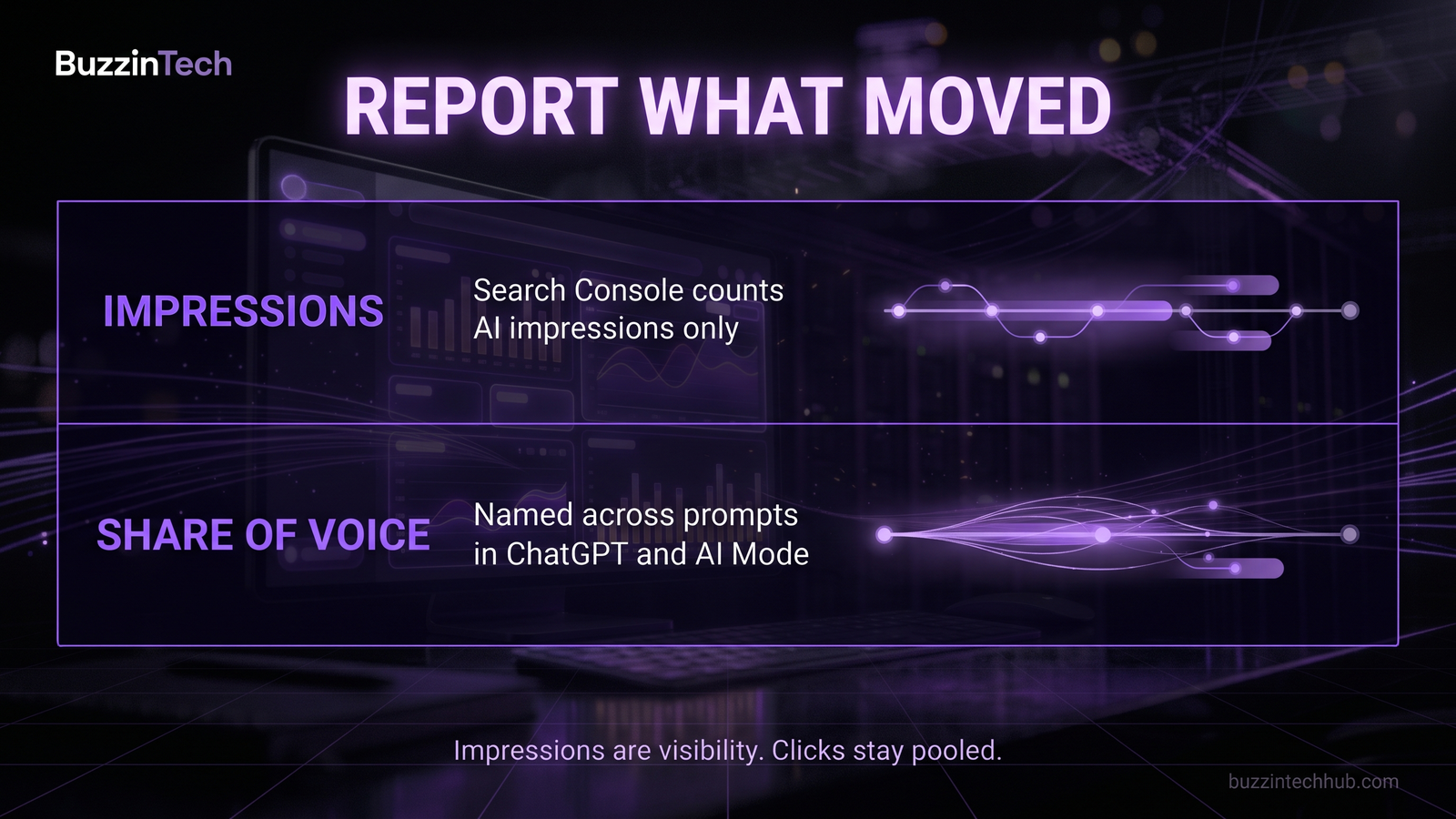
Reporting is where most citation retainers fail, because the honest numbers are thin. Search Console's Generative AI performance report, announced June 3, 2026 and rolled out to all properties worldwide on August 31, 2026, shows impressions only: how often links to a site appeared inside AI Overviews and AI Mode, split by page, country, device, and date.
It shows no clicks, no click-through rate, no average position, and no queries. It does not split AI Overviews from AI Mode. Clicks from those surfaces stay pooled in the main Performance report under the Web search type, with no way to separate them.
The full routine is in our guide to measuring AI search traffic without click data.
The second number in the monthly report is share of voice: how often a brand is named across commercial prompts in the major language models. We run that check on our own channels too, and the current baseline is plain.
We run the same check on our own channels every month: 15 commercial prompts across ChatGPT and Google AI Mode, 30 answers in total, reported alongside the client's numbers. The retainer measures from that baseline, and the monthly report shows whether it moved.
The same check shows what the fix looks like. On ChatGPT, 12 of the 15 answers linked straight to the agencies' own vendor sites: the vendor page is the citable unit there. On AI Mode, vendor sites and Google Business profiles came first, and listicles second.
Clutch pages appeared in 4 of the 30 answers. Three prompts returned how-to guides with no agency named at all: for those queries, the quotable how-to page is the answer. ChatGPT also skewed toward Pakistan and UAE agencies even on UK and London prompts, a location bias in the engine, so no single-engine answer reads as a neutral market view.
The queries that surface a citation post are not always the keyword it targeted. The top queries for our November 10 citation post were people names, with "brodie clark" at 5 impressions and "who google ai mode cites" at 6.
A monthly report that only watches the target keyword misses the traffic the post actually earns. Track the pages too.
What the retainer does not promise
No client-specific citation result is on record for this service, so this post promises none. The figures above are Seer's study, Pew's panel, Google's own report, and our own baseline.
A retainer can promise the work: the audit, the pages, the schema, the cadence, the refreshes, and the monthly report. It cannot promise a citation on a named query by a named date, because the citation decision sits with Google's models, not with the agency.
The timeline is the service page's own: technical fixes show in Search Console impressions within 30 days, content-driven rankings take 90 to 180 days to compound, and real month-over-month growth takes about 6 months. Anyone promising faster is selling a shortcut the site pays for later.
The retainer is a six-month commitment with monthly proof. The shape is the same four stages behind every build we ship: Discovery and Architecture, Design and Prototyping, Engineering and Build, Deployment and Scaling. For a citation retainer, discovery is the audit, design is the quotable page, engineering is the schema and the sprints, and deployment is the monthly report.
Want to know where your brand stands in AI answers?
We run a citation audit that checks which money pages are eligible, which sub-questions they fail to answer, and what each rewrite must fix. Then we ship the pages.
See how we run AI search visibility audits
Frequently asked questions
What does an AI search visibility service actually do?
It runs six steps: a 30-point technical crawl and AI-visibility audit, quotable answer-first pages, code-level JSON-LD schema, 4 to 8 content briefs a month in two-week sprints, quarterly decay refreshes, and a monthly report on citations and share of voice.
How long before a brand starts getting cited in AI answers?
Technical fixes show in Search Console impressions within 30 days, as of November 2026. Content-driven rankings take 90 to 180 days to compound, and real month-over-month growth takes about 6 months. A citation can appear sooner, but no agency can promise one by a named date.
Does llms.txt help Google cite my site?
No. Google's guide says Google Search does not use llms.txt, and its June 2026 update says keeping one will neither harm nor help visibility in AI Overviews or AI Mode. We publish it for GPTBot, ClaudeBot, and PerplexityBot. Google Search ignores the file.
What does the Search Console Generative AI report show?
Impressions only: how often links to your site appeared inside AI Overviews and AI Mode, split by page, country, device, and date. Google announced it on June 3, 2026, and rolled it out to all properties on August 31, 2026. It shows no clicks, queries, click-through rate, or position.
How much more traffic does a citation bring?
Seer Interactive's April 2026 study of 53 brands found cited pages earned about 120 percent more clicks per impression than uncited pages on the same AI Overview. The same study found cited pages still earned 38 percent fewer clicks than queries with no Overview at all, and Seer states the gap is correlation: the study cannot claim causation.
What is AI share of voice, and how is it measured?
Share of voice is how often a brand is named across commercial prompts in the major language models. We test 15 commercial prompts across ChatGPT and Google AI Mode each month, and we run the same check on our own channels. The monthly report shows the result for the client and for us, side by side.