Google's AI Mode update on October 15 changed how links surface inside AI answers. Inline citations now sit higher in the response, official pages get a test slot at the top, and Preferred Sources finally has distribution muscle. Visibility moved — but clicks are still the reader's choice. Here is the practitioner's read on what changed and what to do.
TL;DR
- Google's October 15 update puts inline links higher and more often in AI Mode and AI Overviews.
- A test slots one or two "official pages" at the top of answers for task-based queries.
- Preferred Sources usage is up more than 7x, and preferred publishers now surface in news carousels.
- More visibility is not more traffic: Google shared no click data.
- The response: write citable content, claim your official pages, ask readers to set you as a preferred source.
The five changes in Google's October 15 announcement
On October 15, Google's Search team published "More ways to connect with the web from Search," an announcement covering AI Mode and AI Overviews. The centerpiece: inline links — the citations embedded inside the generated answer — now appear higher in responses, and more often. For teams that treat search visibility as a channel, including our organic growth practice, this is the update that changed the briefing.
Google says it has made "continued and substantial increases to the presence of inline links" across its AI experiences, and is now placing them higher up in responses more frequently. That is the confirmed, rolling-out part of the announcement.
The rest of the package: a test of a top section for official pages, wider news carousels for timely topics, more prominent related links with image thumbnails at the end of some answers, and clickable creator and publisher names on video results in AI Mode. Two of the five — the official-pages section and the clickable creator names — are tests, with no timeline for a wider release. That distinction matters: one change is landing, the others are experiments you should track, not reorganize around.
The direction is clear either way. Google is rebuilding the exit routes from its AI answers, and each one runs on the same fuel: pages with a clear answer, a checkable fact, and a reason the reader trusts the source. Visibility inside AI Mode is now a design property of your content, not an accident of ranking.
Higher links are not the same as more clicks
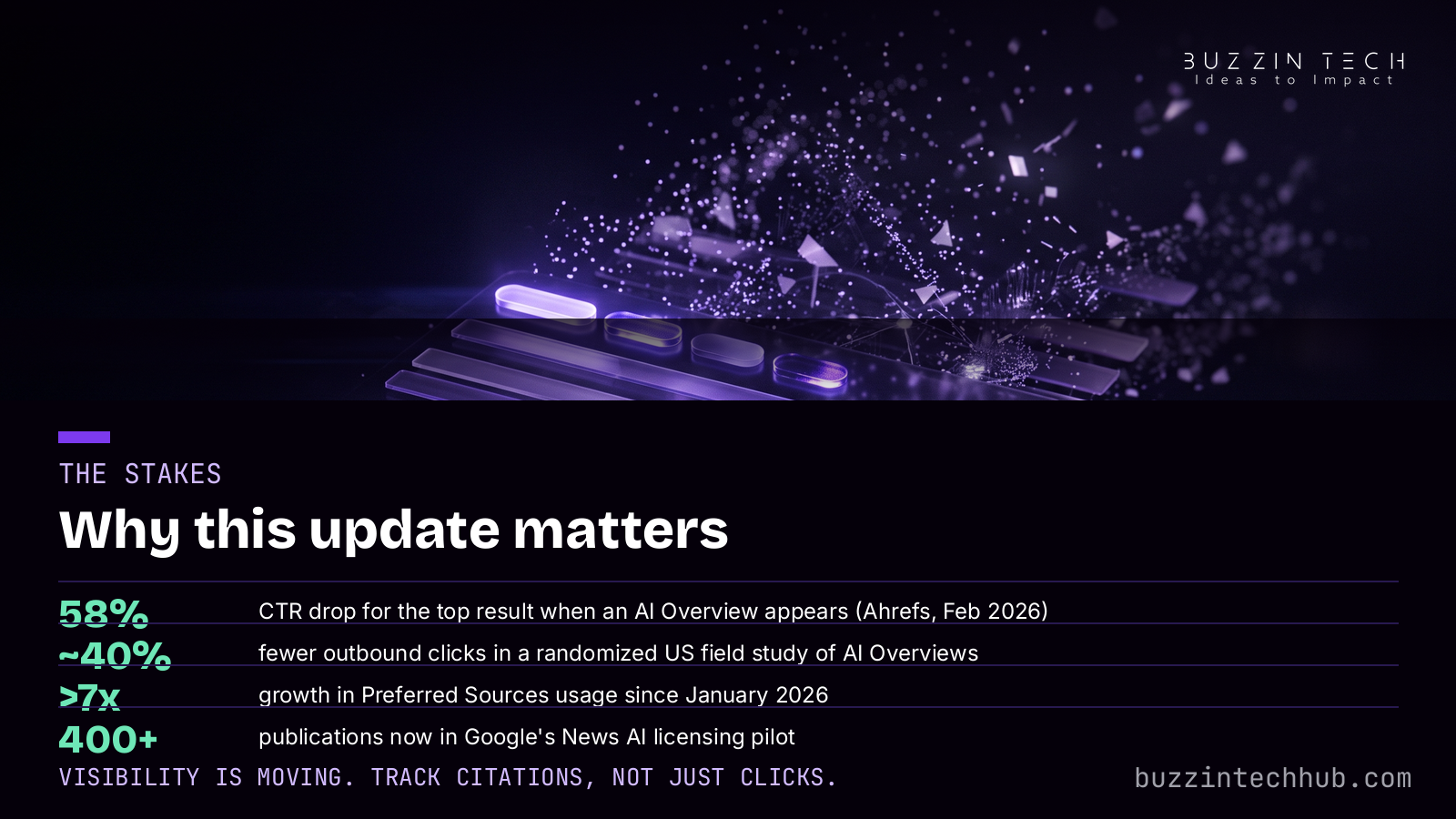
Publishers have been losing traffic to AI answers all year, and the numbers frame this update honestly. Ahrefs measured a 58 percent drop in click-through for top-ranking pages when an AI Overview appears, up from 34.5 percent the year before. A randomized study of about a thousand US users found outbound clicks fell nearly 40 percent. Chartbeat reported news publishers lost roughly 40 percent of their Google-origin traffic between July 2025 and July 2026.
Google's announcement contains no click data at all. No figure shows whether a higher inline link gets clicked more, or how often. That is the fine print to read before celebrating: placement buys attention, but it does not guarantee the reader still wants your page. The answer may already have satisfied them. That silence is normal for Google, but it means nobody should budget around traffic that has not been measured yet.
There is also a measurement gap most teams have not closed. Search Console still reports every link in an AI Overview under a single position, so position data cannot tell you whether the update helped. Compare clicks and impressions for your cited pages before and after the change instead, and track AI Mode and AI Overview referrals in analytics as their own channel.
The official-pages test rewards the one true source
The test worth watching: for queries where a task has one or two official destinations, Google is testing a section at the top of the answer that lists those pages first, with a short note explaining why each link helps. Google's example is an airline refund query showing the airline's refund form and refund policy page — before the summary even starts.
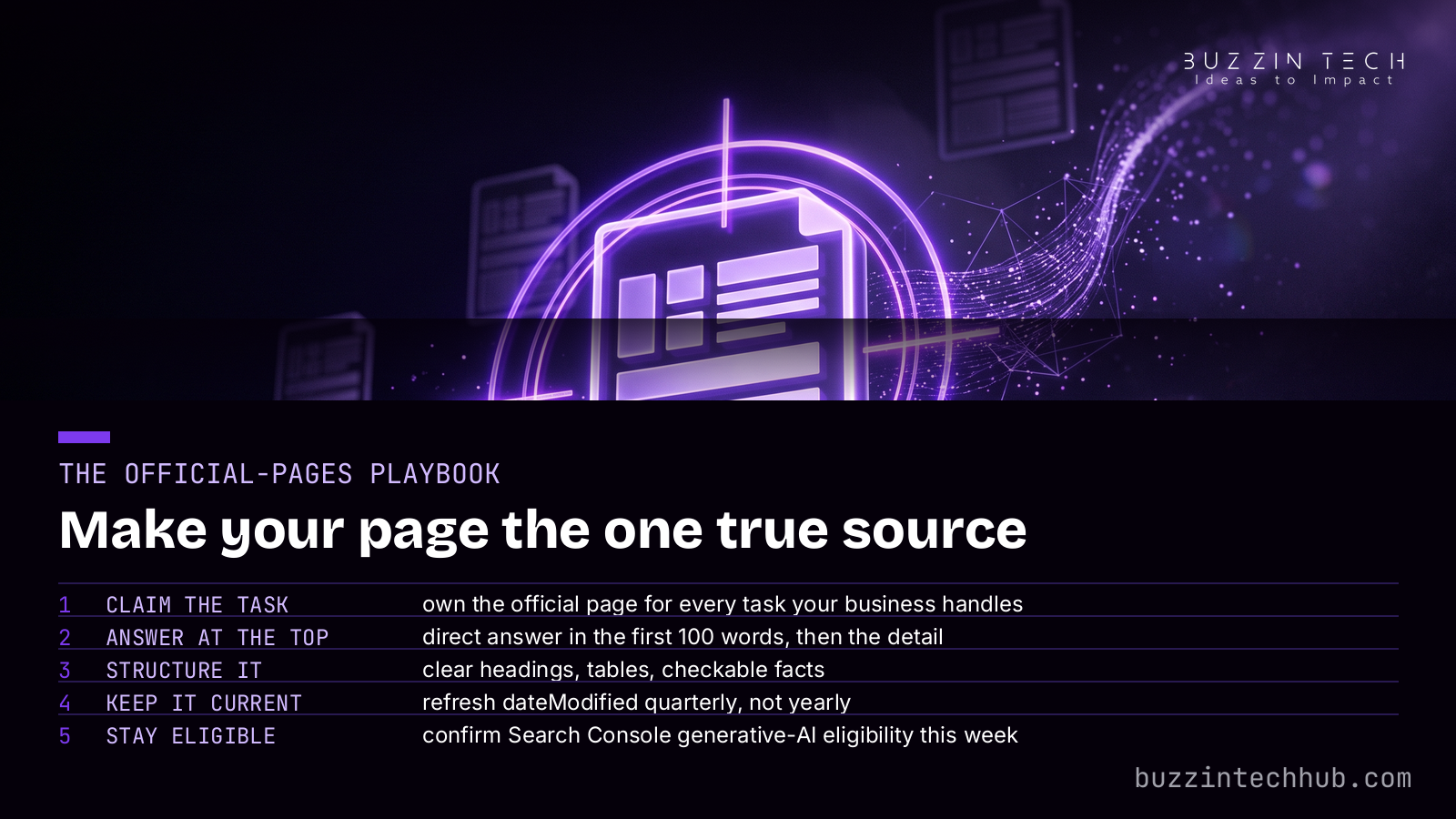
If this test ever ships, it concentrates clicks toward a tiny set of authoritative pages per query instead of spreading them across citations. For brands, the implication is blunt: if your business owns the official page for a task — pricing, documentation, a calculator, a booking form — that page must be the unmistakable authority on the topic. A clear heading, a direct answer at the top, structured details, no filler.
Do not rebuild your site around a test with no release date. Do make your official pages genuinely citable. Citable pages win whether or not the test launches — and if it does launch, yours are already eligible.
Preferred Sources quietly became a distribution channel
The announcement's quietest number may be its most useful. Google says the number of people using Preferred Sources has grown by more than seven times since the start of the year. The feature lets readers pick the publishers they want to see more of — and the news carousels inside AI answers now highlight those picks. Roughly 345,000 publishers have already configured their sites to be selectable.
Google also said earlier this year that users are twice as likely to click through to a source they marked as preferred. Put the two together and the logic is simple: a reader who follows you gets your reporting surfaced inside AI answers for them; a reader who does not gets someone else.
The move this week is straightforward. Confirm your site is eligible for Search's generative AI features in Search Console, then ask your readers — in newsletters, on social, at the end of articles — to add you as a preferred source. It is the closest thing to a subscribe button Google Search has ever had, and most brands are still ignoring it. Our guide to earning citations inside AI answers covers the content side of the same playbook.
One related signal worth tracking: Google also said its News AI pilot now pays more than 400 publications worldwide for enhanced content used to develop new AI features. If you publish original reporting, licensing is a separate track from visibility work — but it shows where the value conversation between Google and publishers is heading. For most businesses, the reader-prompt above comes first.
What to change on your site this week
None of this calls for a strategy rewrite. It calls for five concrete edits, in order.
First, lead every money page with a direct answer. AI systems cite passages that answer plainly, not pages that warm up for six paragraphs. Put the answer in the first 100 words, then the explanation.
Second, give models clean facts to quote: exact figures, named dates, step lists, comparison tables. A table comparing two options is easier to cite than three paragraphs of prose. This is the same advice behind Google's own documentation for site owners — specificity is what gets quoted.
Third, treat thumbnails as part of the link. The redesigned related links carry image thumbnails, which means your featured image and headline now represent you inside someone else's AI answer. Crop images so they read at small sizes, and write headlines that work without their surrounding page.
Fourth, claim your Search profile and check Preferred Sources eligibility in Search Console this week. It takes minutes, and it gates everything above.
Fifth, audit the answers. Search your target queries in AI Mode, note which pages earn inline citations, and ask why the winners were quotable. Copy the structure, not the content. Analysts who tracked the update closely noted the same discipline: inline link density is the metric to watch first.
How we approach AI-search visibility
At BuzzinTech, organic growth has always covered the AI layer — technical SEO plus content, with AI answers included. We treat AI citations the way we treat rankings: measured, tested, and earned with better pages, not shortcuts. The comparison of SEO and AEO budgets we published last week makes the same point: rankings and citations are one system now, funded from one budget.
Every engagement runs our four-step methodology: 01 Discovery & Architecture, 02 Design & Prototyping, 03 Engineering & Build, 04 Deployment & Scaling. On a visibility engagement, discovery is prompt mapping and a citation audit of who already owns your answers. Design is answer-first content architecture. Engineering is the schema, the fact-density rewrites, and the entity cleanup. Deployment is the measurement dashboard and the publishing cadence. Senior engineers and marketers do the work — no account-manager layer in between.
Is your brand showing up inside AI answers — or just beneath them?
We audit your current rankings, your AI-answer presence, and the off-site signals engines cite, then hand you a plan for earning the citations this update rewards.
See how we build AI-search visibility
Frequently asked questions
What did Google change about links in AI Mode and AI Overviews on October 15, 2026? Google announced five changes: inline links now appear more often and higher in AI responses; a test adds a top section for one or two official pages on task-based queries; news carousels expand to more regions and highlight Preferred Sources; related links at the end get image thumbnails; and clickable creator names are being tested on AI Mode video results.
Will higher inline links bring more traffic from AI answers? Possibly, but Google published no click data with the announcement. Higher placement buys attention, yet only cited pages benefit, and readers may still stay inside the answer. Compare clicks and impressions for your cited pages before and after the change rather than trusting position data.
What is the "official pages" test Google is running? For queries where a task has one or two official destinations, Google is testing a section at the top of the AI response listing those links, each with a note explaining why it helps. Google's example is an airline refund query showing the airline's refund form and refund policy page. There is no announced timeline for a wider release.
What are Preferred Sources, and why do they matter now? Preferred Sources is a Search setting where readers pick the publishers they want to see more of. Google says usage grew more than 7x since the start of 2026, and news carousels inside AI answers now highlight preferred publishers. Google also said users are twice as likely to click a preferred source. Make your site selectable and ask readers to add you.
How do I get my pages cited inside AI answers? Put a direct answer in the first 100 words, publish specific checkable facts and comparison tables, use clear question-style headings, keep schema markup honest and current, confirm eligibility in Search Console, and ask readers to set you as a preferred source. Then audit which pages earn inline citations and copy the structure.
Should I change my SEO strategy because of this update? No rebuild is needed. Strong SEO remains the foundation — Google's own guidance says the same fundamentals feed AI features. Add three things: track AI citations and referrals as their own channel, make your official pages genuinely citable, and work the Preferred Sources angle. That is an increment on the budget, not a new one.
More from Buzzin Tech Hub
- Generative Engine Optimization: A Small-Brand Playbook — our Tuesday Growth piece on winning citations inside AI answers.
- AEO vs SEO in 2026: Where to Spend Your Search Budget — last week's Growth comparison on splitting your search budget between rankings and citations.
- Browse the full Buzzin Tech Hub blog