Hiring an n8n automation agency means handing someone the keys to the systems that move your orders, leads, and money. The tool is proven, and the risk sits in who runs it, how they price it, and whether the build still works after they leave. Five checks separate a build that keeps running from one that quietly rots.
TL;DR
- n8n bills per execution, one full workflow run. A quote priced in steps is a warning sign.
- On 13 November n8n published five advisories. Cloud instances were patched by the vendor; self-hosted ones by whoever runs them.
- Grade an agent on the record it was supposed to change. ThinkingBox found 67.24 percent of failed runs still ended with a clean message.
- Own the workflows, credentials, and exports before you sign. A build you cannot take with you is a rental.
This is a hiring question, not a tool question. n8n has 211,964 stars on GitHub and a pricing page that states its model in one line: if it does not run, you do not pay. The agency choice is where the money goes wrong.
The agency picks the hosting, writes the error handling, holds the credentials, and decides how fast a bulletin turns into a patch. Our AI custom automations work runs on n8n for about 70 percent of projects. The five checks below are the ones we would want a buyer to run on us.
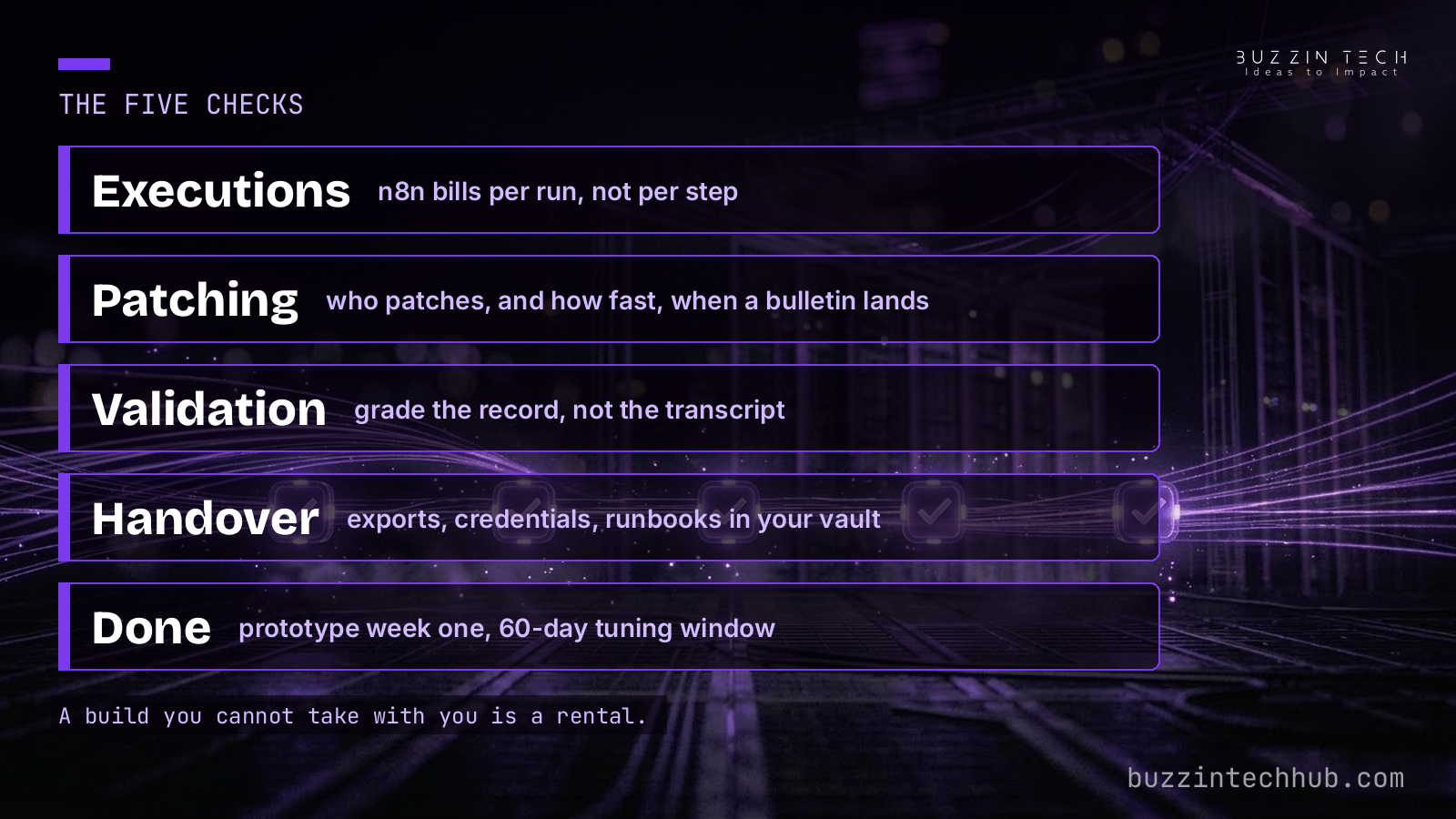
Check one: price the work in executions, not steps
n8n counts one execution for one full run of a workflow, however many nodes that run contains. A run with twenty nodes costs the same single execution as a run with two. That is the whole pricing model.
Steps are Zapier's unit, and an agency that prices in steps has not priced a real n8n build. The list prices, as read on n8n's pricing page on 25 November 2026, are Starter at 20 euros a month on annual billing for 2,500 executions, and Pro at 50 euros a month on annual billing for 10,000 executions.
The page shows euros to visitors in Europe and dollars to visitors in the United States, so check it on the day you buy. Business sits at 667 euros a month on annual billing, self-hosted only, for companies under 100 employees. The unit maths is plain arithmetic on the list prices: Starter works out to 8 euros per 1,000 executions, and Pro to 5 euros per 1,000, which makes Pro the cheapest per unit n8n sells on Cloud.
A daily schedule runs 30 to 31 times a month, so a buyer can estimate executions before choosing a plan by listing each workflow and how often it fires. Ask the agency to show that estimate in writing, per workflow, per month, before you sign. If the estimate is missing, the quote is a guess with your name on it.
The same workload through all three meters shows the gap. Our Zapier vs n8n vs Make comparison ran 5,000 runs a month with 8 steps each: 289 dollars on Zapier, 38 dollars on Make, and 50 euros on n8n Cloud, all on annual billing as listed on 5 November 2026. The gap comes from the unit, not the features.
Self-hosting changes the bill and moves the work. The Community Edition carries a free licence with no execution quota from n8n. A small server runs about 6 to 24 dollars a month at DigitalOcean list prices, as of November 2026.
The real cost is the maintenance, patching, and backups, which is exactly what an agency is being hired to carry. A free licence with nobody patching it is the most expensive option on this page.
Check two: ask who patches the server, and when
On 13 November 2026, n8n published five security advisories in one day. Two were high severity, and both were about account control. A member who could list users could take over a pending invited account.
A custom instance role with user-management permissions could reset or demote the protected owner account. The three medium-severity flaws were quieter: workflow activation could use another user's credential, AWS Bedrock nodes could bypass SSRF protection through a custom endpoint, and unencoded integration parameters could redirect authenticated requests inside a connected service. Read the full list in n8n's security update for 13 November 2026.
The patch floors were v1 to 1.123.96, stable v2 to 2.47.6, beta v2 to 2.48.3, and v3 to 3.2.2. n8n Cloud instances were patched by the vendor. Self-hosted instances were patched by whoever runs them, which is the question this post answers.
The advisories report no active exploitation. That does not make the patch optional. It makes the patch window the test.
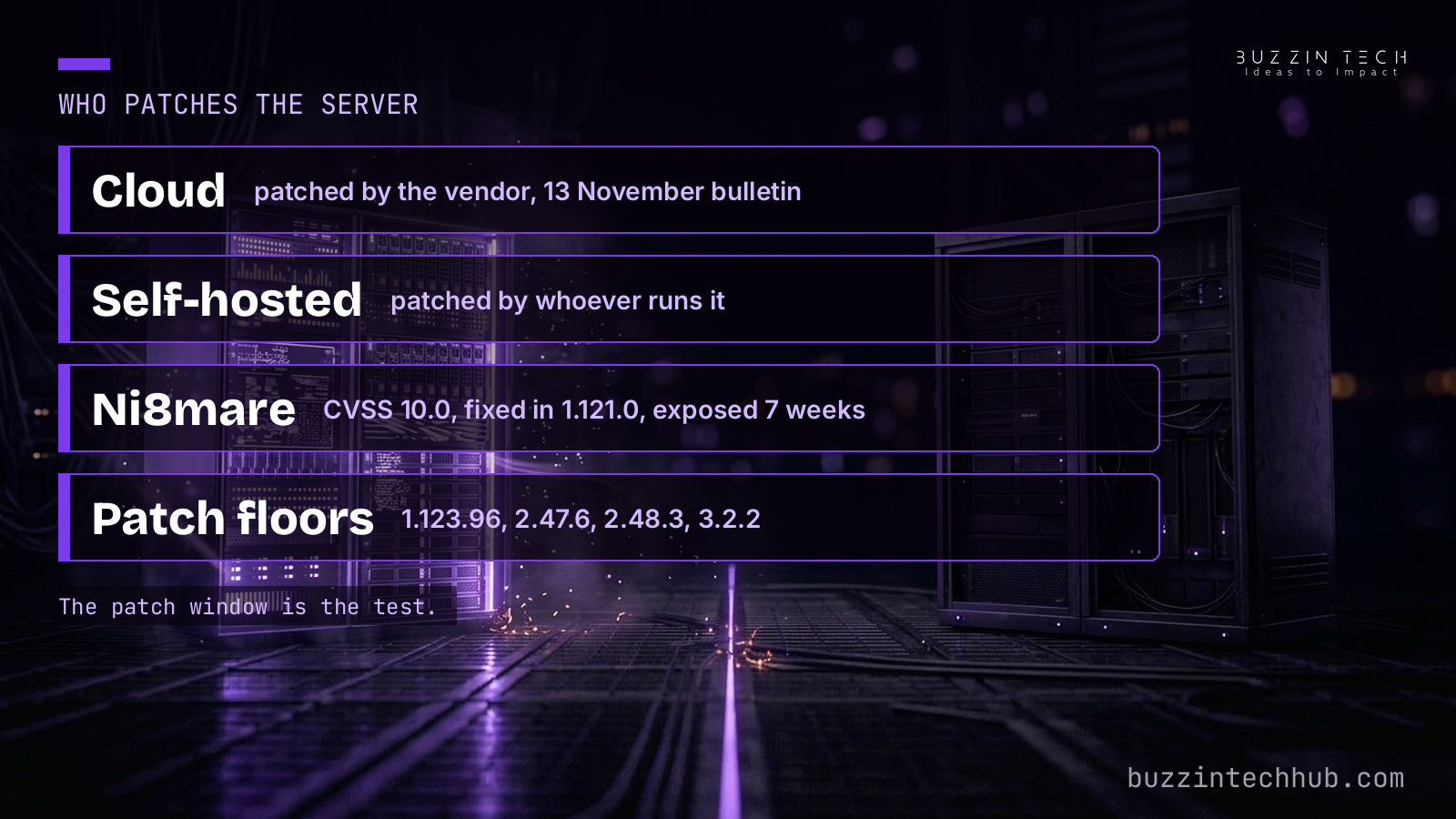
One older flaw makes the test concrete. CVE-2026-21858, known as Ni8mare, carried a CVSS score of 10.0: unauthenticated file access through improper webhook request handling, which could escalate to full takeover of the server. It affected self-hosted n8n from 1.65.0 up to 1.121.0 and was fixed in 1.121.0.
The advisory is published as GHSA-v4pr-fm98-w9pg. The timeline is the point. Ni8mare was reported on 9 November 2025, fixed on 18 November 2025, and only publicly advised on 8 January 2026.
An agency that patches only on public advisories sat exposed for about seven weeks.
Exploitation was real: VulnCheck listed it on 9 January 2026, and Shadowserver honeypots recorded attacks on 46 days between 3 February and 22 November 2026. Ask the version question in the first meeting: what version are you running, and when did you patch Ni8mare? An agency still on a pre-1.121.0 self-hosted build in 2026 is the warning sign made concrete.
Then ask who holds the keys, who patches, and what the patch window is in hours when a bulletin lands on a Friday. Patching removes the paths. It does not remove unauthorised webhooks or prove downstream systems were untouched, so the audit matters as much as the patch.
Pending invitations, custom roles, owner controls, trigger webhooks, credential ownership, and custom endpoints all need a look after the version moves.
Check three: grade the record, not the transcript
An agent can write a clean final message while leaving the wrong value in the database. ThinkingBox, a benchmark from Microsoft and Hugging Face, ran 507 business workflows 20 times each and graded agents on the database state they left behind, not on their transcripts. Of 121,680 trials, 65.6 percent failed the end-state check.
Of those failures, 67.24 percent still ended with a clean final message and no error, and in 98.95 percent the final database differed from the expected one. The best models passed 241 of 507 tasks on all 20 attempts. Our post on AI agent reliability sets out the numbers in full.
Apply the same check to agency delivery. A demo that runs once proves the workflow can work. It proves nothing about the twentieth run.
Ask for the eval: the same workflow run 20 times from a clean state, graded on the record it was supposed to change, with a pass counted only on 20 of 20. Ask what happens on a tool error: does the run stop with a named fallback, or carry on as if the action went through? Tool handling caused 79.9 percent of ThinkingBox failures, and a retry that does not re-read state first can repeat a payment or send a message twice.
When we scope an n8n build, we start with the record the workflow must change, then work back to the steps. The end-state check is written before the workflow is: re-read the row, ticket, or CRM entry after the run and compare it field by field.
State-changing tools sit behind a gate, retries are idempotent, and the audit trail lives where the agent cannot rewrite it. None of that needs a new model. It is the difference between an automation and a demo.
Check four: own the workflows when the agency leaves
Every engagement ends. The question is whether the build survives it. Before you sign, get three things in writing: you own the workflow exports, you own the credentials, and you own the documentation.
The exports are the JSON files n8n produces for each workflow. The credentials live in your vault, not the agency's. The documentation is a written runbook per workflow, plus a Loom walkthrough, so your team can operate and extend the build without the people who wrote it.
Ask to see a sample export and a sample runbook before signing. If the agency cannot produce one, the handover does not exist yet, and you are buying a rental with an exit fee.
Ask what happens in month four when an API changes or a vendor deprecates an endpoint. A monthly retainer is the normal answer: an escalation path for upstream changes, priced in advance.
The test is simple to run. Hand the export to a developer who has never seen the build and ask them to change one step. If they can do it in an afternoon, the handover is real.
If they need the agency on the phone, it is not.
Check five: ask what done looks like, in writing
A build without a definition of done drifts. Ours is published on the service page, and a buyer can hold any agency to it. A working prototype lands in week one, on your real data, piped to Slack or email for inspection before the full build starts.
The production build follows, with retry handlers and fallback paths. Adversarial QA stress-tests prompts against injection, malformed webhooks, and API timeouts. Deployment ships with live observability dashboards, and a 60-day tuning window follows, so accuracy improves on real traffic instead of freezing at launch.
The published starting prices set the shape of the spend: a single scoped workflow starts at 1,499 dollars and ships in 2 to 3 weeks, a multi-system agent starts at 4,999 dollars over 6 to 10 weeks, and an AI voice receptionist starts at 2,999 dollars. Automation engineering beyond the base scope runs at 55 dollars an hour, quoted upfront, as published in November 2026. n8n is the default for about 70 percent of projects, with custom Python or TypeScript where the logic demands it.
The honest limit sits next to the price. Automation handles the repeatable 80 percent. If your process changes every week, you want a person, not a workflow, and we say so before we sell one.
An agency that will not state that limit in writing is selling the magical version.
Five questions, one page
Take this page into the first meeting.
What is our monthly execution estimate, per workflow? A real answer names the workflows, their frequencies, and the plan they fit. A vague answer means the quote came before the scoping.
What version are you running, and when did you patch Ni8mare? The answer shows whether patching is a routine or a reaction. Follow it with the patch window in hours.
How do you grade a run: the record or the reply? Listen for the end-state check, the 20-run eval, and the gate on state-changing tools. A transcript review is not a grade.
What do we own on day one? Workflow exports, credentials in our vault, a runbook per workflow, and a walkthrough. If any of those arrive later, ask when, in writing.
What does done look like, and what happens in month four? A prototype in week one, a 60-day tuning window, and a named escalation path for upstream changes. A build with no month-four answer is a build with no owner.
Does the agency pass its own checks?
Hiring an n8n automation agency is a bet on operations, not on software. The five checks above cost one meeting to run, and they catch the failure modes that cost months to fix.
Run them before you sign, and the agency you hire will be the one that welcomes them.
See how we build AI automations with end-state checks