October opens with more change queued on your devices than any month in recent memory. iOS 27 is settling in, macOS is closing the Intel era, Android's September Pixel Drop was the last feature update some Pixels will ever get, Windows patched two zero-days being exploited in the wild, both Chrome and Firefox shipped big releases, and the end-of-support clock is ticking on Windows 11 24H2. This is the software-update rundown for October 2026: what shipped, what needs your attention this week, and which updates you can safely leave for later.
iOS 27 brings the new Siri to your phone
Apple's biggest release of the year landed on September 14, and if you have an iPhone 11 or newer, it is already waiting in Settings. iOS 27's centerpiece is the rebuilt Siri: a generative assistant that understands personal context, sees what is on your screen, and can take actions inside apps. It speaks English at launch, with French, Japanese, Korean, Portuguese, and Spanish arriving through October. It is available in the EU; China is excluded for now.
Alongside the assistant, iOS 27 carries refined Liquid Glass design touches, an overhauled set of parental controls and Screen Time options, and iPhone Handoff, which lets the same phone number live on two iPhones at once. The watch paired with your phone changed just as much: watchOS 27 (Apple Watch Series 9 and newer, Ultra 2 and newer, SE 3) adds the new Siri, a daily Readiness score from 0 to 10, a standalone Workout Buddy, and perimenopause and menopause cycle tracking. iPadOS 27, tvOS 27, and visionOS 27 shipped the same day, with tvOS claiming app launches roughly 30 percent faster.
Apple also shipped a small fix release you should not skip. iOS 27.0.1 arrived September 28 with repairs for Face ID restarts and camera artifacts on the new iPhone 18 Pro and Pro Max, plus a touchscreen fix affecting Notification Center and Control Center. If you stayed on the previous major release, September also brought iOS 26.6.2 (September 8, which fixed software updates failing to download over cellular) and then iOS 26.7.1 and iPadOS 26.7.1 on September 28. That last one matters: it patches CVE-2026-86950, a CoreGraphics out-of-bounds write with a CVSS score of 8.8, which Apple says may have been used in an extremely sophisticated attack against targeted individuals running versions before iOS 27. The patch was reported to Apple by Meta's Product Security team. If your iPhone has not moved to iOS 27 yet, install 26.7.1 now.
macOS Golden Gate closes the Intel era
The Mac update carries a codename and a milestone. macOS 27 "Golden Gate" shipped September 14, and it is Apple-silicon only. Tahoe, the previous release, was the last major macOS for Intel Macs, and Golden Gate is also the last full release to ship Rosetta, the translation layer that let Intel apps run on Apple silicon. If you still have an Intel Mac, this is the update train stopping: you keep Tahoe with its security maintenance releases (26.7.1 shipped September 28 alongside Golden Gate's own 27.0.1) but no future major versions.
Golden Gate itself brings the new Siri AI, further Liquid Glass refinements, faster AirDrop, AI-assisted photo editing, and Safari tabs that organize themselves. A follow-up bug-fix release, 27.0.1, landed September 28.
Android 17's September Pixel Drop, and a last call for Pixel 6
Google's stable Android 17 QPR1 rollout began September 15 with build CP3A.260905.009, reaching the Pixel 6 through Pixel 11 lines. The headline feature is Pause Point, which interrupts you for ten seconds when you open a distracting app, a digital-wellbeing idea with teeth. The drop also refines the Material 3 Expressive visuals (system blur, a carousel media player, a Quick Settings tile for the keyboard), adds Motion Assist bubbles that reduce motion sickness in vehicles (rolling out through Play Services 26.33.32 on Pixel and Samsung Galaxy devices), and carries the September 2026 security patch levels 2026-09-01 and 2026-09-05, with roughly 200 fixes in the bulletin.
For Pixel 6 and 6 Pro owners, the news is final: this was the last feature drop before the end of updates in October 2026. Android 17 QPR2 is already in beta (Beta 6 shipped around September 24, with a stable release expected in December), but Pixel 6 hardware will not follow. If you are still carrying one, October is the month to decide its replacement.
Samsung moved fast on the new Android generation as well. One UI 9, built on Android 17, went stable first on the Galaxy S26 series (Korea on September 16 with build BZI6, the United States on September 23, Europe and India on September 26) and then on the Galaxy S25 series including the S25 Edge, S25 FE, Z Fold7, and Z Flip7, starting in Korea on September 28 with firmware S93xNKSUCDZIF and the September 5, 2026 security patch. The global rollout continues through October, with conversational Galaxy AI capabilities layered in. Check Software update in Settings; if it has not arrived yet, it is coming.
Windows patches two zero-days you do not want to meet
The September Patch Tuesday release, KB5124008, arrived September 8 with builds 26100.9445 (Windows 11 24H2) and 26200.9445 (25H2). It patched roughly 966 to 974 vulnerabilities, and two of them were already being exploited in the wild: CVE-2026-81963 and CVE-2026-85880, a Windows ALPC heap buffer overflow that attackers chained with Chrome exploits in the "BlueMoon" campaign. Both were added to CISA's known-exploited list with federal patch deadlines in late September. If you manage Windows machines or run one that has not updated since August, this is the update to install first.
The release also carries visible changes: a movable and resizable taskbar, a resizable Start menu, a cleaner Search experience, and a faster File Explorer. Older builds got their own updates the same day: KB5122880 moved Windows 11 23H2 to build 22631.7582, and KB5122878 took Windows 10 22H2 to 19045.7725 (with ESU coverage), fixing Remote Desktop audio and BitLocker policy issues.
Windows 11 26H2, the "2026 Update," began a phased controlled rollout in late September. One wrinkle from early hardware adopters: devices on 26H1 had no direct upgrade path to 26H2, so check the Windows Update history before assuming the big one is coming to you.
One known problem to know about before you patch Office: September's KB5002914 broke copy and paste in Excel across Office 2016, 2019, 2021, and 2024. Microsoft has acknowledged it and published a workaround (uninstalling the KB) but had no fix ready as September closed. If Excel copy-paste breaks for you this week, that update is the first suspect.
Chrome 154, Firefox 157, and a faster Edge
The browsers all moved in September. Chrome 153 went stable September 8 with fixes for two serious bugs that also made CISA's exploited list (a V8 type-confusion flaw, CVE-2026-85046, and a sandbox escape, CVE-2026-87491). Chrome 154 followed September 22 with 108 security fixes, and a September 29 point release, 154.0.8037.92, fixed 32 more, including a critical ANGLE buffer overflow, CVE-2026-102331. Edge tracks Chrome's version line closely: Edge 154 shipped September 24 (154.0.4258.37) with a point release September 29, and Microsoft has moved Edge to a two-week major release cadence since version 152. That means browser updates now arrive twice as often, and the "I'll restart next week" habit leaves more holes open than it used to.
Firefox had its most visible release in years. Firefox 157 shipped September 29 as the first stable with the Project Nova redesign: new tabs, new icons, new themes, and the return of compact mode. It also adds hardware AV1 decoding for WebRTC calls. Firefox 155 (September 1) and 156 (September 15) preceded it, so if you update now, you jump three generations at once.
The productivity suites went agentic
The September that just ended may be remembered as the month office software stopped waiting for instructions. Microsoft announced its largest Copilot update yet on September 25: a new Home that combines Chat with a working view called Cowork, Office fully embedded inside Copilot, a "Code" mode that builds apps from natural language, "Autopilot" for long-running agents that keep working after you close the tab, and "Today," which surfaces what needs your attention before you ask. Prompt input directly on the Copilot button is rolling out from September through December, and inline code and diagram previews arrived in M365 Copilot chat in mid-September, with PowerPoint organization skills reaching general availability during the month.
Google answered through Workspace. September brought Gemini connectors to Asana, Atlassian Rovo, HubSpot, Mailchimp, QuickBooks, Monday, and Salesforce through the Model Context Protocol (turned on by default from September 15), automatic Meet note-taking switched on by default for Business Standard and Plus plans from September 29, and Gemini cross-app creation that builds Docs, Sheets, and Slides from inside Gmail (rollout began September 2, announced September 9, alongside five new agentic capabilities). Then on September 30 Google announced that Gemini "skills" will replace Gems: free users keep skills, while Gems sunset in November 2026 for personal accounts, March 2027 for Workspace business tiers, and June 2027 for education. If you built Gems you depend on, migration is on the calendar now.
Developers got their usual rapid cadence too. Visual Studio Code shipped four releases in September: 1.136 on the 2nd, 1.137 on the 10th with voice mode, agent automations, and the coding pet, 1.138 on the 17th with agent sessions inside Dev Containers and an expanded Codex harness, and 1.139.0 on the 23rd with an enterprise managed-settings fix following in 1.139.1 on the 25th. And Adobe announced September 24 that Photoshop, Lightroom, Express, and Firefly capabilities are coming inside Google Gemini across all plans, with Acrobat tools landing in the Claude plugin, so the design tools are moving into the assistants rather than the other way around.
For the communication side of this shift, our look at the free software switch showed the same pattern from the open-source angle: the tools that let you leave a subscription are improving at the same pace as the subscriptions themselves.
The security emergencies you should not skip
September was rough for enterprise software, and several of these fixes are the kind that go from advisory to exploit quickly. Citrix pushed emergency patches September 27 for two unauthenticated remote-code-execution flaws in NetScaler, CVE-2026-88771 and CVE-2026-88772, both scored 9.5 and both actively exploited, with a CISA deadline of September 30. Adobe Commerce stores faced "StyleSmuggler," CVE-2026-75650, a perfect-10-score unauthenticated remote-code-execution bug exploited in the wild since September 4, with an emergency hotfix (APSB26-146) on September 7, discovered by the Sansec team. Cisco's Catalyst SD-WAN Manager got emergency guidance September 30 for CVE-2026-76504, a 9.8-score flaw giving unauthenticated admin API access, already exploited, with a CISA deadline of October 3: the fifth SD-WAN-family zero-day exploited in the wild since January. F5 BIG-IP APM had its own 9.8, CVE-2026-94127, actively exploited, with a September 25 CISA deadline. If any of this equipment sits in your rack or your cloud, check the fixed builds (NetScaler 14.1-73.37 and 13.1-64.23 and later) before the weekend.
Consumer devices were not spared: the WhatsApp stable release 2.26.39.5 (September 30) added group-history sharing for new members, call transfer between mobile and desktop, and call-link waiting rooms. WhatsApp also raised its minimums: Android 6.0 became the floor on September 8, 2026, and iOS 15.5 becomes the minimum on November 30, 2026. Older phones that can no longer update WhatsApp are living on borrowed time.
Gaming platforms patched too. The PS5 system software 26.06-14.00.00 shipped September 16 with enhanced PSSR image quality on by default for the PS5 Pro, a voice-chat speaker indicator, and a Community Activity widget with Trending Now and Top 10 in the Welcome Hub. The PS Portal updated to 7.1.7 on September 24 with a new 80 percent default charge limit for long-term battery health. The Xbox September update (OS 10.0.26100.9438, September 22) fixed Share-button remapping, search-term errors, and Manage queue crashes. Steam's client beta brought an experimental Pyrowave codec for Remote Play in the September 22 build, promising up to 10x bandwidth efficiency for lower latency with full YUV 4:4:4 and HDR.
Deadlines on the calendar
October is also a month of endings. Windows 11 24H2 Home and Pro stop receiving updates on October 13, 2026 (Enterprise and Education get until October 12, 2027); unmanaged PCs will be moved to 25H2 automatically, but managed machines need a plan. Exchange Server 2016 and 2019 and Office 2021 lose support around October 13 to 14, and Office 2021 has no Extended Security Updates option, so this is a migration, not a grace period. As noted above, the Pixel 6 and 6 Pro reach end of updates this month, and Intel Macs are off the major-version train entirely. On the browser side, Microsoft is retiring Windows Information Protection and Defender Application Guard from Edge, with a push toward Purview.
The industry context around these shifts is bigger than any one release. Our September breakdown of the five problems the tech industry can't dodge this year covered the layoffs, the software-stock repricing, and the AI spending wave that all of these update strategies are part of.
How to update without breaking your week
The volume of change in this month's list makes process matter. Update in this order: phone first (the iOS security fix is the one attackers have actually used), then your PC's operating system, then your browser, then your apps. On a work machine, back up before major-version jumps: iOS 27, macOS Golden Gate, and One UI 9 are all the kind of releases where a small share of users hit a bad migration, and a backup turns that into an annoyance instead of a disaster.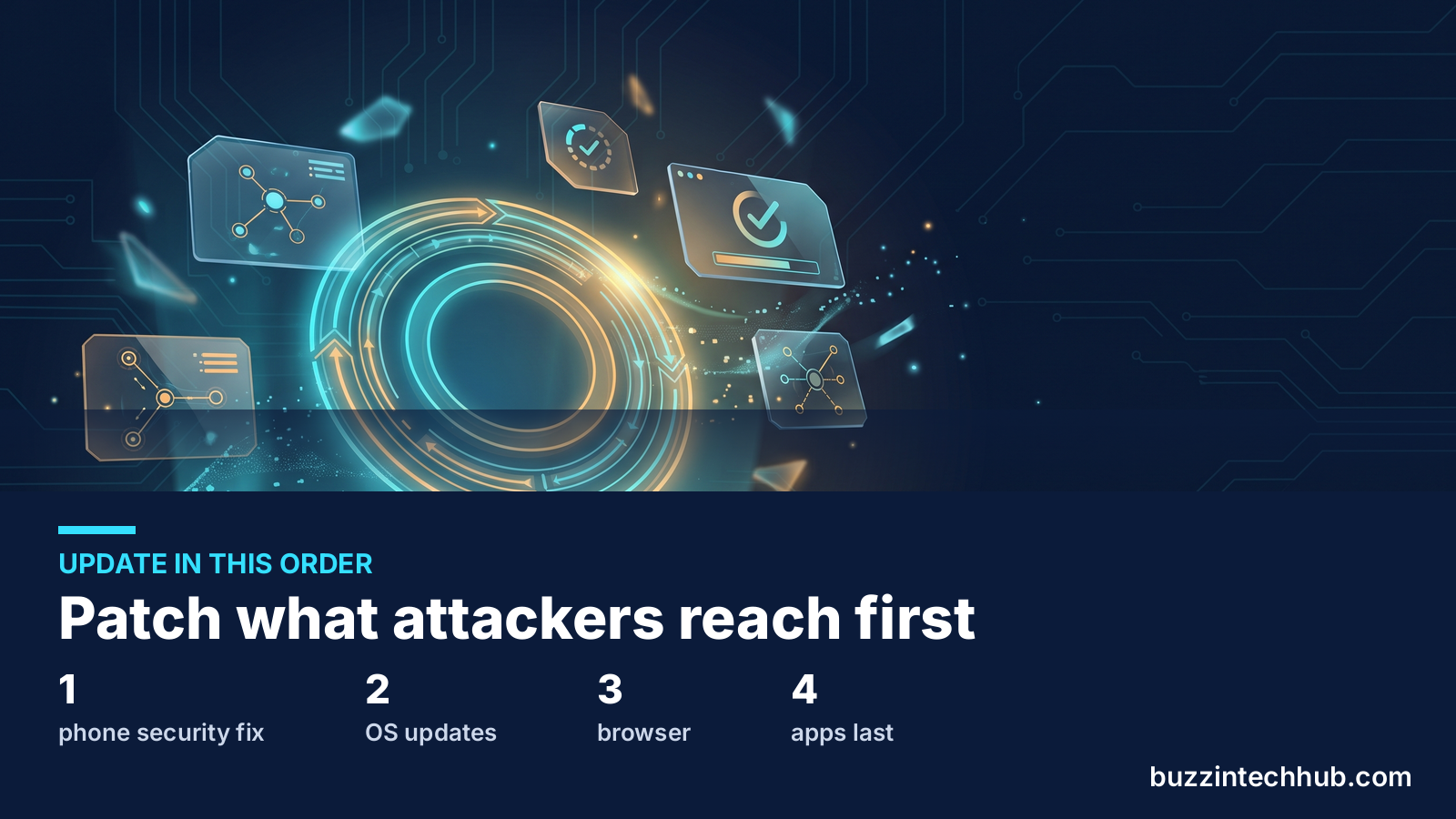
Read the known-issues list before you click on Windows, especially on machines running Office heavily, given the Excel copy-paste bug still has no fix. If an update offers itself in stages, take the security patch now and let the feature release wait a week: the zero-days in this month's Windows and Chrome releases argue for speed, while the cosmetic changes argue for patience, and those are two different updates wearing the same prompt. For the EOL items (Windows 11 24H2, Pixel 6, Intel Macs), the decision is not whether to move but when; the security coverage simply stops.
On the security side, the month rewards the habit we keep returning to: patch the edge devices first. The Citrix, Cisco, and F5 emergencies were all network-edge equipment, reachable from the internet, with unauthenticated exploits. That pattern is the reason the developer workflows that hold up in 2026 put verification and environment discipline first: the teams that update their infrastructure in an orderly, verifiable way are the ones that do not learn about a zero-day from a ransom note.
What this month is really about
Strip away the version numbers and October 2026 is the month the software industry's three big bets all landed at once. Apple bet that the phone's assistant should know your context. Google bet that the operating system should interrupt you for your own good. Microsoft bet that the office suite should work while you sleep. Each of these is an update you install, but together they are a change in what "updated" means: not newer buttons, but software that acts.
The practical consequence is simple. The updates that protect you (the iOS security fix, the Windows zero-days, the browser point releases) cannot wait. The updates that change how you work (Siri AI, Copilot's Autopilot, Gemini skills, One UI 9's conversational layer) deserve a look, because the defaults are being set right now and the defaults are what most people keep. And the deadlines (Windows 11 24H2, Exchange, Office 2021, Pixel 6, Intel Macs) are real ends, not warnings. Install the patches this week, try the new assistants with fresh eyes, and make the migration plans before the calendar makes them for you.
Frequently asked questions
Which October 2026 software update should I install first?
The security patches, in this order: iOS 27.0.1 or at minimum iOS 26.7.1 on iPhone (it fixes a CoreGraphics flaw Apple says was used in targeted attacks), the September Windows update KB5124008 (it patches two zero-days exploited in the wild), and Chrome 154 or Firefox 157 (both closed serious vulnerabilities). Feature updates like macOS Golden Gate and One UI 9 can wait a week while early issues surface.
Is it safe to update to iOS 27 now?
Yes, for iPhone 11 and newer. The initial September 14 release was followed by iOS 27.0.1 on September 28, which fixed the early Face ID, camera, and touchscreen issues reported on the new iPhone 18 Pro models. Waiting for the .0.1 or .1 release is the classic safe pattern, and that box is now checked.
What happens when Windows 11 24H2 reaches end of support on October 13, 2026?
Home and Pro editions stop receiving security updates. Unmanaged PCs will be upgraded to 25H2 automatically, but business machines managed by IT need an upgrade plan. Enterprise and Education editions are covered until October 12, 2027. Running 24H2 Home or Pro past the date means no more security patches.
Should Pixel 6 owners worry about the October 2026 end of updates?
The September 2026 Pixel Drop (Android 17 QPR1, build CP3A.260905.009) was the last feature update for the Pixel 6 and 6 Pro, and security updates end this month. The phone keeps working, but new vulnerabilities will no longer be patched. If the phone holds anything sensitive, start planning its replacement now rather than after the last patch.
Why are there so many zero-days in September 2026's updates?
Several factors coincided: enterprise edge equipment (Citrix NetScaler, Cisco SD-WAN, F5 BIG-IP) is internet-reachable and high-value, which draws exploit development, and both Microsoft and Apple disclosed flaws already being used in targeted attacks. The practical takeaway is unchanged: patch internet-facing equipment first, then phones, then PCs, then everything else.
More from Buzzin Tech Hub
Next in the rotation, tomorrow: new games. For the industry context behind this month's releases, read our breakdown of the five problems the tech industry can't dodge this year, and browse every post at buzzintechhub.com/blog.php.