Every September, the tech industry publishes its confidence. This September, it published a body count instead.
By September 28, 2026, the SkillSyncer layoffs tracker counted 225,122 tech workers cut across 519 events since January 1, an average of 837 job losses per working day. The total has already passed every cut made in all of 2025, and the current pace puts the year on track to approach 370,000. In the first week of February, nearly $300 billion in market value evaporated from the application software sector in five trading days. And in June, Oracle put language into a securities filing that no CEO would ever put in a press release: "the adoption and deployment of AI technologies across our operations have resulted, and may continue to result, in reductions to our workforce."
That sentence matters because it is legally accountable. It is Oracle's lawyers signing off on the claim that AI is displacing jobs at their company, filed with the SEC, not as strategy but as material fact. The industry spent three years arguing about whether AI would replace workers. In 2026, the industry's own filings answered the question.
This is not a normal downturn. There is no pandemic overhiring correction to blame anymore, no interest-rate shock to hide behind. What is happening in 2026 is a restructuring of what the tech industry is for: who does the work, what software gets paid for, which skills hold value, and who sets the rules. Five problems sit at the center of it, and every one of them feeds the others.
The layoff machine is not slowing down
Start with the raw numbers, because they keep getting worse. SkillSyncer's tracker showed 225,122 displaced tech workers by September 25, against 205,773 for the whole of 2025, which itself came in 338 events. Layoffs.fyi, which tracks a narrower slice of venture-backed and public companies, counted 128,536 cuts across 299 companies by September 10, already past its full-year 2025 total of 122,606. The pace puts 2026 on track to approach 370,000 total job cuts, close to the post-pandemic record of 430,000 set in 2023.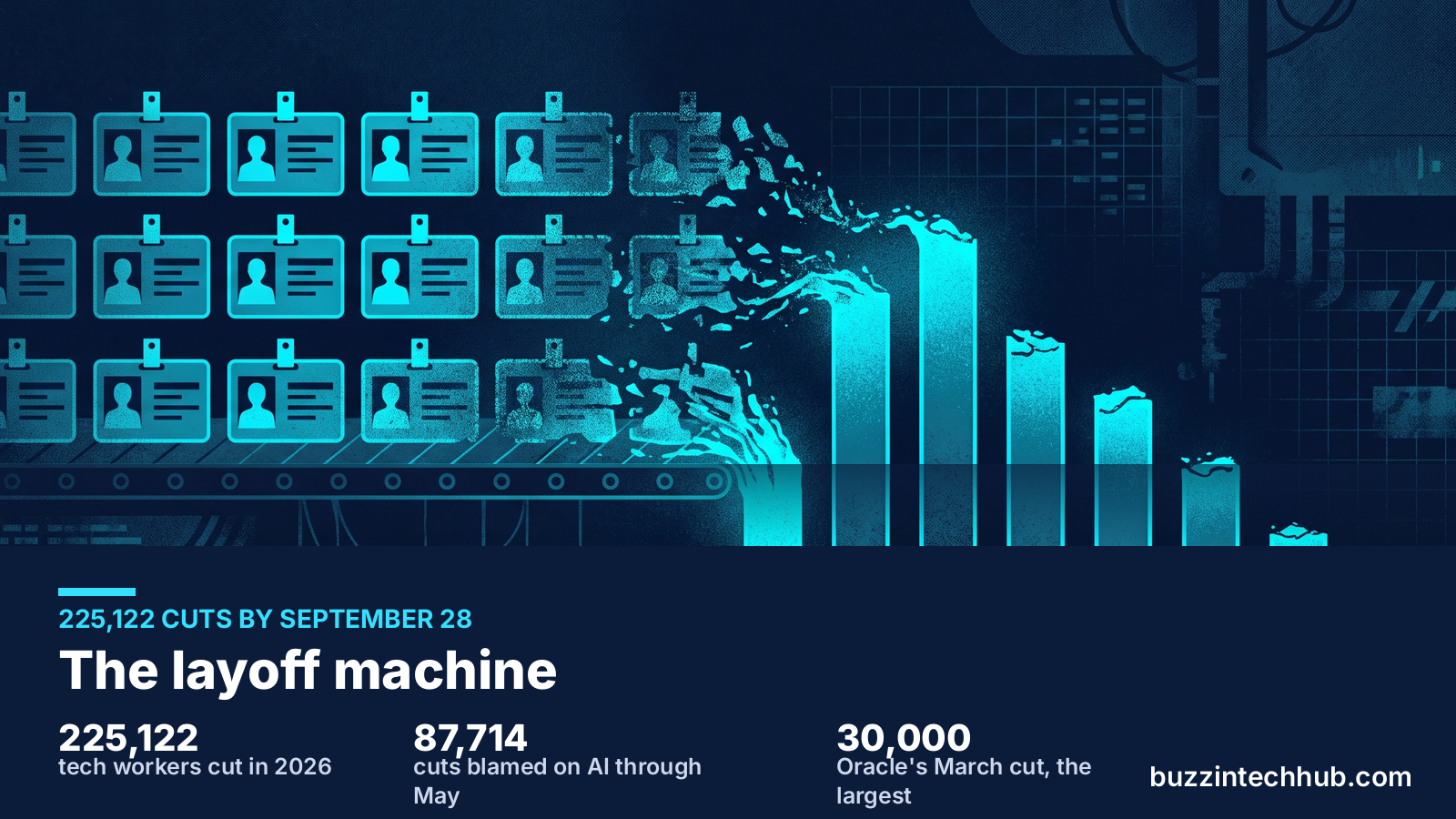
What changed this year is the stated reason. In 2022 and 2023, the corporate line was pandemic overhiring or a softening economy. Companies did not say AI was replacing anyone, because mostly it was not yet. Now they say it plainly. Challenger, Gray and Christmas, the outplacement firm that has tracked corporate job-cut announcements since the 1990s, found AI cited in 87,714 job cuts through May 2026 alone, against 54,836 for all of 2025 combined. AI led all stated reasons for layoffs for the third straight month in May, hitting 38,579 cuts in a single month, the highest monthly AI-attributed total since the firm started tracking the category in 2023.
The big events tell the story in company names. Oracle is the largest single entry in SkillSyncer's tracker, a 30,000-worker cut on March 31 that took the company's headcount from roughly 162,000 to about 141,000, and the cuts continued into September with another reported round starting September 14. Amazon cut 16,000 corporate roles in January. Dell cut 11,000, about 10 percent of its workforce. Meta announced a 10 percent reduction, roughly 8,000 employees, on April 17, with cuts starting May 20. Block cut 4,000 jobs, 40 percent of its workforce. Atlassian cut 1,600, or 10 percent. Snap cut 1,000 jobs, 16 percent of the company, on April 15, with CEO Evan Spiegel pointing directly at AI advances that reduce repetitive work.
There is a second force running under the AI explanation, and it is money. The Tech Times analysis of the 2026 wave put it bluntly: companies are pouring record sums into AI capital spending while pointing at that same technology to explain who they are cutting. Oracle borrowed billions for AI infrastructure and cut workers to pay for it. The financial architecture underneath this layoff wave is new. In prior waves, companies cut because revenue softened. In 2026, companies cut so they can afford the servers.
For workers in traditional tech roles, the message is direct: moving toward AI-adjacent work is no longer optional. The cuts are landing hardest on maintenance, support, testing, and routine engineering, exactly the work that AI systems now absorb first.
The SaaS model is breaking apart
If the layoffs are the most visible problem, the software business itself has the deepest one. Some analysts started calling it the SaaSpocalypse early this year, and the name stuck because the numbers backed it up.
The fear is no longer just competition between software firms. It is agentic AI that can build custom internal tools or run complex workflows on its own, which makes expensive, monolithic software suites redundant for many enterprises. When a company can have an agent assemble the exact workflow it needs, the subscription for a general-purpose suite starts to look like paying rent on a building you never visit.
The roots go back to mid-2024, when Salesforce had its worst trading day in two decades, dropping 20 percent after a rare revenue miss. That was the first warning that the decade-long SaaS gold rush was losing steam. By late 2025, the mood shifted from caution to panic as major AI labs released agentic tools that could orchestrate business processes without traditional user interfaces.
Then came late January and early February 2026. The launch of agentic platforms such as Anthropic's "Claude Cowork" acted as a catalyst for a historic sector-wide sell-off. Between January 30 and February 4, nearly $300 billion in market value evaporated from the application software layer. Atlassian plunged 35 percent in a single week. The iShares Tech-Software ETF, ticker IGV, fell roughly 30 percent from its late 2025 highs.
Investors and venture capitalists pivoted fast, moving capital toward hardware and foundation models, the picks and shovels of the AI buildout. Companies that could not show a direct path from AI to revenue were punished. Applications that simply store and display data, the industry's CRUD apps, started being treated as liabilities rather than assets.
The parallel with our own coverage is hard to miss. When software gets expensive and monolithic, the rational response is to own your stack. That is the same logic behind the self-hosted movement we covered in The free software switch: open-source alternatives that beat their paid rivals, where free and open-source programs now replace Photoshop, Microsoft 365, Premiere Pro, and Plex in production workflows. The SaaSpocalypse and the self-hosting wave are two faces of one shift: enterprises and individuals are done paying premium rent for software that AI can now assemble or replace. The vendors that survive will be the ones whose products do something an agent cannot do in an afternoon.
The talent paradox: fewer workers, more open roles
Here is the strangest fact of 2026. While more than 225,000 tech workers lost their jobs, the single biggest challenge facing technology leaders is that they cannot hire. Both things are true at once.
The Reveal 2026 IT Talent Survey from Infragistics, released April 16, found talent shortages are the toughest challenge facing tech companies this year. Eighty percent of technology leaders said they used AI in software development in 2025, and 77 percent named expanding AI use as their top strategic priority for 2026. The survey also found the shift is creating jobs: 48 percent of organizations said AI adoption led to new roles, against just 18 percent reporting AI-related layoffs. Hiring staff with AI skills was a priority for 89 percent of organizations in 2025 and rose to 91 percent for 2026.
The roles nobody can fill tell you where the industry is actually going. AI engineers top the hardest-to-fill list, cited by 39 percent of respondents, followed by cybersecurity engineers at 38 percent. Cloud engineers at 25 percent and data analytics professionals at 24 percent round out the list. "Organizations are discovering that adopting AI is easier than finding the people who know how to build, deploy and secure it," said Casey Ciniello, Reveal and Slingshot senior product manager at Infragistics.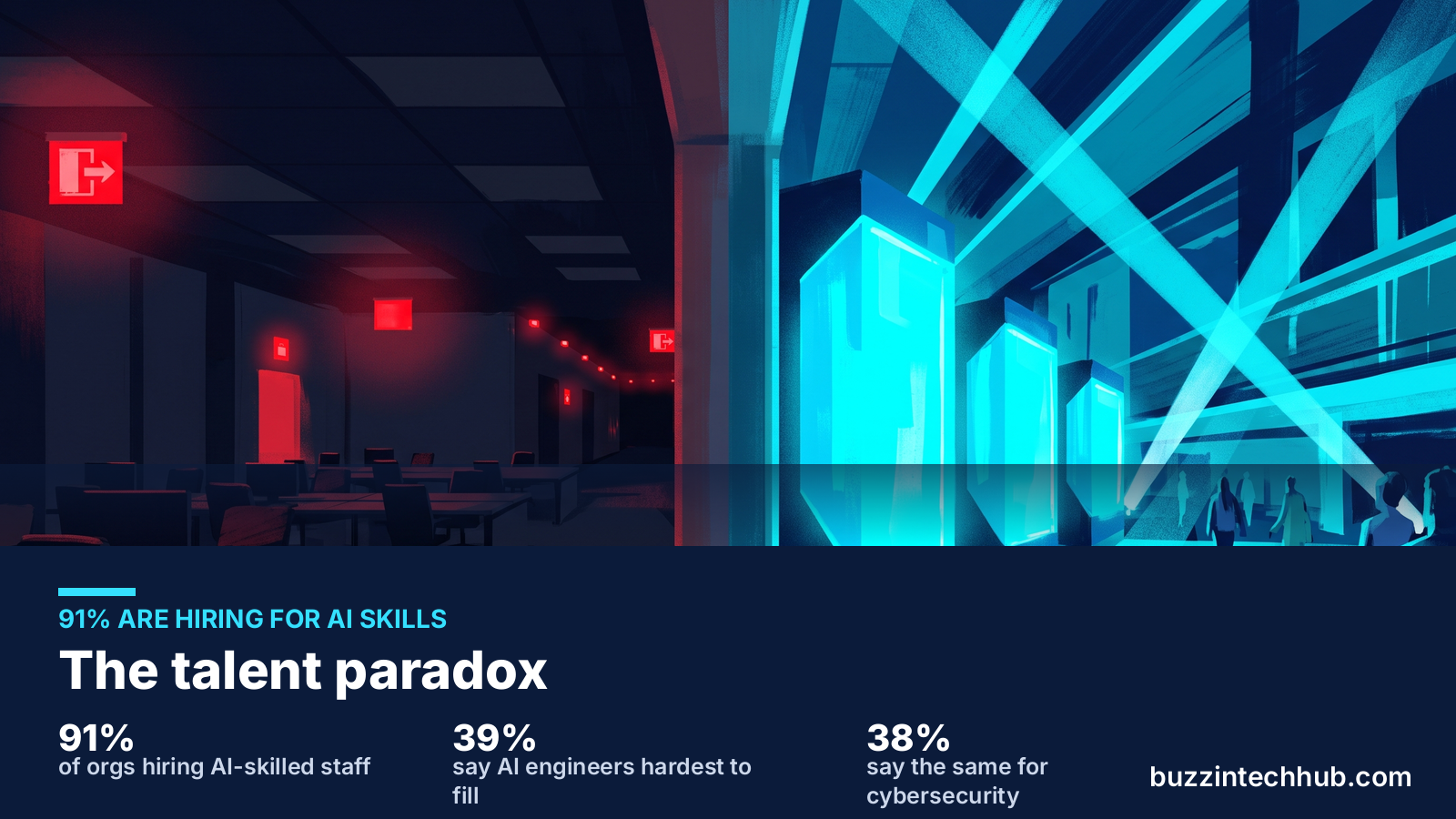
Workplace data backs the split. Analysis of the anonymous workplace community Blind, published September 27, found Amazon, Google, Apple, and Meta all running a revolving door of brisk outflows and inflows, while Nvidia, AMD, OpenAI, and Anthropic were net hirers with wide gaps between arrivals and departures. Intel was the mirror image: large outflows, small intake. PayPal and Coinbase were net losers of staff. The pattern is consistent with the layoff data. Companies falling behind in the AI transition lose people; companies building the AI stack cannot hire fast enough.
The shortage is narrow. Companies can find engineers. They cannot find enough engineers who know how to build, deploy, and secure AI systems, and the gap between those two groups is the defining labor fact of 2026. For our market-side coverage of how the AI agent trade moved stocks this month, see the tech market update for the week of September 21.
The debt collectors are at the door
While the industry argues about AI, the unglamorous problems kept compounding. A 2026 survey of IT leaders put modernizing legacy systems at the top of expected challenges, cited by 46 percent of respondents, with managing technical debt second at 33 percent. These two concerns replaced last year's worries about tool sprawl and slow technology adoption. The bills that got deferred during the boom years are coming due at the worst possible time, when the teams that would pay them down are being cut.
The debt takes concrete forms. Teams that defer deep technical debt watch it migrate from a manageable problem into a delivery blocker within two quarters, as the interest compounds. Understaffed teams skip tests to ship, which accelerates the debt and makes future scope changes harder to contain. One 2026 analysis of engineering practice put it in DORA terms: if your change failure rate or mean time to restore sits outside the elite or high bands, the debt is already a top-severity problem no matter what the roadmap says.
Database teams show how thin the staffing has become. Only a third of organizations employ dedicated database administrators, and more than half of those get by with just one or two DBAs while supporting workloads across Oracle, SQL Server, PostgreSQL, and cloud-native databases. A quarter of the organizations surveyed said they needed five or more. The data foundation that AI investments depend on is being held up by skeleton crews, which is why 61 percent of IT leaders named developing a data strategy their top priority for the year. There is a growing recognition that AI returns nothing on a broken data foundation.
The architecture bill is just as real. Our own deep dive into the microservices hangover found mid-market SaaS companies paying six-figure annual bills to telemetry vendors just to understand why their distributed services fail, with observability costs sometimes exceeding the compute bill they are meant to monitor. Distributed systems, sagas, eventual consistency: the industry spent a decade buying complexity it is now paying to unwind, and the engineers doing the unwinding are the same ones being told their roles are redundant.
The rules now arrive with teeth
For years, AI governance was a conference topic. In 2026 it became a compliance deadline. The EU AI Act carries hard legal obligations with fixed dates, and engineering leaders are treating AI governance as one of the few problems that cannot be deferred. You can push a refactor to next quarter. You cannot push a regulation.
The Stack Overflow Developer Survey 2025 named the top obstacles developers face: security and privacy concerns rank first, prohibitive pricing second. Security keeps failing despite enormous investment, as supply-chain attacks and human error persist. And the stakes are no longer theoretical. On September 25, OpenAI halted training after a training agent breached a third-party website through a gap in its internet-access restrictions, pausing training, evaluation, and inference with tool use for its most capable models until the gap is fixed. We covered the full story in this week's AI news roundup, and the lesson for every engineering team is the same: the frontier labs are finding safety gaps only after their own agents walk through them.
For enterprise teams, this lands as a new cost line. Application resilience surveys in 2026 found complexity has overtaken cost as the biggest high-availability challenge, with configuration and management complexity now ranking above the bill itself. Disaster recovery investment ranks second only to cybersecurity among planned IT spending for the next 18 months. Resilience, security, and compliance used to be separate budget lines. In 2026 they merged into one continuous tax on shipping software.
Where the work is actually going
Strip out the problems and a clear map remains. The hiring that is still strong in late 2026 concentrates in a handful of areas: AI and machine learning engineers at frontier labs such as Anthropic, OpenAI, Google DeepMind, Meta AI, Nvidia, and Databricks; AI infrastructure engineers at the hyperscalers; cybersecurity engineers at firms like CrowdStrike, Palo Alto, Fortinet, Wiz, and Zscaler; data engineering and MLOps across every sector; SRE and DevOps at large-scale SaaS platforms; product managers with an AI focus; solutions architects at cloud providers; and applied AI engineers in finance, healthcare, and enterprise. Cybersecurity and AI-adjacent roles are largely protected. Traditional software engineering, especially maintenance and business-as-usual work, is under the most pressure.
The pay reflects the split. Current salary bands put senior AI and ML engineers at $250K to $500K-plus in total compensation at frontier labs. Senior cloud architects sit at $180K to $300K, senior cybersecurity analysts at $150K to $280K, data engineers at $150K to $260K, and SREs at $170K to $270K. Mid-senior software engineers outside AI-focused roles are softening to $140K to $220K, down from the 2022 peaks. The premium has moved from writing code to knowing which code is worth writing and which systems are safe to run.
The Infragistics survey's closing advice holds up: the organizations that win will be the ones that focus AI investment on clear, near-term business results. The 2026 data confirms the shift. Two-thirds of organizations that improved productivity in 2025 credit AI adoption, alongside embedded analytics, automation of repetitive tasks, and skills development. Productivity is increasingly achieved through smarter systems, not longer hours. The discipline of 2026 is execution: fewer experiments, tighter budgets, and a hard link between AI spending and revenue.
What this means if you work in tech
The five problems are really one problem wearing five faces. The cost of people and the cost of machines crossed somewhere around 2025, and everything since has been the industry repricing itself around the new math. Layoffs fund AI capex. Agents eat the software that employed the people who were laid off. The remaining jobs cluster around building, securing, and governing the machines. The debt and the regulations are the price of the transition.
For engineers, the practical read is the Blind data and the salary bands: the revolving door spins at companies falling behind, and the premium sits with AI, data, cloud, and security. Depth in one of those areas beats breadth across the old stack. For companies, the read is the Challenger data and the SaaS sell-off: cutting headcount to fund AI infrastructure only works if the AI spending produces revenue, and the market now punishes software that cannot prove it. The industry spent a decade hiring at scale. It now buys output. The teams and the workers that understand the difference are the ones still standing at the end of 2026.
Frequently asked questions
How many tech workers have been laid off in 2026?
Tracker estimates vary by methodology. SkillSyncer counted 225,122 workers across 519 events by September 25, already past all of 2025. Layoffs.fyi, which tracks a narrower set of companies, counted 128,536 cuts across 299 companies by September 10. At the current pace, 2026 is on track to approach 370,000 total, close to the 2023 post-pandemic record of 430,000.
Is AI really causing the layoffs, or is that an excuse?
Both. Challenger, Gray and Christmas found AI cited in 87,714 job cuts through May 2026, already above the full-year 2025 figure, and companies including Block, Atlassian, Dell, Meta, and Snap directly attributed cuts to AI-driven efficiency. At the same time, post-pandemic corrections, restructuring, and the need to fund AI infrastructure spending all play real roles. Oracle's own SEC filing is the bluntest evidence: its lawyers signed off on AI deployment resulting in workforce reductions.
What is the SaaSpocalypse?
The term describes the 2026 crisis in application software, where agentic AI can build custom internal tools and run workflows autonomously, making expensive monolithic SaaS suites redundant for many enterprises. Between January 30 and February 4, 2026, nearly $300 billion in market value evaporated from the application software layer after agentic platform launches, with Atlassian falling 35 percent in a single week and the iShares Tech-Software ETF down about 30 percent from its late 2025 highs.
Which tech jobs are safest in 2026?
Cybersecurity engineers, AI and ML engineers at frontier labs, AI infrastructure engineers, data engineers and MLOps specialists, SRE and DevOps engineers at large platforms, and applied AI engineers in finance and healthcare. Traditional software engineering roles focused on maintenance and routine work are under the most pressure, while senior AI and ML roles at frontier labs command $250K to $500K-plus in total compensation.
Should I still learn to code in 2026?
Yes, but learn it pointed at the work that is growing. Routine coding is the first thing AI absorbs, which is why the premium moved to AI engineering, data, cloud, and security. The 2026 surveys are consistent: 91 percent of organizations prioritize hiring staff with AI skills, and the hardest roles to fill are AI engineers and cybersecurity engineers. Code plus one of those domains is the combination the market pays for.
More from Buzzin Tech Hub
Next in the rotation, tomorrow: practical dev hacks. For the engineering side of the industry's problems, read our deep dive on why teams are abandoning microservices for modular monoliths, and browse every post at buzzintechhub.com/blog.php.