WooCommerce vs Shopify is usually argued on the wrong number. One side quotes a free plugin, the other quotes a monthly plan, and neither number is the bill. This post prices both platforms on one store, at $200,000 in yearly sales, and counts every line: the plan, the hosting, the card fees, the apps, and the hours nobody budgets.
TL;DR
- Shopify Basic costs $29 a month on yearly billing. WooCommerce costs $0, and the plugin is the only free part.
- At $200,000 in sales, card processing runs $6,550 a year on both platforms, through their own payment products.
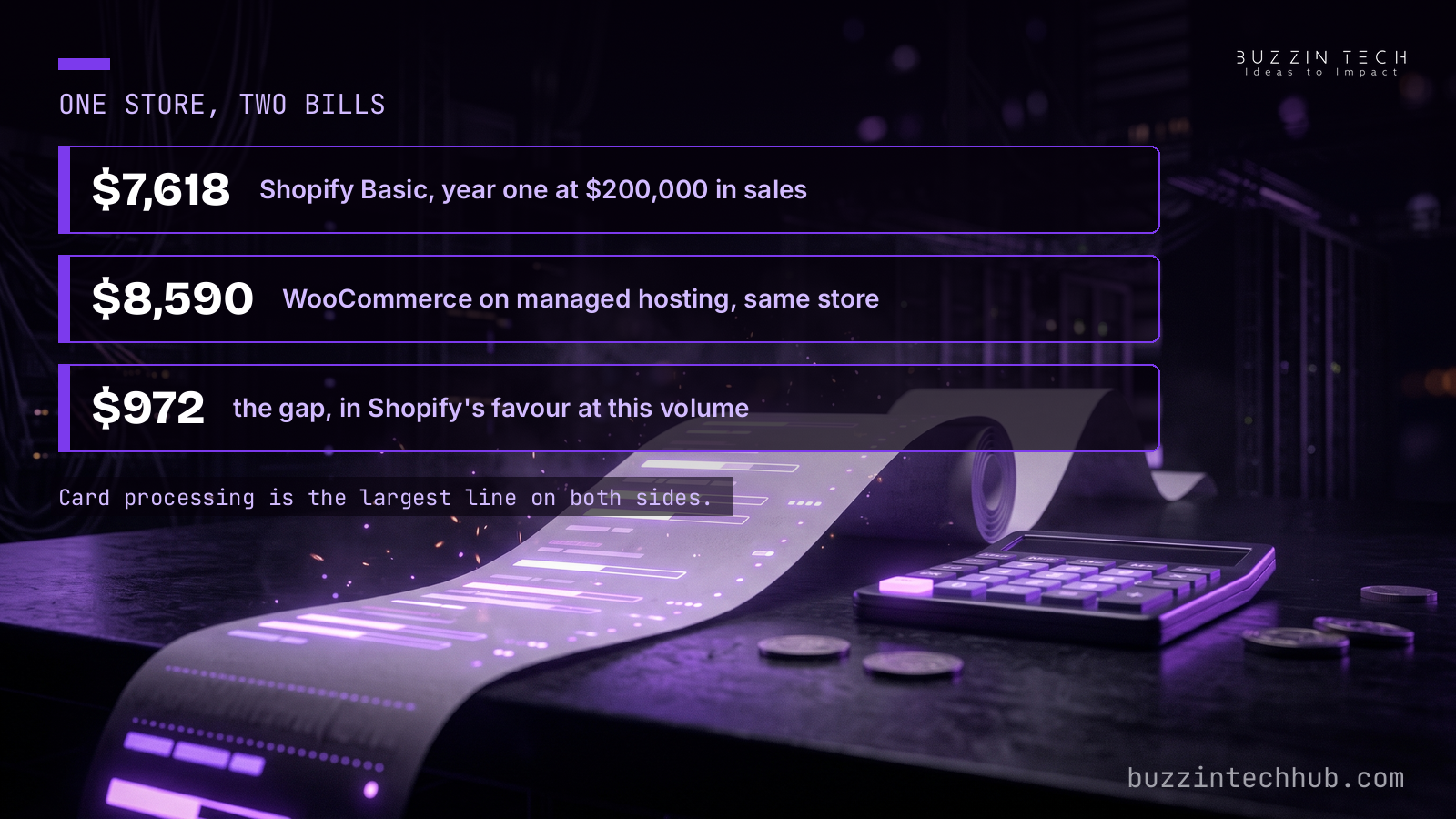
- Counted line by line, Shopify Basic totals $7,618 a year. WooCommerce totals $8,590 on managed hosting.
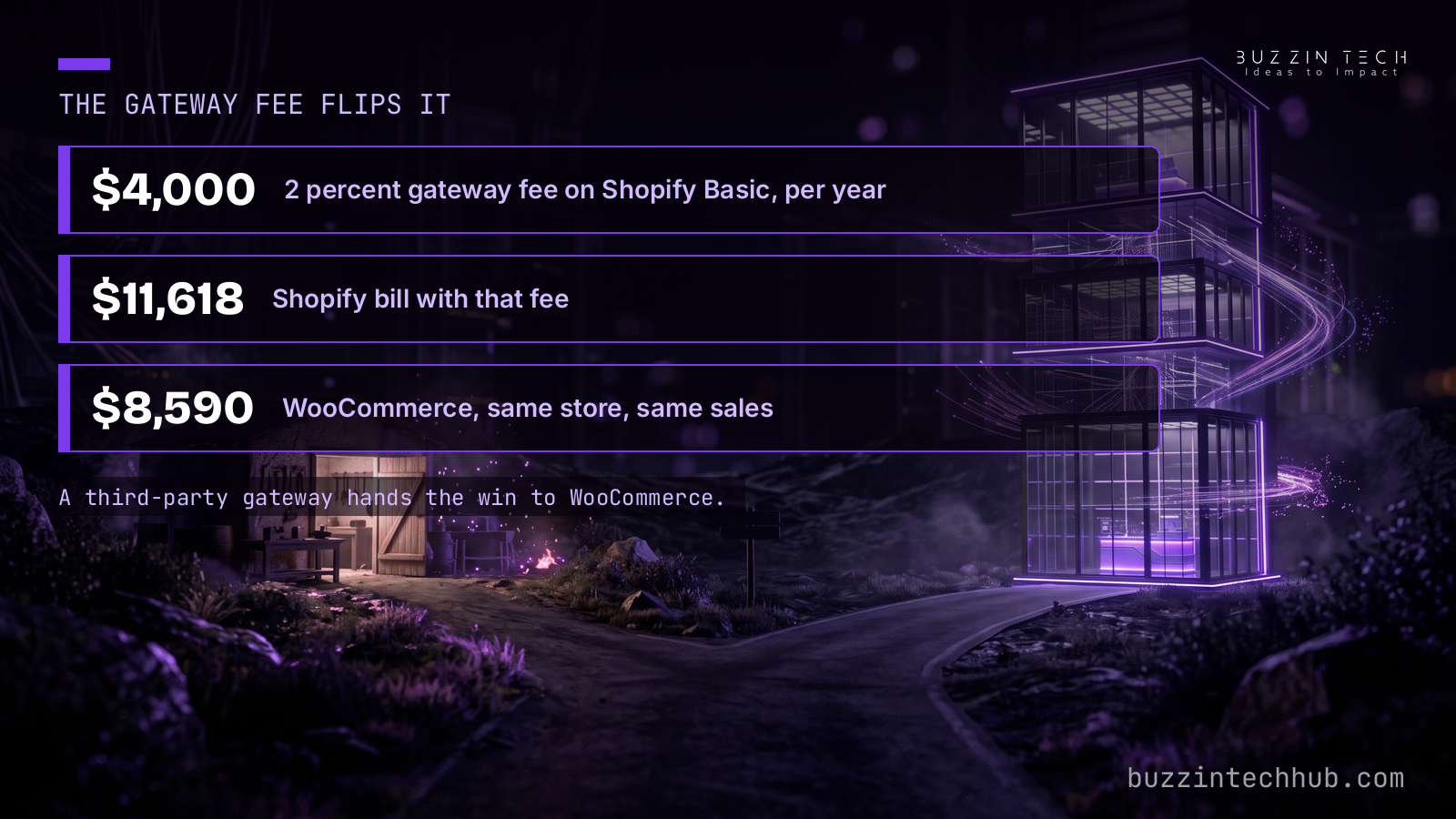
- A third-party gateway on Shopify Basic adds 2 percent, $4,000 a year, and hands the win to WooCommerce.
The free plugin and the rented platform
WooCommerce is a free plugin that turns a WordPress site into a store. Shopify is a hosted platform that rents you the whole store, checkout included. The two are different kinds of purchase, so comparing their sticker prices answers the wrong question.
The plugin costs $0 because it is open-source code under the GPL. Everything around it carries a price: hosting, a theme, paid extensions, backups, security, and the hours spent keeping it all updated. Our web development team builds on both platforms, and the first question we ask a store is who keeps it running, not which logo it wears.
Shopify charges a monthly plan, and the plan buys the hosting, the security, the checkout, and the uptime. The platform takes a fee on every sale when you use a payment provider other than its own. What you rent is freedom from the server work, and the rent rises with the plan.
Shopify, priced from the pricing page
Shopify lists four plans, and every figure below comes from its pricing page, read on November 19, 2026. Prices are US dollars.
Basic costs $39 a month billed monthly, or $29 a month billed yearly. Grow costs $105 monthly, or $79 yearly.
Advanced costs $399 monthly, or $299 yearly. Plus starts at $2,300 a month.
The yearly prices carry a note. In November, some reads of the same page showed Grow at $89 and Advanced at $359 a month on yearly billing. The page we read this morning shows $79 and $299, in the plan cards and in the comparison table.
The $89 figure is real, but it belongs to POS Pro, an add-on priced at $89 a month per location. That is the likely source of the confusion, and it is worth knowing before you trust a quoted price.
Card rates fall as the plan rises. Shopify Payments charges 2.9 percent plus 30 cents on Basic, 2.7 percent plus 30 cents on Grow, and 2.5 percent plus 30 cents on Advanced. The third-party gateway fee is the line that matters most: 2 percent on Basic, 1 percent on Grow, and 0.6 percent on Advanced, charged on every sale on top of the processor's own rate.
WooCommerce, priced line by line
WooCommerce itself charges no transaction fee and no monthly fee. The plugin is free, and the store pays its payment processor directly. WooPayments, its built-in option, charges 2.9 percent plus 30 cents on a standard US card, the same headline rate as Shopify Payments on Basic.
Hosting is the first real line. Kinsta lists its ecommerce-recommended plan, Single 65k, at $50 a month, and its cheaper Single 35k at $35 a month is not marked for ecommerce.
WP Engine lists Essential at $28 a month billed annually, $336 paid today, with first-year pricing noted on the page. Both hosts are running Black Friday offers until December 1, 2026, and this post quotes regular prices only.
Extensions are the second line. A premium theme, a paid shipping or tax extension, and a backup and security setup add up to roughly $40 a month on a typical store. That figure is an estimate, and it varies with the stack.
The third line is maintenance: WordPress core updates, plugin updates, conflicts between plugins, and the fix when an update breaks checkout. We price that at two hours a month at $40 an hour, the mid-engineer rate on our own published rate card, or $960 a year. It is the line that makes free misleading.
One store, two bills at $200,000 in sales
Take one store and cost it on both sides. The store takes $200,000 a year in sales, across 2,500 orders, at an $80 average order. All prices below are US list prices read on November 19, 2026, and the two estimate lines are labelled as estimates.
On Shopify Basic, billed yearly, the plan costs $348 a year. Card processing at 2.9 percent plus 30 cents comes to $6,550: $5,800 on the rate and $750 on the per-order fee.
A typical app stack adds about $60 a month, or $720 a year. The year-one total is $7,618.
On WooCommerce, hosted on Kinsta Single 65k at $50 a month, hosting costs $600 a year. Card processing through WooPayments is the same $6,550.
Extensions add about $40 a month, or $480 a year. Maintenance at two hours a month costs $960. The year-one total is $8,590.
The gap is $972 a year in Shopify's favour, at this volume. On WP Engine Essential at $28 a month on annual billing, the WooCommerce total falls to $8,326 and the gap narrows to $708.
Either way, the platform fee is not what decides the bill. Card processing is the largest line on both sides, $6,550 of the $7,618 on Shopify and $6,550 of the $8,590 on WooCommerce, and the maintenance line is what puts the free plugin behind.
Last week we priced three CRMs the same way, and the same pattern held: the headline price was the smallest number on the invoice.
Speed under load belongs in the same costing. A high-volume store we rebuilt held 5,000 shoppers at once and cut mobile load from 4 seconds to 0.75 seconds, and the full numbers sit in our WooCommerce speed case study. A store that crashes on its busiest day pays for the outage in lost sales, whatever the plan costs.
The gateway fee flips the answer
The answer flips when the store cannot use the platform's own payments. Some stores keep a processor they already use, or a local gateway Shopify Payments does not cover. On Shopify Basic, that choice adds a 2 percent fee on every sale, on top of the processor's own rate.
At $200,000 in sales, 2 percent is $4,000 a year. The Shopify bill rises to $11,618, and WooCommerce at $8,590 wins by $3,028. The fee is a tax on every order, so it compounds with volume while the plan saving stays flat.
The same maths sets the upgrade points. Grow costs $600 a year more than Basic, and its 0.2 percent card-rate saving covers that at $300,000 in sales.
Advanced costs $2,640 a year more than Grow, and its 0.2 percent saving covers that at $1,320,000 in sales. Below those lines, the higher plan is a feature purchase, not a saving.
Two rules follow. If you must use a third-party gateway, price the gateway fee first, because it is the largest line on the Shopify side. If you use the built-in payments, price the maintenance line first, because it is the largest line on the WooCommerce side.
Six questions that pick the platform
Price settles the bill, and six questions settle the platform. First, own the stack or rent the platform.
WooCommerce means you own the code, the data, and the failure modes. Shopify means the platform owns uptime, PCI compliance, and the checkout, and charges for it.
A WooCommerce store we built with a WhatsApp inventory sync runs its inventory through a custom webhook engine: a sale posted in WhatsApp deducts stock and updates the storefront in under 3 seconds, with zero oversold orders. That build exists because the inventory logic lives in custom code no hosted platform ships. When the workflow is the product, own the stack.
Second, speed under load, not speed on a quiet page. Flash drops and sale days are the test, and a store that holds 5,000 shoppers at once was built for the spike, not the average afternoon.
Third, checkout is the product. A WooCommerce store we run paid acquisition on sends Meta dynamic product ads, retargeting, and Google Performance Max traffic to a checkout the brand owns, so the ad spend lands where the brand controls the conversion.
Fourth, apps or plugins: count the stack, not the subscription. Both platforms charge monthly for the extras, and a store with twelve apps has twelve bills.
Fifth, who fixes it at 2:00 AM. A managed platform answers its own pager, a managed host answers for the server, and an owned stack answers to your developer.
Sixth, the exit. Migrating off either platform costs real money in redirects, data, and retraining, so pick the one you can still leave. Our service page covers zero-loss legacy migrations with full URL and 301 redirect matrices.
Either platform can carry a serious store. We build both, through the same four steps: Discovery and Architecture, Design and Prototyping, Engineering and Build, then Deployment and Scaling. The choice turns on which bill you would rather pay, and which work you would rather own.
Which platform bill are you actually signing for?
If the plan price is the only number on your shortlist, the invoice will teach you the rest.
See how we approach commerce builds
Frequently asked questions
Is WooCommerce really free?
The plugin is free, and the store is not. Hosting, extensions, and maintenance carry the cost: on managed hosting checked November 19, 2026, a WooCommerce store totals about $8,590 a year at $200,000 in sales, against $7,618 on Shopify Basic. The $0 is the price of the code, not the price of the store.
How much does Shopify cost per month?
Basic costs $39 a month billed monthly, or $29 a month billed yearly, as listed on Shopify's pricing page on November 19, 2026. Grow costs $105 monthly or $79 yearly, and Advanced costs $399 monthly or $299 yearly. Card processing is charged on top, from 2.9 percent plus 30 cents on Basic.
What are Shopify transaction fees?
Shopify charges no extra fee when you use Shopify Payments. When you use a third-party gateway, it adds 2 percent on Basic, 1 percent on Grow, and 0.6 percent on Advanced, on every sale, on top of the processor's own rate. At $200,000 in sales, the Basic fee is $4,000 a year.
Which is cheaper for a small store?
At $200,000 in yearly sales, Shopify Basic is cheaper: $7,618 a year against $8,590 for WooCommerce on managed hosting, both counted line by line on November 19, 2026. The answer flips if the store uses a third-party gateway on Shopify, or if the owner does the WooCommerce maintenance themselves.
When does WooCommerce become cheaper than Shopify?
When the store pays Shopify's third-party gateway fee, or when its sales pass the point where the card-rate saving covers the higher plan. Grow pays for itself over Basic at $300,000 in sales, and Advanced over Grow at $1,320,000. Below those lines, WooCommerce wins only when the gateway fee or the maintenance line is removed.
Can you migrate from Shopify to WooCommerce later?
Yes, and the cost is the migration, not the platform. Products, customers, and order history move across, and URLs need a full 301 redirect map so search rankings survive. We build migrations with that map included, and the same applies in the other direction.