HubSpot vs Salesforce vs Zoho is the comparison a team runs before it buys a CRM, and all three vendors sell the same headline: a price per seat per month. The bill is decided by what that seat price leaves out. This post prices all three on one workload, then prices a fourth option the vendors never offer: build it.
TL;DR
- Zoho Professional: $23 per user a month on annual billing. HubSpot Professional: $90, plus a $1,500 onboarding fee. Salesforce Pro Suite: $100.
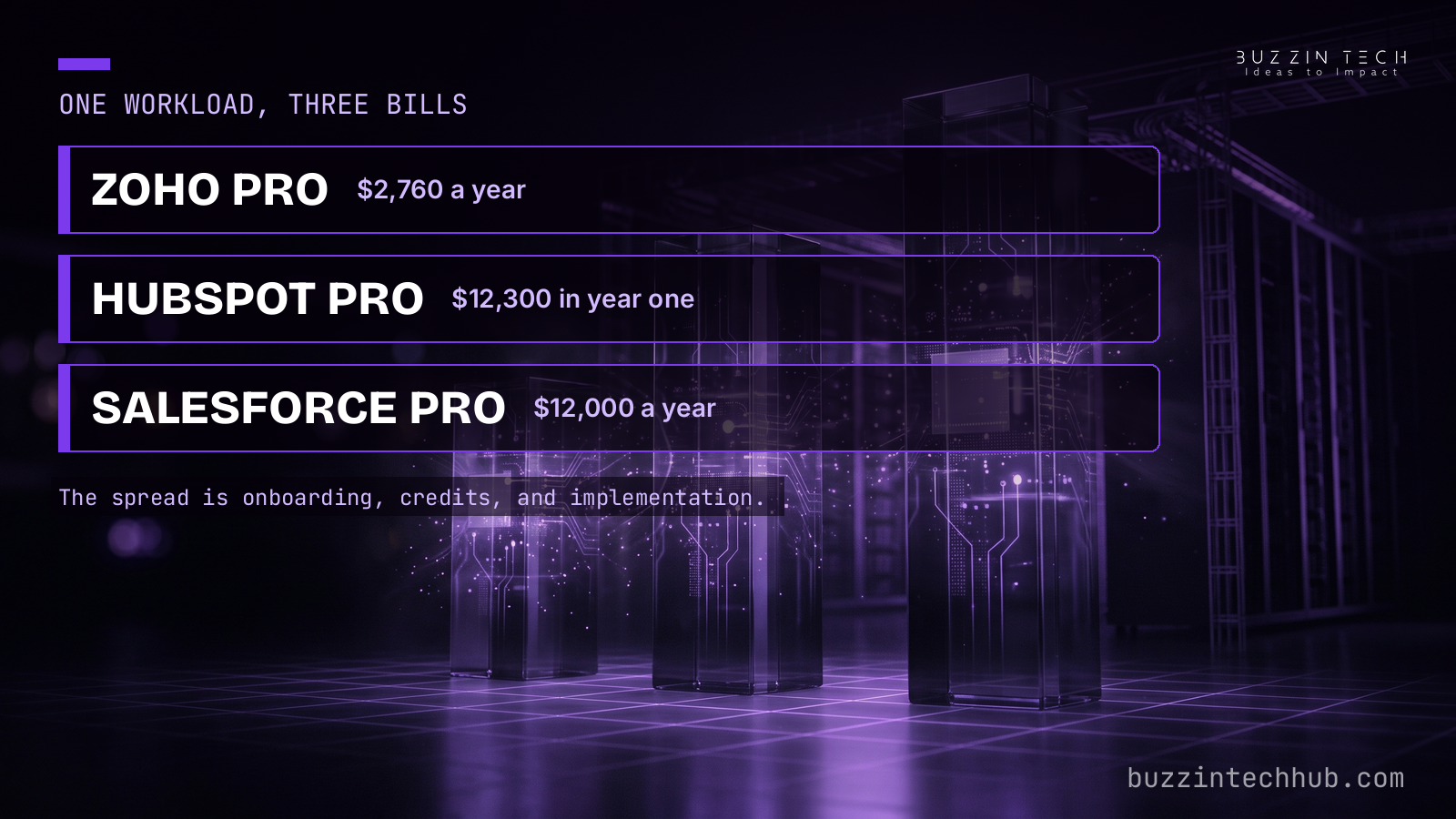
- Ten mid-tier seats: $2,760 a year on Zoho, $12,300 in year one on HubSpot, $12,000 on Salesforce.
- Salesforce renamed Enterprise to Core at $195. HubSpot's $7 Starter is a new-customer promo against a $20 list.
- Two or three seats pay nothing on a free plan. A team whose sale is the workflow should price a custom build.
The seat price is the smallest number on the invoice
Every CRM vendor quotes a price per seat per month. That number is real, and it is also the smallest number on the invoice. The rest of the bill sits in onboarding fees, annual commitments, AI credits that run out, and admin time.
This post reads the three pricing pages as they stand on November 12, 2026, and prices one team on all three. The build side comes from the custom CRM systems we build for clients, where the sale itself is the workflow.
All prices below are US list prices, per user per month, on annual billing unless stated. Vendors change prices without notice, so treat the date as part of each figure and check the page on the day you buy.
The comparison below runs on the tier a real team actually buys. Free plans cover a trial, and the top tier covers a company with a dedicated admin. The middle tier is where automation and AI live, and the bill starts to bite there.
Zoho: the stable leg, and the extras it leaves out
Zoho CRM is the stable leg of this comparison. Its prices have not moved across the checks we ran through the autumn, and every source we read agrees. The free edition covers three users forever.
Standard costs $14 per user a month on annual billing, or $20 billed monthly. Professional costs $23 on annual billing, or $35 monthly. Enterprise costs $40 on annual billing, or $50 monthly.
Ultimate is the one edition Zoho does not price on its main pricing page. The page calls it tailored for large-scale bespoke deployments, and the feature-comparison page lists it at $52 per user a month on annual billing, or $65 monthly. If you are quoted Ultimate, ask for the full figure in writing, because the main page will not give it to you.
Professional is the tier most small teams land on. It adds Blueprint process management, CPQ, inventory, and portals to the Standard set. Enterprise adds Zia AI, territory management, a sandbox, and approvals.
The automation a team wants usually lives in Professional, which is why the costed example below runs on it.
The caveat with Zoho is what the seat price leaves out. Support tier, storage, backup, training, and portal access are priced separately, and Zoho's own licence calculator is the only place that adds them up.
One September 2026 check found a $1,534 gap between the sticker price and the real first-year invoice for a 10-user Standard team. That was one team's result, not a general figure, but it shows the seat price is a starting point and not a quote.
HubSpot: the cliff from seven dollars to ninety
HubSpot Sales Hub is the cliff leg. Starter shows $7 per seat a month on annual billing, with $20 struck through beside it. The $7 figure is a time-limited promo for new customers only.
The list price is $20, and the monthly-billing figure is $10 against the same $20 list. Quote both numbers, never the promo alone, because the promo ends and the list price is what you renew at.
Professional costs $90 per seat a month on annual billing, or $100 billed monthly. That is the largest jump in mainstream CRM pricing: from a $20 list to $90, a 4.5x rise in the seat rate, and from the $7 promo to $90, steeper still. The jump buys sequences, forecasting, and conversation intelligence, plus a mandatory one-time onboarding fee of $1,500 that the card price does not include.
Enterprise costs $150 per seat a month on annual billing, with a mandatory $3,500 onboarding fee. Its card shows no monthly billing option, only a talk-to-sales step.
Professional has a monthly option, but HubSpot's pricing page labels it "commit annually", so paying monthly does not let a team walk away in month three. The annual commitment is part of the price, even when the invoice arrives monthly.
HubSpot also meters AI with credits. Starter includes 500 HubSpot Credits a month, Professional includes 3,000, and Enterprise includes 5,000. The credits pay for AI agents and some automated features.
HubSpot publishes no overage rate we could verify, so this post quotes none. A team that leans on AI agents should ask what happens when the credits run out, before the first invoice, not after.
The free plan covers two users at $0, and for a team of two it is a real option. The trap is the middle: a team that outgrows Starter does not pay a little more for a little more product. It pays four and a half times more per seat, plus $1,500, for a year.
Salesforce: the edition you shopped for no longer exists
Salesforce is the unsettled leg, because the product itself changed. On September 3, 2026, Salesforce replaced Enterprise, Unlimited, and Agentforce 1 with new editions for new customers only. The old Enterprise list was $175.
A new buyer today is quoted Core at $195 per user a month on annual billing, 11% above the edition it replaces. Advanced costs $395, and Max costs $550. The old names do not appear on Salesforce's pricing page for a new customer at all.
Two editions below Core did not change. Starter Suite costs $25 per user a month, and it is the only edition payable monthly. Pro Suite costs $100 per user a month on annual billing.
Core, Advanced, and Max bundle Flex Credits, 500,000 a year on Core, 1,000,000 on Advanced, and 2,750,000 on Max, plus Slack, Tableau Next, and a Premier Success Plan. Existing customers keep the old editions until renewal, so two buyers can hold two different price books.
A pricing page that renames its editions is a warning about the quote, not about the product. The product is strong on complex sales: territories, advanced API access, and a dedicated admin.
The bill needs a second reading, because implementation sits outside the seat price entirely and Salesforce shows no implementation figure. Budget the licences, then budget implementation as its own line.
One workload, three bills
Take one concrete workload and run it through all three vendors. Ten users, the mid-tier, annual billing, year one.
Last week, our Zapier vs n8n vs Make comparison showed that the billing unit decides the bill. This week it is what the billing unit leaves out.
On Zoho Professional, 10 seats at $23 a month for 12 months is $2,760 a year. On HubSpot Professional, 10 seats at $90 a month for 12 months is $10,800, plus the $1,500 onboarding fee: $12,300 in year one, $10,800 a year after. On Salesforce Pro Suite, 10 seats at $100 a month for 12 months is $12,000 a year, before implementation.
The same headcount, the same tier of product, and the spread is about 4.5x between Zoho and the other two. The spread comes from the onboarding, the AI credits, and the implementation, not the seat rate. Further up, 10 seats on Salesforce Core cost $23,400 a year, nearly double Pro Suite, before implementation.
The counter-case matters as much as the example. A team of two fits HubSpot Free at $0, and a team of three fits Zoho Free at $0. At that size the paid comparison is irrelevant: stay free until the pipeline outgrows the free limits.
The paid decision starts when the team needs automation, AI, or a fourth seat.
The fourth option: build the CRM around the sale
The three vendors sell the same shape: a generic pipeline with fields renamed to fit your business. Some sales do not fit that shape.
A property developer sells units on instalment plans, with payments coming in over months, penalties for late payment, and cancellations that free a unit for resale. The sale itself is the workflow, and a generic pipeline bends around it badly.
That is why we built a custom CRM for DCC Developers, with one view of every unit sold, its instalment plan, and its payment history. The same shape of work sits behind the Eight Square property CRM, built for a team that sells in WhatsApp-first markets, where follow-up happens in a chat thread and not an email queue. Both builds sit on our projects page.
Price the build the way you price the seats: over three years, not one. At 10 seats, the seat bill alone is about $12,000 a year on HubSpot Professional or Salesforce Pro Suite, before onboarding and implementation.
Over three years that is about $36,000 before the extras, and it rises with every seat added. A custom build costs once, and the team owns it. The build also fits the way the team already sells, instead of asking the team to sell the way the software expects.
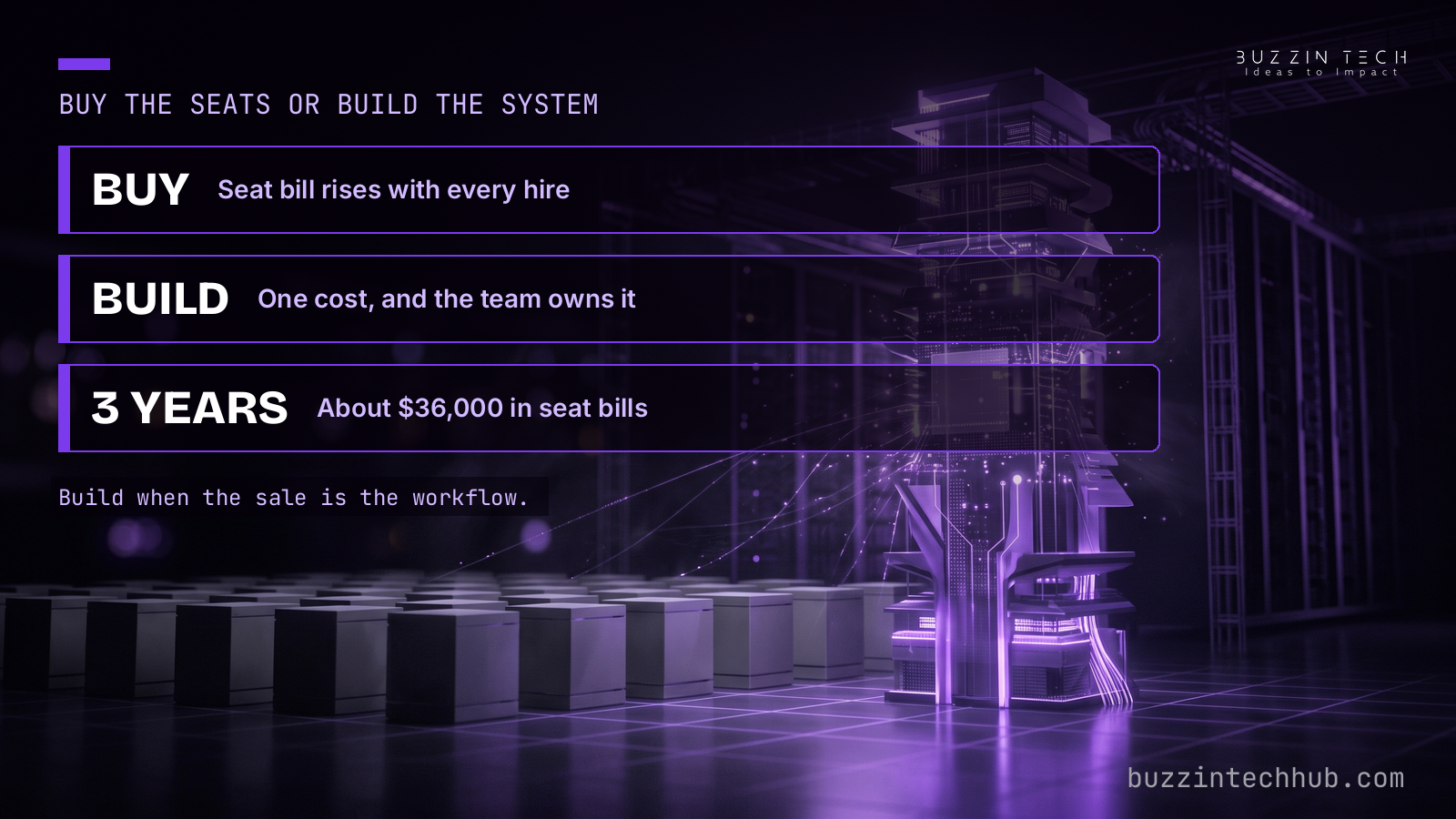
The honest rule cuts both ways. We still recommend buying Zoho or HubSpot when the workflow is standard: a pipeline, a few stages, and a team that sells the way the next company does.
A custom build earns its cost only when the sale itself is the workflow. If a generic pipeline fits, buy it, and spend the build budget on selling instead.
How to pick in one afternoon
Start with the headcount and the shape of the sale. Under five seats, with a standard pipeline and no special workflow, Zoho Professional is the pick on price, because its automation lives in the mid-tier rather than the top one. Budget the extras the seat price leaves out, and run the licence calculator before you sign.
A marketing-led team already on HubSpot's marketing tools, or a team that will actually use sequences, forecasting, and conversation intelligence, should take HubSpot Professional. Budget the $1,500 onboarding and the annual commitment into the first-year number, and put the credit limit in writing before the team leans on AI agents.
Complex enterprise sales, with territories, advanced API access, and a dedicated admin, point to Salesforce Pro Suite or Core. Budget implementation as its own line, and confirm in writing whether the quote uses the new Core editions or a legacy Enterprise price book, because the two books differ.
None of the three fits a team whose sale is the workflow: units and instalments, WhatsApp-first follow-up, or project selling with its own rules. Price a custom build over three years against the seat bill, and judge it on whether it follows the way the team already sells.
One timing note: today is the day PostgreSQL 14 reaches end of life. If your CRM runs on it, our upgrade guide to version 18 covers the move.
Which CRM bill are you actually signing for?
If the seat price is the only number on your shortlist, the invoice will teach you the rest. We build CRMs when the sale is the workflow, and we tell clients to buy Zoho or HubSpot when a standard pipeline fits, through our four-step method: Discovery and Architecture, Design and Prototyping, Engineering and Build, Deployment and Scaling.
See how we build custom CRMs around the way you sell
Frequently asked questions
Which CRM is cheapest for a small team? Zoho Professional, at $23 per user a month on annual billing, is the cheapest of the three mid-tiers by a wide margin. Ten seats cost $2,760 a year, against $12,300 in year one on HubSpot Professional and $12,000 on Salesforce Pro Suite. A team of two or three pays nothing at all on the free plans from HubSpot or Zoho. The cheapest option is free until the team needs automation, AI, or a fourth seat.
Why is HubSpot Starter so cheap and Professional so expensive? Starter at $7 a seat a month is a time-limited promo for new customers, against a $20 list price. Professional at $90 is the tier where sequences, forecasting, and conversation intelligence live, and it adds a mandatory $1,500 onboarding fee. The jump from the $20 list to $90 is 4.5x in the seat rate. A team that outgrows Starter should budget the full Professional figure, not the promo it started on.
What happened to Salesforce Enterprise? On September 3, 2026, Salesforce replaced Enterprise, Unlimited, and Agentforce 1 with Core, Advanced, and Max for new customers only. Core costs $195 per user a month on annual billing, against the old Enterprise list of $175. Existing customers keep the old editions until renewal. A new buyer will not see the Enterprise name on the pricing page, and a quote that still uses it belongs to the old price book.
What does HubSpot onboarding cost, and can I skip it? Professional onboarding costs $1,500 once, and Enterprise onboarding costs $3,500 once. Both are mandatory, and the price shown on the plan card does not include them. HubSpot sells onboarding as part of the purchase, so there is no way to skip it. Add the fee to the first-year total before comparing HubSpot with Zoho or Salesforce, where no equivalent mandatory fee appears on the pricing page.
Is Zoho CRM really free? The free edition is free for up to three users, with no time limit stated on the pricing page. It covers a small team that needs a shared pipeline and little else. The limits arrive with growth: automation, AI, and portals sit on the paid tiers, and support, storage, backup, and training are priced separately. A team of three can run on it for $0, and a team of four cannot.
When is a custom CRM cheaper than HubSpot or Salesforce? When the team grows past the mid-tier and the sale itself is the workflow. Ten seats on HubSpot Professional or Salesforce Pro Suite cost about $12,000 a year before onboarding and implementation, and the bill rises with every seat added. A custom build costs once and the team owns it. Price the build over three years against the seat bill, and build only when a generic pipeline bends around the way the team sells.